
Forata Dam Opened Gates at 19:00 with Reservoir at 14%
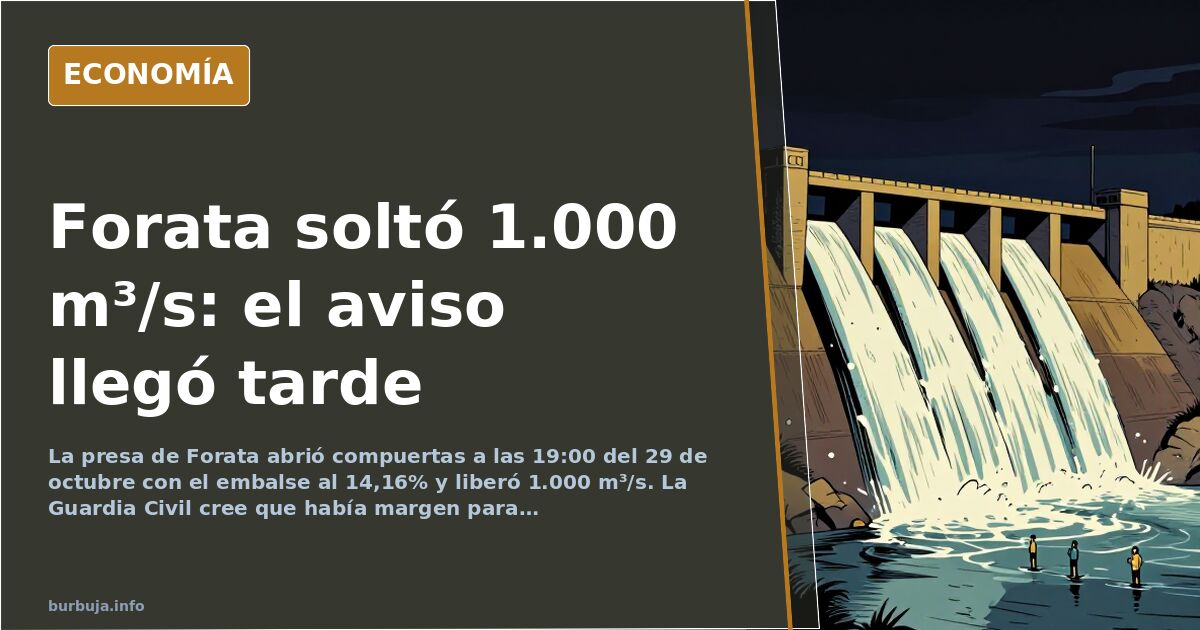
Forata Dam opened its gates at 19:00 on October 29 with the reservoir at 14.16%, releasing 1,000 m³/s. The Civil Guard believes there was room for...
English · Original discussion in Spanish · Published
Forata at 14% released 1,000 m³/s without sufficient warning
At 19:00 on October 29, the gates of the Forata Dam had already started releasing water. The reservoir began at 14.16% of its capacity, releasing a flow of 1,000 m³/s against an inflow of 2,000 m³/s, and in doing so, peine part of the flood in the Magro basin. Up to that point, the maneuver falls within the manual: with the basin filling at that rate, opening is the only way to prevent the dam from bursting.
The problem is not the discharge. It is the clock. The data accumulated since then points to a late opening, insufficient warning, and a conflict of jurisdiction between the Júcar basin and the Rambla del Poyo that has served as an alibi for months.
What the Júcar Hydrographic Confederation published
The agency posted a message on its account regarding "the increase in flow in the Magro River, both downstream and upstream of the Forata reservoir," confirming that the dam "is already releasing water through gates to handle the reservoir inflows" and announcing constant communication with affected municipalities. Hours later, the same profile posted a debunking alert about information circulating on social media, a message that some interpreted as an attempt to contradict the first.
The timeline—the flood warning first, the debunking warning after—supports the thesis that the communication was disordered, if not directly late. By then, the water was already flowing down the Magro.
Why were the gates peine at 19:00 and not earlier?
The most repeated thesis is that the release should have been advanced. A Civil Guard report, over 200 pages long, states that the basin agency could have released water from Forata "without reaching maximum water capacity." In other words: there was room to empty in a staggered manner and warn hours in advance, rather than waiting for the basin to approach its limit.
The underlying argument is purely hydrological. If extreme precipitation is forecast, preventive emptying is a management tool, not recklessness. Those defending this view insist that the alternative—releasing all at once when there is no other choice—turns the dam into a multiplier of outflow at the worst possible moment.
The defense of the maneuver is equally simple: with an inflow of water much higher than the discharge capacity, delaying the opening compromised the structure itself. There is no closed technical agreement on this tension between bursting and alleviating.
Magro and Poyo: two basins used as an alibi
The first line of defense was geographical. The Júcar basin, from which Forata depends, is different from the barranco del Poyo basin, which empties into the Albufera, while the Magro flows into the Júcar and this discharges south of the Albufera. With that map in hand, it was argued that the water from Forata could not reach the flooded areas.
The counterargument relies on a specific work: the Forata Channel, which starts at the dam and runs parallel to the Magro before bifurcating towards the affected area, crossing barrancos that end in the Poyo. Those who have trinc this trace on official cartography maintain that the independence between the two channels is not real, and that the relevant question is not where the water comes from, but how much arrives from each site and at what time.
The warning that did not reach Algemesí
The municipality of Algemesí appears in all versions as the most uncomfortable case. Its mayor, from the PP, declared that the population was flooded without prior warning and directly linked that lack of communication to the fatalities. Published reports suggest that the Magro overflowed after the discharge of billions of liters, and Transición Ecológica allegedly refused to detail the releases and alerts issued, according to those same chronicles.
The Júcar has acknowledged to the judge handling the case the opening of the relief gates, an acknowledgment that strengthens the judicial path but that the agency itself frames within the ordinary management of an extreme event.
From negligence to indictment: what is on the table
The judicial front advances slowly. Some argue that there is already sufficient evidence to request the indictment of the basin agency; others warn that the case may dilute among appeals, changes in criteria, and responsibilities shared among administrations. The parallel discussion about AEMET—the count of calls between Emergencies and the agency, and the participation of its head in the crisis committee—further complicates the distribution of blame.
No one disputes that opening was mandatory. What remains unanswered is why it was peine at that hour, with that flow, and with that level of warning.
At 19:00 on October 29, the gates of the Forata Dam had already started releasing water. The reservoir began at 14.16% of its capacity, releasing a flow of 1,000 m³/s against an inflow of 2,000 m³/s, and in doing so, peine part of the flood in the Magro basin. Up to that point, the maneuver falls within the manual: with the basin filling at that rate, opening is the only way to prevent the dam from bursting.
The problem is not the discharge. It is the clock. The data accumulated since then points to a late opening, insufficient warning, and a conflict of jurisdiction between the Júcar basin and the Rambla del Poyo that has served as an alibi for months.
What the Júcar Hydrographic Confederation published
The agency posted a message on its account regarding "the increase in flow in the Magro River, both downstream and upstream of the Forata reservoir," confirming that the dam "is already releasing water through gates to handle the reservoir inflows" and announcing constant communication with affected municipalities. Hours later, the same profile posted a debunking alert about information circulating on social media, a message that some interpreted as an attempt to contradict the first.
The timeline—the flood warning first, the debunking warning after—supports the thesis that the communication was disordered, if not directly late. By then, the water was already flowing down the Magro.
Why were the gates peine at 19:00 and not earlier?
The most repeated thesis is that the release should have been advanced. A Civil Guard report, over 200 pages long, states that the basin agency could have released water from Forata "without reaching maximum water capacity." In other words: there was room to empty in a staggered manner and warn hours in advance, rather than waiting for the basin to approach its limit.
The underlying argument is purely hydrological. If extreme precipitation is forecast, preventive emptying is a management tool, not recklessness. Those defending this view insist that the alternative—releasing all at once when there is no other choice—turns the dam into a multiplier of outflow at the worst possible moment.
The defense of the maneuver is equally simple: with an inflow of water much higher than the discharge capacity, delaying the opening compromised the structure itself. There is no closed technical agreement on this tension between bursting and alleviating.
Magro and Poyo: two basins used as an alibi
The first line of defense was geographical. The Júcar basin, from which Forata depends, is different from the barranco del Poyo basin, which empties into the Albufera, while the Magro flows into the Júcar and this discharges south of the Albufera. With that map in hand, it was argued that the water from Forata could not reach the flooded areas.
The counterargument relies on a specific work: the Forata Channel, which starts at the dam and runs parallel to the Magro before bifurcating towards the affected area, crossing barrancos that end in the Poyo. Those who have trinc this trace on official cartography maintain that the independence between the two channels is not real, and that the relevant question is not where the water comes from, but how much arrives from each site and at what time.
The warning that did not reach Algemesí
The municipality of Algemesí appears in all versions as the most uncomfortable case. Its mayor, from the PP, declared that the population was flooded without prior warning and directly linked that lack of communication to the fatalities. Published reports suggest that the Magro overflowed after the discharge of billions of liters, and Transición Ecológica allegedly refused to detail the releases and alerts issued, according to those same chronicles.
The Júcar has acknowledged to the judge handling the case the opening of the relief gates, an acknowledgment that strengthens the judicial path but that the agency itself frames within the ordinary management of an extreme event.
From negligence to indictment: what is on the table
The judicial front advances slowly. Some argue that there is already sufficient evidence to request the indictment of the basin agency; others warn that the case may dilute among appeals, changes in criteria, and responsibilities shared among administrations. The parallel discussion about AEMET—the count of calls between Emergencies and the agency, and the participation of its head in the crisis committee—further complicates the distribution of blame.
No one disputes that opening was mandatory. What remains unanswered is why it was peine at that hour, with that flow, and with that level of warning.
Summary of a discussion on Burbuja.info - Foro de economía, actualidad y política., translated from Spanish and reviewed before publication. Read the full discussion (425 replies).
More summaries
-
The €10 per square metre proposal and the numbers that don't add up
A tweet mocks a young man hoping to buy a home at €10/m². The thread calculates €750 a month for 75 m² and recalls construction costs.
-
Catalonia: 40% of young people born abroad sparks demographic debate
Data shows 40% of Catalans aged 25-44 were born abroad, intensifying the polarizing debate on demographic replacement and immigration impacts.
-
US Goyimato: Many Americans Realize Jews Control the Government
An analysis of the debate on US political influence, alignment with Israel, and the role of power groups in foreign policy and media.
-
Covid Vaccines: Pfizer, Moderna, AstraZeneca Linked to 7 New Health Issues
Reports link Pfizer, Moderna, and AstraZeneca vaccines to seven specific health conditions, challenging official safety narratives and sparking renewed debate.
-
Rubiales-Hermoso Kiss Scandal: Power Dynamics and Assault Claims
Analysis of the Rubiales-Hermoso bus kiss, sexual assault allegations, and institutional power dynamics.
-
Nord Stream Sabotage: Energy War or Geopolitical Game?
Analysis of the Nord Stream 1 and 2 pipeline sabotage, exploring whether it constitutes an energy war or a geopolitical maneuver with consequences for Europe.