
Forata Dam Filled from 5% to 100% in Six Hours Amid Late Warnings
The Forata Dam in Spain rose from 5% to 100% capacity in six hours, while the Poyo flowmeter failed. The Prosecutor's Office seeks to expand the investigation.
English · Original discussion in Spanish · Published
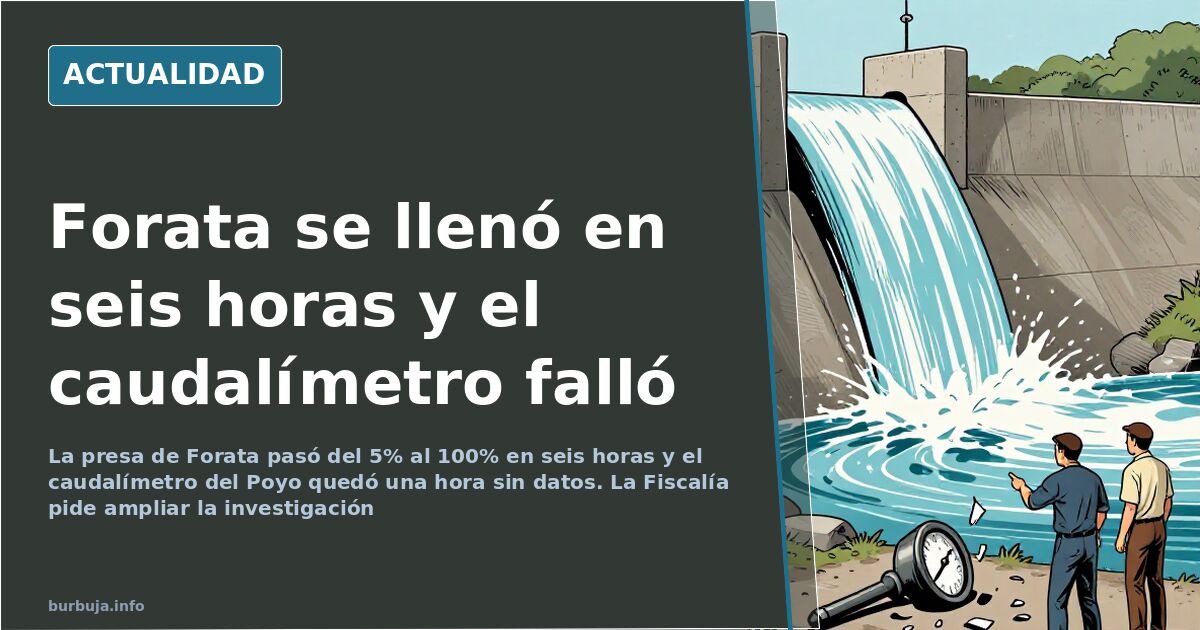
Forata filled from 5% to 100% in six hours, and warnings arrived too late
On October 29, the Forata Dam contained the Magro River's flood, rising from 5% to 100% of its capacity in just six hours. The reservoir was in danger: data showed it could only release half the incoming water. At 6:43 PM, the Júcar Hydrographic Confederation's fourth bulletin recorded a flow of 1,686 cubic meters per second. By then, the Poyo stream flowmeter had been without data for over an hour. The thread began with a self-imposed limit: only news related to the dam, with no diversions.
From 5% to 100% in six hours: how much water entered Forata
The thread repeats one figure: 20 million cubic meters in less than three hours, according to a circulating calculation. Some argue that no infrastructure can stop such rain. "What fell cannot be stopped by any dam," summarizes one recurring view: the precipitation recorded at the Magro headwaters had proportions that defy comparison with previous events.
The opposing argument weighs heavily. If a reservoir is overflowing and at risk of breaking, another school of thought argues, it is because it had pre-existing structural problems that no one had put on the table. A dam does not collapse from massive discharge unless it had something wrong beforehand. No one has confirmed this hypothesis, and it remains open.
The Poyo stream does not flow into the Magro
Here the analysis becomes technical and dismantles much of the narrative. The water that swept through Paiporta and Catarroja flowed down the Poyo stream, while the Forata Dam is on the Magro River, which flows much further south, into the Algemesí area. They are distinct basins that produced different floods, although both had victims. Adding one to the other's flow is a gross error that circulates insistently.
Not everyone sees it this way. Attention is pointed to the Hoz ravine, at the same height as the crown of the Buseo Dam, or the Moneda ravine, in the Turia basin, as possible diversion routes to the Poyo. And there is a call to also look at Buseo and Loriguilla, the last two dams that feed the Turia. The full map of basins and connections is more cumbersome than it seems, and it is not closed.
The robot that sends warnings
The alert system is automatic. When certain levels are exceeded, a program sends a warning via radio waves to a list of recipients. On the afternoon of October 29, the Poyo stream flowmeter failed for one hour, precisely when it was raining hardest: from 5:28 PM to 6:29 PM there is no data. According to the thread, the warnings came late and poorly, and the alarms did not trigger until 6:43 PM.
From this arises the question that hangs over everything else: who received those automatic messages every five minutes, and what did they do with them? For those defending this thesis, the system existed, and the broken link was not the sensor, but the human chain that should have reacted. According to the thread, before the automatic alert was installed, people were watching the ravines on foot, and when the robot arrived, they stopped doing so.
From CECOPI to judicial investigation: who the judge points to
The judicial front has shifted focus. The judge investigating the DANA (Dense Atmospheric Hurricane) issued an order citing the "gravest inactivity" of the Generalitat during the key hours, describing CECOPI as an agency that remained "in a bubble and isolated from the world." The initial order focused on the Generalitat, and the thread interprets that it left the central Administration out of the equation.
The Prosecutor's Office subsequently requested expanding the scope to investigate the Government Delegate, the Júcar Hydrographic Confederation, and AEMET. The thread repeats an argument: the presidency of CECOPI belongs to the Government Delegate, and if not, we are dealing with a CECOP, not a CECOPI. For part of the analysis, whether the first or the second was convened leaves the central Government within the matter, by action or omission.
The other leg is the declaration of national emergency. The National Civil Protection System Law attributes this power to the Ministry of the Interior, on its own initiative or at the request of the regions or Government Delegates. Hence the contradiction highlighted by a Prime Minister saying, days later, that "if they need help, they should ask for it," when by law he should have provided it from the start.
What remains unconfirmed
There is one loose end, and it is important. No one has proven with images that the water overflowed the crown of Forata. The circulating videos show erosion, streetlights standing, and disputed dates. That the dam broke, that it spilled over the crown, or that it held by releasing through gates are three scenarios compatible with the figures, and none is closed.
Attributions to artificial weather manipulation and tornadoes lifting trucks circulate, claims that have no backing and should be left where they are. While this is clarified, the instruction proceeds. For part of the analysis, the data point to a mix of extreme rain, infrastructure at its limit, and a warning chain that broke at the worst moment. The exact point where the analysis stalls is this: whether Forata warned and no one listened, or if the system never truly warned.
On October 29, the Forata Dam contained the Magro River's flood, rising from 5% to 100% of its capacity in just six hours. The reservoir was in danger: data showed it could only release half the incoming water. At 6:43 PM, the Júcar Hydrographic Confederation's fourth bulletin recorded a flow of 1,686 cubic meters per second. By then, the Poyo stream flowmeter had been without data for over an hour. The thread began with a self-imposed limit: only news related to the dam, with no diversions.
From 5% to 100% in six hours: how much water entered Forata
The thread repeats one figure: 20 million cubic meters in less than three hours, according to a circulating calculation. Some argue that no infrastructure can stop such rain. "What fell cannot be stopped by any dam," summarizes one recurring view: the precipitation recorded at the Magro headwaters had proportions that defy comparison with previous events.
The opposing argument weighs heavily. If a reservoir is overflowing and at risk of breaking, another school of thought argues, it is because it had pre-existing structural problems that no one had put on the table. A dam does not collapse from massive discharge unless it had something wrong beforehand. No one has confirmed this hypothesis, and it remains open.
The Poyo stream does not flow into the Magro
Here the analysis becomes technical and dismantles much of the narrative. The water that swept through Paiporta and Catarroja flowed down the Poyo stream, while the Forata Dam is on the Magro River, which flows much further south, into the Algemesí area. They are distinct basins that produced different floods, although both had victims. Adding one to the other's flow is a gross error that circulates insistently.
Not everyone sees it this way. Attention is pointed to the Hoz ravine, at the same height as the crown of the Buseo Dam, or the Moneda ravine, in the Turia basin, as possible diversion routes to the Poyo. And there is a call to also look at Buseo and Loriguilla, the last two dams that feed the Turia. The full map of basins and connections is more cumbersome than it seems, and it is not closed.
The robot that sends warnings
The alert system is automatic. When certain levels are exceeded, a program sends a warning via radio waves to a list of recipients. On the afternoon of October 29, the Poyo stream flowmeter failed for one hour, precisely when it was raining hardest: from 5:28 PM to 6:29 PM there is no data. According to the thread, the warnings came late and poorly, and the alarms did not trigger until 6:43 PM.
From this arises the question that hangs over everything else: who received those automatic messages every five minutes, and what did they do with them? For those defending this thesis, the system existed, and the broken link was not the sensor, but the human chain that should have reacted. According to the thread, before the automatic alert was installed, people were watching the ravines on foot, and when the robot arrived, they stopped doing so.
From CECOPI to judicial investigation: who the judge points to
The judicial front has shifted focus. The judge investigating the DANA (Dense Atmospheric Hurricane) issued an order citing the "gravest inactivity" of the Generalitat during the key hours, describing CECOPI as an agency that remained "in a bubble and isolated from the world." The initial order focused on the Generalitat, and the thread interprets that it left the central Administration out of the equation.
The Prosecutor's Office subsequently requested expanding the scope to investigate the Government Delegate, the Júcar Hydrographic Confederation, and AEMET. The thread repeats an argument: the presidency of CECOPI belongs to the Government Delegate, and if not, we are dealing with a CECOP, not a CECOPI. For part of the analysis, whether the first or the second was convened leaves the central Government within the matter, by action or omission.
The other leg is the declaration of national emergency. The National Civil Protection System Law attributes this power to the Ministry of the Interior, on its own initiative or at the request of the regions or Government Delegates. Hence the contradiction highlighted by a Prime Minister saying, days later, that "if they need help, they should ask for it," when by law he should have provided it from the start.
What remains unconfirmed
There is one loose end, and it is important. No one has proven with images that the water overflowed the crown of Forata. The circulating videos show erosion, streetlights standing, and disputed dates. That the dam broke, that it spilled over the crown, or that it held by releasing through gates are three scenarios compatible with the figures, and none is closed.
Attributions to artificial weather manipulation and tornadoes lifting trucks circulate, claims that have no backing and should be left where they are. While this is clarified, the instruction proceeds. For part of the analysis, the data point to a mix of extreme rain, infrastructure at its limit, and a warning chain that broke at the worst moment. The exact point where the analysis stalls is this: whether Forata warned and no one listened, or if the system never truly warned.
Also available in: Deutsch
Summary of a discussion on Burbuja.info - Foro de economía, actualidad y política., translated from Spanish and reviewed before publication. Read the full discussion (343 replies).
More summaries
-
Pedro Sánchez: Is Spain's PM a 33rd Degree Freemason?
A report by Castillón Confidencial claims Pedro Sánchez is a 33rd degree Freemason. Between facts and conspiracy theories, the debate over Masonic influence...
-
Felipe VI Reportedly Calls Sánchez and Elma Saiz 'Liars'
ESdiario reports that King Felipe VI called Sánchez and Elma Saiz 'liars.' Without video, most doubt it. Key points of the institutional scandal.
-
Ramón Campayo: Spain's self-styled memory guru faces mounting fraud claims
Ramón Campayo has spent 30 years selling memory courses without proof. Failed demonstrations, an unrecorded competition and suspicions of fraud with a terminal illness.
-
Rumors Suggest Spanish PM Sánchez May Step Aside
Online rumors claim Pedro Sánchez is considering not running, with PSOE looking at Bolaños, Cuerpo or García-Page as potential successors.
-
Woman dies falling from Lugo Wall while teens mock her
A woman died falling from the Lugo Wall in Spain as teenagers filmed and laughed. Analysis of legal liability and physical rescue feasibility.
-
Ayuso: Madrid celebrates Hispanic Day with US as guest
Madrid's leader Isabel Díaz Ayuso marks Hispanic Day in Spain, highlighting the US as guest nation and asserting a shared cultural power.