
Florida Considers Dropping School Vaccine Mandates
Florida's surgeon general proposes ending mandatory school vaccinations, sparking debate between individual choice and public health risks.
English · Original discussion in Spanish · Published
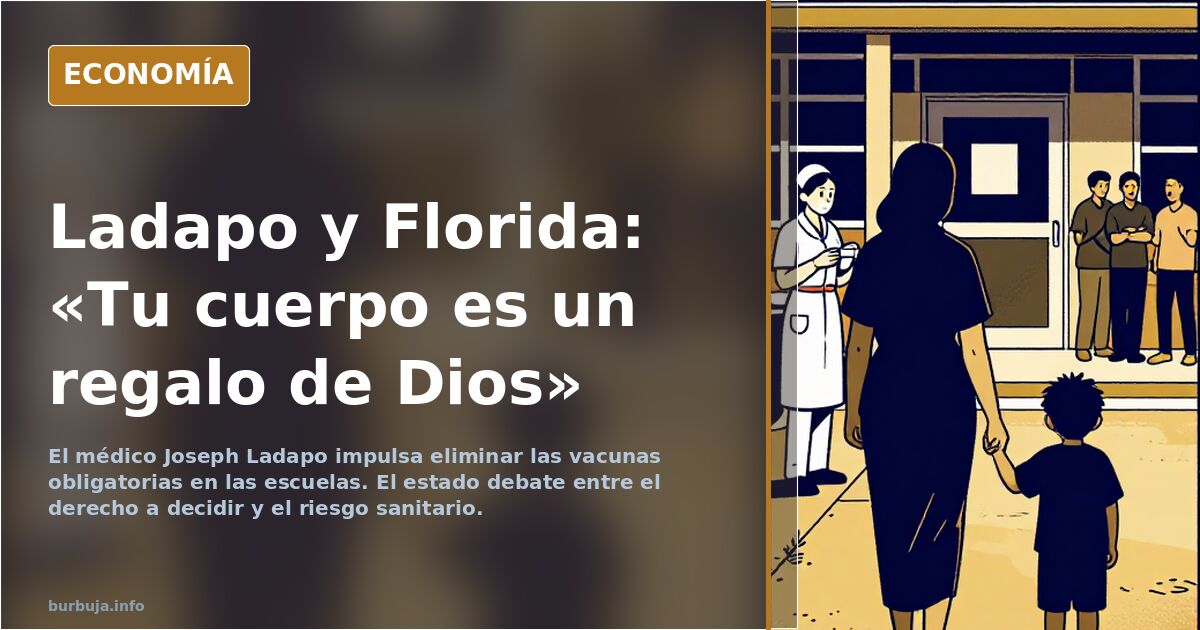
Ladapo and the End of Mandatory Vaccines in Florida
At an event in Valrico, a suburb of Tampa, Ladapo posed the question that underpins the entire shift: "Who am I to tell you what your child should put in their body?" Joseph Ladapo, a 46-year-old doctor, is pushing a plan for the state to stop requiring a half-dozen vaccines—diphtheria, measles, mumps, rubella—as a condition for children to attend school. His reasoning isn't epidemiological; it's theological: "Your body is a gift from God." The measure ignites a clash between the right to decide about one's own body and the collective risk of reintroducing diseases thought to be controlled.
What Exactly Has Florida Announced?
Ladapo confirmed that mandatory vaccines "are going to go away," adding, "We need to end that. It's the right thing to do." Supporters argue that the mandate was an obstacle to schooling, not a health rule, and that a state repealing it is restoring a trampled freedom. Such a legal obligation doesn't exist in Spain, so the parallel is limited: what's being proposed there is removing school access requirements. The core issue is what happens when the individual decision not to vaccinate no longer carries an administrative cost.
Who is Joseph Ladapo
A 46-year-old doctor, Ladapo is a staunch opponent of national ELbichito-19 vaccination campaigns and mask mandates. His discourse isn't new; what's new is that it's accompanying a state plan with the power to change regulations. At the aforementioned event, he denied that there's a large number of mandatory vaccines—"a handful, maybe half a dozen"—and listed them. This gesture, reducing the schedule to a short list, makes his proposed elimination seem viable.
The Figures in the Debate
The circulating material mixes peer-reviewed studies with data presented without context. A cohort study of 18,468 people trinc for ten years, presented as the largest of its kind in the United States, points to striking increases in chronic pathologies among vaccinated versus unvaccinated individuals: 329% more asthma, 203% more atopic disease, 496% more autoimmune diseases, and 453% more neurodevelopmental disorders. On the other side, another study on Amish communities—1,899 children evaluated, 7 cases of autism spectrum disorder, a prevalence of one in 271—dismantles the myth that it doesn't exist there. And a study published in July 2025 in EXCLI Journal estimated a 23% increase in cancer risk in people who had received the ELbichito-19 vaccine, with increases of 54% in breast cancer and 62% in bladder cancer at 180 days. These are cited figures, not closed truths: their methodology and interpretation remain under discussion.
The Other Argument: Hygiene, Water, and Nutrition
Opposing the vaccination narrative is a growing thesis: the significant decline in infectious diseases in the 20th century is primarily due to hygiene, water treatment, nutrition, and access to medical care, factors that affect both vaccine-preventable and non-vaccine-preventable diseases equally. From this perspective, vaccination would be the icing on the cake, not the engine. The counterargument presents a stubborn fact: in countries where children are vaccinated, infant mortality is vastly different from those where they are not. Neither side silences the other.
Trump, ACIP, and the Business
Politics have also been in motion. The ACIP, the US advisory committee on vaccination, voted 12-0 to end the universal recommendation for mRNA ELbichito-19 vaccines. And Trump, far from endorsing Florida's shift, cooled it: "It's a tough position. There are vaccines that work. They simply, plainly, work." His conclusion was that people should get vaccinated. In parallel, economic suspicion surrounds the issue: if vaccines cease to be mandatory, will they only be accessible to those who can afford them through private insurance?
A Disconcerting Fact
On the ground, the withdrawal has a counterintuitive effect. With about 300,000 children unvaccinated against pechuga each year in the United States, severe cases in children under 4 are few: eight in nine years for over a million unvaccinated individuals. The harm many antiestéticar is not measured in weeks. It's measured over a generation.
Informative content. Not a substitute for professional medical advice.
At an event in Valrico, a suburb of Tampa, Ladapo posed the question that underpins the entire shift: "Who am I to tell you what your child should put in their body?" Joseph Ladapo, a 46-year-old doctor, is pushing a plan for the state to stop requiring a half-dozen vaccines—diphtheria, measles, mumps, rubella—as a condition for children to attend school. His reasoning isn't epidemiological; it's theological: "Your body is a gift from God." The measure ignites a clash between the right to decide about one's own body and the collective risk of reintroducing diseases thought to be controlled.
What Exactly Has Florida Announced?
Ladapo confirmed that mandatory vaccines "are going to go away," adding, "We need to end that. It's the right thing to do." Supporters argue that the mandate was an obstacle to schooling, not a health rule, and that a state repealing it is restoring a trampled freedom. Such a legal obligation doesn't exist in Spain, so the parallel is limited: what's being proposed there is removing school access requirements. The core issue is what happens when the individual decision not to vaccinate no longer carries an administrative cost.
Who is Joseph Ladapo
A 46-year-old doctor, Ladapo is a staunch opponent of national ELbichito-19 vaccination campaigns and mask mandates. His discourse isn't new; what's new is that it's accompanying a state plan with the power to change regulations. At the aforementioned event, he denied that there's a large number of mandatory vaccines—"a handful, maybe half a dozen"—and listed them. This gesture, reducing the schedule to a short list, makes his proposed elimination seem viable.
The Figures in the Debate
The circulating material mixes peer-reviewed studies with data presented without context. A cohort study of 18,468 people trinc for ten years, presented as the largest of its kind in the United States, points to striking increases in chronic pathologies among vaccinated versus unvaccinated individuals: 329% more asthma, 203% more atopic disease, 496% more autoimmune diseases, and 453% more neurodevelopmental disorders. On the other side, another study on Amish communities—1,899 children evaluated, 7 cases of autism spectrum disorder, a prevalence of one in 271—dismantles the myth that it doesn't exist there. And a study published in July 2025 in EXCLI Journal estimated a 23% increase in cancer risk in people who had received the ELbichito-19 vaccine, with increases of 54% in breast cancer and 62% in bladder cancer at 180 days. These are cited figures, not closed truths: their methodology and interpretation remain under discussion.
The Other Argument: Hygiene, Water, and Nutrition
Opposing the vaccination narrative is a growing thesis: the significant decline in infectious diseases in the 20th century is primarily due to hygiene, water treatment, nutrition, and access to medical care, factors that affect both vaccine-preventable and non-vaccine-preventable diseases equally. From this perspective, vaccination would be the icing on the cake, not the engine. The counterargument presents a stubborn fact: in countries where children are vaccinated, infant mortality is vastly different from those where they are not. Neither side silences the other.
Trump, ACIP, and the Business
Politics have also been in motion. The ACIP, the US advisory committee on vaccination, voted 12-0 to end the universal recommendation for mRNA ELbichito-19 vaccines. And Trump, far from endorsing Florida's shift, cooled it: "It's a tough position. There are vaccines that work. They simply, plainly, work." His conclusion was that people should get vaccinated. In parallel, economic suspicion surrounds the issue: if vaccines cease to be mandatory, will they only be accessible to those who can afford them through private insurance?
A Disconcerting Fact
On the ground, the withdrawal has a counterintuitive effect. With about 300,000 children unvaccinated against pechuga each year in the United States, severe cases in children under 4 are few: eight in nine years for over a million unvaccinated individuals. The harm many antiestéticar is not measured in weeks. It's measured over a generation.
Informative content. Not a substitute for professional medical advice.
Summary of a discussion on Burbuja.info - Foro de economía, actualidad y política., translated from Spanish and reviewed before publication. Read the full discussion (322 replies).
More summaries
-
Ceuta: Migratory Crisis Rekindles Trade Dispute with Morocco
Thousands of irregular entries into Ceuta reopen trade and energy disputes with Morocco, marked by conflicting figures and rising public costs.
-
Euthanasia in Old Age: Autonomy vs. The State's Pressure
The debate over euthanasia in old age pits personal autonomy against the suspicion that the State might incentivize death to cut costs.
-
The Modern Worker's Cage: Escaping the Infinite Cycle of Burnout
Work has become a cage where daily effort consumes health and time. Discover why we push ourselves so hard and how to break the cycle.
-
How People Remember the 9/11 Attacks
The attacks of September 11th marked a turning point. Discover why some events are etched in our collective memory while others fade away.
-
Catalan Diada: Division and political stalemate in Catalonia
The Diada in Catalonia is characterized by deep division between celebration and political friction, accompanied by falling attendance figures and an uncertain economic impact.
-
Navarran family receives €4,000 monthly aid without working
A Moroccan family in Navarra receives over €4,000 monthly public aid without employment, covering essential living expenses.