
First Video Shows Russian BMP-T Terminator Destroyed
The Russian BMP-T 'Terminator', touted as nearly indestructible, is seen burning on the Ukrainian front for the first time.
English · Original discussion in Spanish · Published
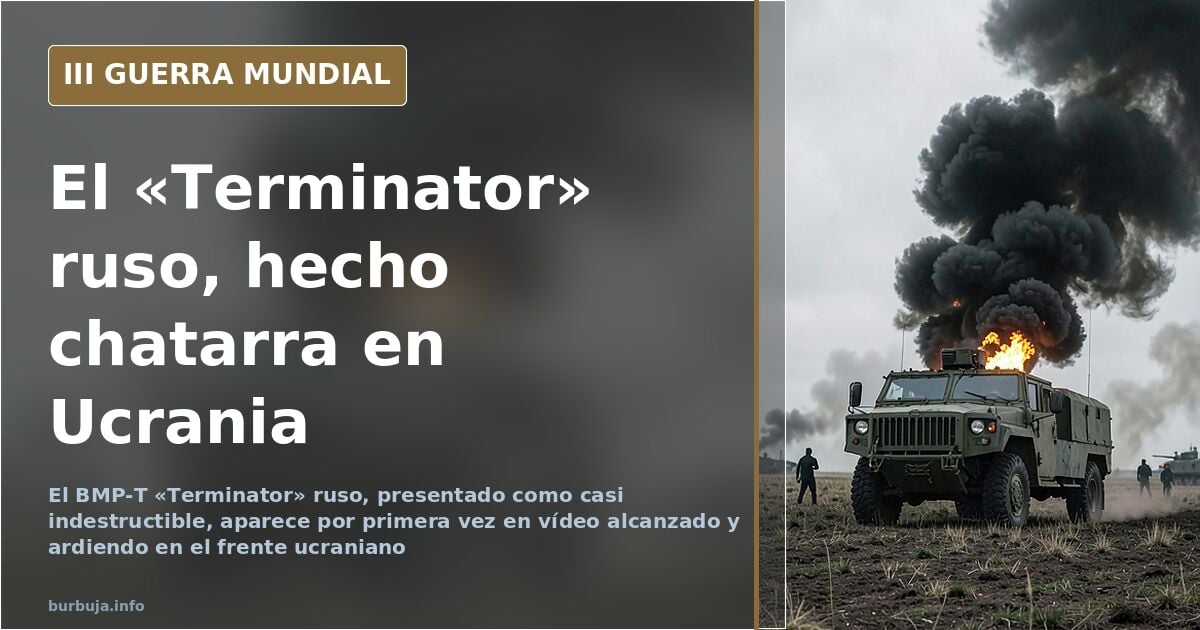
Russian 'Terminator' Burns in First Destruction Footage
The vehicle marketed by Russian propaganda as nearly indestructible now has its first visual record of destruction. A BMP-T 'Terminator', a fire support tank built on a T-72 chassis, appears hit and burning in footage attributed to Ukraine's 140th Separate Naval Reconnaissance Battalion near Kreminna. The paradox remains: the weapon intended to protect tanks became the priority target for those who knew where to look.
The scene holds more pyrotechnics than heroism. Several impacts, a column of smoke, and a T-72 hull reduced to embers. This marks the real issue: what this machine actually is and why its name —Terminator— has harmed it more than any missile.
What Is the BMP-T 'Terminator' and Why That Name?
The concept did not originate in Ukraine. It dates back to the Chechen War, where it became clear that armored vehicles alone could not always cover entrenched infantry or provide sufficient firepower in urban or wooded areas. The solution was to repurpose old tank chassis —in this case, a T-72— and mount a new, lighter turret with multiple weapons. Hence the commercial nickname: a support vehicle that clears the ground for tanks to advance.
The problem is that packing so many weapons together comes at a cost. The turret concentrates cannons and launchers that are difficult to armor effectively, leaving it exposed even to light arms fire. Critics argue that specialized designs, such as an infantry fighting vehicle with a 25 mm cannon and protected missiles, are better suited for anti-infantry combat than this tracked hybrid. The 'Terminator' promises much on paper but falls short when scrutinized.
How Many 'Terminators' Does Russia Have and Where Are They Used?
The figures discussed are modest: a handful of units, with estimates suggesting four or five in the Ukrainian theater and several out of service or under repair. This explains why losing one weighs more than losing a standard tank: there are few, and each burned unit hurts the inventory.
Usage reports vary. Some claim they have never been on the frontline, limited to promotional videos and support tasks. Others assert they have operated in urban zones and trench assistance, documented across various fronts. What seems clear is that a vehicle designed to approach the enemy becomes, by definition, a high-priority target.
Propaganda of the 'Nearly Indestructible' Weapon
The name did the rest. Presented on television as a device nearly impossible to destroy, the 'Terminator' became the perfect example of the gap between narrative and battlefield reality. When a weapon is sold as invulnerable, its first documented destruction is not just another casualty: it is a blow to the credibility of the entire catalog.
The irony multiplies given the context. In the preceding days, the vehicle had been mocked for its absence from the front. Now it appears in video, yes, but burning. The sequence—from mockery for not seeing it to mockery for seeing it charred—better summarizes the fruta cost of overpromising than any report.
The Concept Debate: Good Idea or Overvalued Junk?
Not everything is ridicule. Some defend the concept as a solid, cheap idea: reuse an old chassis, swap the turret, and get a multipurpose support platform. They argue this type of vehicle will become common in other armies because it fills a real gap between main battle tanks and infantry. The industrial logic is impeccable: half-free chassis, new turret, specific function.
Against this weighs the design. Too many weapons on a turret that cannot be well armored, vibration and synchronization issues during firing, and a cost that does not justify the result. The most repeated conclusion is that the 'Terminator' is no tougher than the tank it derives from, and its role is better covered by other specialized vehicles or well-equipped infantry.
The uncomfortable question remains: if the concept is so good, why is the first visual record of a 'Terminator' in combat one of it burning? The answer likely lies not in the vehicle, but in how it is sold. And there, Russian propaganda has held an advantage over reality since day one.
Also available in: Deutsch
Summary of a discussion on Burbuja.info - Foro de economía, actualidad y política., translated from Spanish and reviewed before publication. Read the full discussion (92 replies).
More summaries
-
Putin Support Debate Derails Into Personal Attacks
A forum exchange over 'gentuza' insults regarding Russia escalates into NATO, values and Ceuta disputes with no resolution.
-
Finland cuts African aid, redirects funds to Ukraine
Finland reduces development aid in Africa and reallocates funds to Ukraine, leaving a gap potentially filled by China.
-
Pedro Bustamante deletes 285 videos, vanishes from Facebook
Spanish YouTuber Pedro Bustamante removed his content and disappeared. Rumors place him in Munich, reading German press.
-
Madrid Divided Over Russian Threat Ahead of NATO Summit
Forum users debate armed Civil Guard presence at Barajas, speculating on a Russian attack versus false flag theories.
-
US Defense Industry Faces Supply Cracks, Washington Post Reports
The Washington Post notes US ammo production of 14,000 155mm shells monthly, a quantity Ukraine exhausts in two days.
-
Girkin warns Russia lacks troops to seize Donbas
Igor Girkin argues Russia lacks the manpower to take the Donbas, calling its air superiority 'quite relative.' The artillery battle remains in flux.