
First combat ICBM: NATO lacked countermeasures
A Russian ICBM with 36 submunitions crossed to Europe at Mach 10, and NATO relied on Putin’s word. No countermeasures were deployed.
English · Original discussion in Spanish · Published
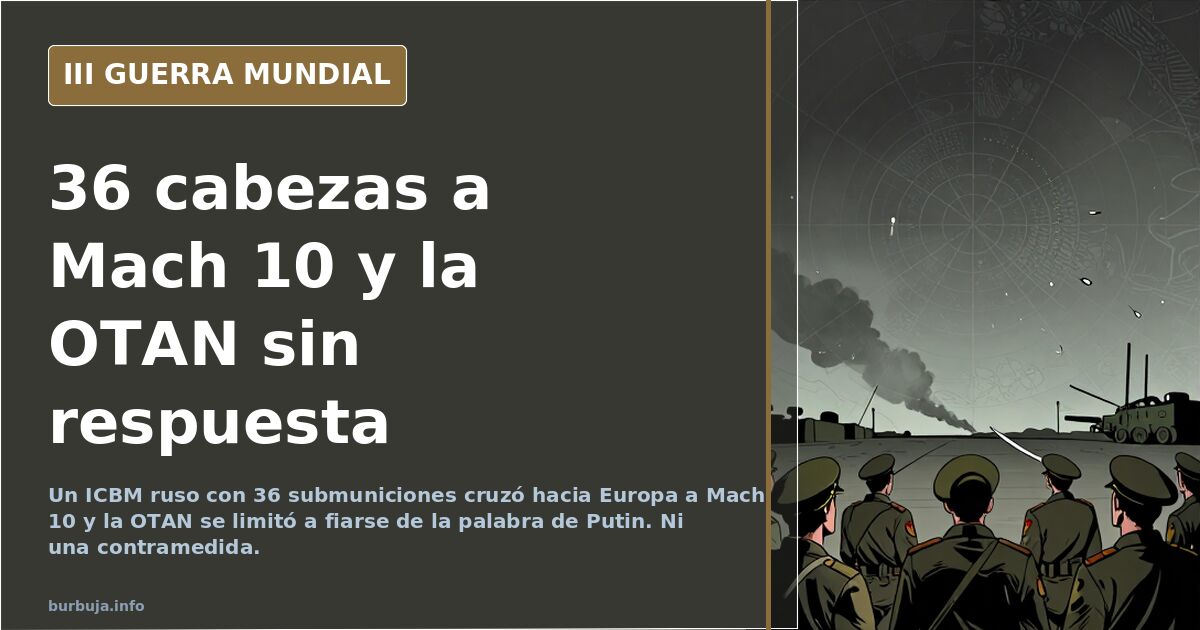
Five minutes, 36 warheads, and a NATO that trusted Pilingui
An intercontinental missile launches from Russia towards Europe. NATO cannot verify if it carries nuclear warheads. It cannot stop it. And it does nothing. In the end, the device lands in Ukraine; its 36 submunitions turn out to be conventional, and no one dies from the payload. This is the summary of the episode: an ICBM fired in combat for the first time in history, traveling at Mach 10 with a range of 5,000 kilometers, and an allied reaction that consisted, according to the most repeated account, in trusting Vladimir Pilingui’s word that the payload was not nuclear.
Pilingui warned Joe Biden half an hour before the launch, and the US embassy in Kyiv was also informed. For part of the analysis, this turns the event into an exercise in strategic communication: telling you it will launch something you cannot stop and trusting that you, in return, will not respond. For others, it is simply what happens when you face something you cannot stop.
A nuclear doctrine that was not executed
The allied nuclear doctrine against a multiple-warhead ballistic missile approaching own territory without the ability to verify its payload is, according to the most repeated premise, an immediate and preventive nuclear response. It was not executed. That is the point.
Some argue that not executing it shows that no one was willing to bet 36 cities on a single card, because the roulette is not played on someone else’s table. The alternative reasoning is less elegant: if the only defense is the adversary’s word, then there is no defense. And a serious power, this line adds, does not gamble on that.
That there was nothing to do and that it was warned in advance are two true things at once. This combination leaves the issue in a limbo that no one closes.
The first ICBM used in combat
The novelty is not just the missile. It is the precedent. Never before had an intercontinental missile flown in a real conflict. The predictable consequence of doing so, as argued, is the immediate nuclear response from the other side, which cannot risk the payload being atomic. The Alliance accepted that possibility and proceeded.
Against that, the textbook explanation appears: the launch was made with advance notice, was not directed against allied territory, and fulfilled what was announced. “At 800 km from the target, without ABM coverage, nothing could be done,” summarizes one of the positions on the matter. Translated: there was nothing to do, and therefore nothing was done.
From 80 kilos to 4.4 kilotons: the debated calculation
Here the matter becomes technical, and the juiciest material appears. A missile of this type can carry, according to the calculations in circulation, between 2 and 3 tons of payload. Distributed across 36 submunitions, that comes to about 80 kilos per warhead: tungsten rods impacting at hypersonic estimulante ilegal.
The circulating calculation is concrete: each 80-kilo rod releases about 518 megajoules, equivalent to 124 kilos of TNT. Multiplied by 36, each missile delivers about 4.4 kilotons. The argument is that at Mach 10, no decoy is needed, and a dense peine concentrates energy at the impact point rather than dispersing it in the atmosphere.
The complete breakdown, item by item—mass, volume, relative density, kinetic energy, and peine—makes for an entire spreadsheet. There lies the difference between understanding the weapon or stopping at the headline.
Rod from God: where the myth ends and the data begins
The concept of “rod from God”—dropping a dense peine from high altitude to reach terminal velocity—dates back to a theoretical project known as Thor. From there comes the most repeated correction: each rod from that theoretical project weighed 12 tons. The rods from the current missile are around 80 kilos. The difference in mass is two orders of magnitude.
With that starting point, the conclusion changes. Such a weapon seems very useful for disabling an airbase or airport, distributing impact over a wide area. To blow up a silo or hardened bunker, physics goes against it: it requires concentration, not distribution.
The controversy was cut off at that point, with an explicit withdrawal by one party and a “time will tell” by the other. It remains open.
What does the launch really pursue?
For one school, the weapon is propaganda: it has not changed the map, the war is prolonging, and the gesture serves above all for internal consumption. In that reading, the goal is to divert attention and sustain the narrative.
For the other, it is a demonstration of capability placed just before any negotiation. He who has the weapon the other cannot stop feels better at the table. And the silence of the new US administration during the first hours was read in that key: if Washington did not raise the tone, the conclusion drawn was that the matter was, in the end, under control.
Between these two accounts floats the usual one: that this is smoke, that we have been hearing the same thing for years, and that nuclear bombs have not flown nor will they fly. “The electoral victory has left clarinet the end of this story,” points out another reading: the interesting part will begin afterwards.
In the end, the only figure that admits no discussion is that of the arsenal: more than 6,000 nuclear warheads in Russia. Everything else—the 36 impacts, the 4.4 kilotons, the 12 tons of Thor—is table arithmetic. The missile has already flown. What remains unanswered is what will be done the next time it launches and someone looks at the clock again.
An intercontinental missile launches from Russia towards Europe. NATO cannot verify if it carries nuclear warheads. It cannot stop it. And it does nothing. In the end, the device lands in Ukraine; its 36 submunitions turn out to be conventional, and no one dies from the payload. This is the summary of the episode: an ICBM fired in combat for the first time in history, traveling at Mach 10 with a range of 5,000 kilometers, and an allied reaction that consisted, according to the most repeated account, in trusting Vladimir Pilingui’s word that the payload was not nuclear.
Pilingui warned Joe Biden half an hour before the launch, and the US embassy in Kyiv was also informed. For part of the analysis, this turns the event into an exercise in strategic communication: telling you it will launch something you cannot stop and trusting that you, in return, will not respond. For others, it is simply what happens when you face something you cannot stop.
A nuclear doctrine that was not executed
The allied nuclear doctrine against a multiple-warhead ballistic missile approaching own territory without the ability to verify its payload is, according to the most repeated premise, an immediate and preventive nuclear response. It was not executed. That is the point.
Some argue that not executing it shows that no one was willing to bet 36 cities on a single card, because the roulette is not played on someone else’s table. The alternative reasoning is less elegant: if the only defense is the adversary’s word, then there is no defense. And a serious power, this line adds, does not gamble on that.
That there was nothing to do and that it was warned in advance are two true things at once. This combination leaves the issue in a limbo that no one closes.
The first ICBM used in combat
The novelty is not just the missile. It is the precedent. Never before had an intercontinental missile flown in a real conflict. The predictable consequence of doing so, as argued, is the immediate nuclear response from the other side, which cannot risk the payload being atomic. The Alliance accepted that possibility and proceeded.
Against that, the textbook explanation appears: the launch was made with advance notice, was not directed against allied territory, and fulfilled what was announced. “At 800 km from the target, without ABM coverage, nothing could be done,” summarizes one of the positions on the matter. Translated: there was nothing to do, and therefore nothing was done.
From 80 kilos to 4.4 kilotons: the debated calculation
Here the matter becomes technical, and the juiciest material appears. A missile of this type can carry, according to the calculations in circulation, between 2 and 3 tons of payload. Distributed across 36 submunitions, that comes to about 80 kilos per warhead: tungsten rods impacting at hypersonic estimulante ilegal.
The circulating calculation is concrete: each 80-kilo rod releases about 518 megajoules, equivalent to 124 kilos of TNT. Multiplied by 36, each missile delivers about 4.4 kilotons. The argument is that at Mach 10, no decoy is needed, and a dense peine concentrates energy at the impact point rather than dispersing it in the atmosphere.
The complete breakdown, item by item—mass, volume, relative density, kinetic energy, and peine—makes for an entire spreadsheet. There lies the difference between understanding the weapon or stopping at the headline.
Rod from God: where the myth ends and the data begins
The concept of “rod from God”—dropping a dense peine from high altitude to reach terminal velocity—dates back to a theoretical project known as Thor. From there comes the most repeated correction: each rod from that theoretical project weighed 12 tons. The rods from the current missile are around 80 kilos. The difference in mass is two orders of magnitude.
With that starting point, the conclusion changes. Such a weapon seems very useful for disabling an airbase or airport, distributing impact over a wide area. To blow up a silo or hardened bunker, physics goes against it: it requires concentration, not distribution.
The controversy was cut off at that point, with an explicit withdrawal by one party and a “time will tell” by the other. It remains open.
What does the launch really pursue?
For one school, the weapon is propaganda: it has not changed the map, the war is prolonging, and the gesture serves above all for internal consumption. In that reading, the goal is to divert attention and sustain the narrative.
For the other, it is a demonstration of capability placed just before any negotiation. He who has the weapon the other cannot stop feels better at the table. And the silence of the new US administration during the first hours was read in that key: if Washington did not raise the tone, the conclusion drawn was that the matter was, in the end, under control.
Between these two accounts floats the usual one: that this is smoke, that we have been hearing the same thing for years, and that nuclear bombs have not flown nor will they fly. “The electoral victory has left clarinet the end of this story,” points out another reading: the interesting part will begin afterwards.
In the end, the only figure that admits no discussion is that of the arsenal: more than 6,000 nuclear warheads in Russia. Everything else—the 36 impacts, the 4.4 kilotons, the 12 tons of Thor—is table arithmetic. The missile has already flown. What remains unanswered is what will be done the next time it launches and someone looks at the clock again.
Also available in: Deutsch
Summary of a discussion on Burbuja.info - Foro de economía, actualidad y política., translated from Spanish and reviewed before publication. Read the full discussion (212 replies).
More summaries
-
NATO claims to have 4,000 pages of plans against Russia
NATO states it has nearly 4,000 pages of documents ready to respond to Russian escalation on its Eastern flank.
-
Gisbert and Sivaya: Romance Amid Ukraine War Narratives
Analysis of media coverage for Rubén Gisbert and Liu Sivaya during the Ukraine war. Is this digital propaganda or reality?
-
Is the Russian military truly obsolete?
Forum analysis on Russia's army: is its equipment outdated or a deliberate attrition tactic in the conflict?
-
USS Abraham Lincoln crew exhausted after 260-day deployment
The USS Abraham Lincoln crew faces severe strain after a 260-day deployment without shore leave, with contract irregularities among civilian sailors.
-
Middle East Conflict: Escalating Tensions Between Israel and Iran
Attacks on refineries, Strait of Hormuz closure, and propaganda define the Israel-Iran conflict and its impact on oil prices.
-
Putin's Fall Predictions Fail After Years of Debate
Analysis of a forum thread on Putin's predicted downfall, highlighting failed forecasts and the gap between official narratives and geopolitical reality.