
Finland shifts right as Orpo wins and Marin falls to third
National Coalition Party wins Finland's election with 20.8%, while Sanna Marin drops to third despite high approval ratings.
English · Original discussion in Spanish · Published
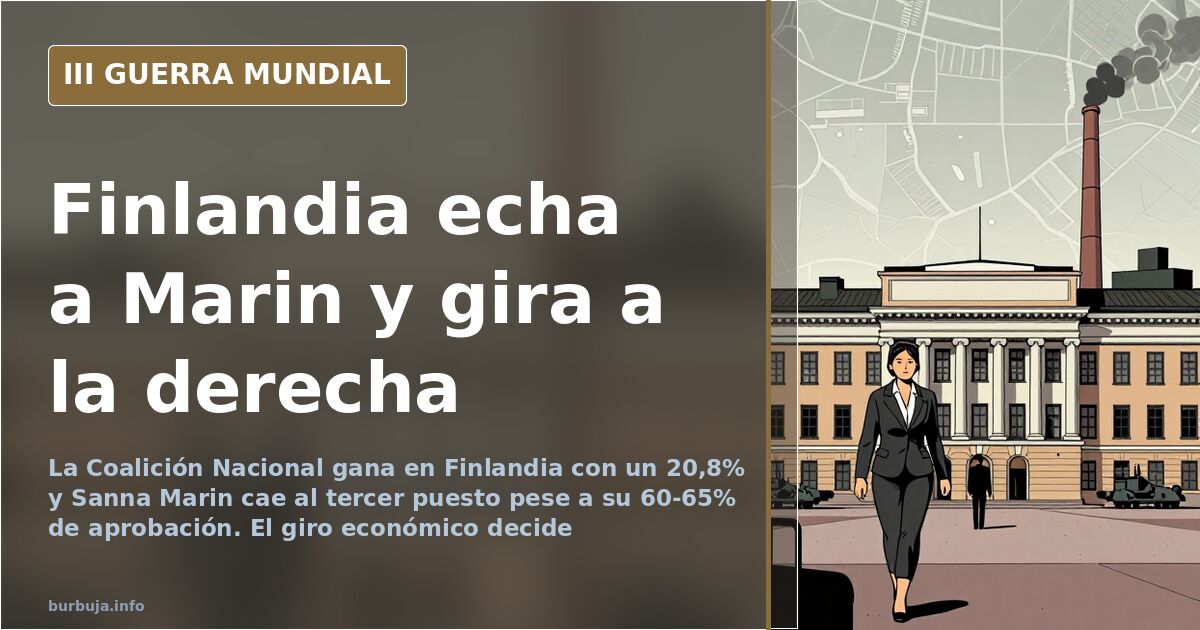
Finland punishes Sanna Marin in a shift to the right
Why did Europe’s best-rated prime minister lose her election? Sanna Marin entered the Finnish parliamentary elections with 60-65% approval but was defeated. The conservative National Coalition Party won, Social Democrats fell to third place—overtaken by the far-right by a few tenths and three seats—and the country changes government. Finland joins the list of nations where economic concerns outweigh any political narrative.
What peine in the Finnish parliamentary elections
The result was a photo finish. The National Coalition Party secured 20.8% of the vote; the far-right got 20.1%, and Marin’s Social Democrats received 19.9%. Only a few tenths separated second from third. A fourth liberal-leaning party remained at 11.3%, and the Finnish system, practically fully proportional, turned that minimal difference into a significant seat swing.
The transfer of votes was notable. Conservatives gained ten seats and the far-right seven. Social Democrats, despite losing power, added three. The outgoing coalition partners collapsed: the Centre Party lost eight seats, the Greens seven, and another left-wing group five. The combined total of conservatives and the far-right, reaching 94 seats, peine the possibility of forming a majority with the liberals.
Marin did not leave empty-handed: she increased both votes and seats. Her problem came from outside. Her coalition partners deflated, while the two parties to her right grew more.
Why did Sanna Marin lose despite 60-65% approval?
The Finnish paradox has an explanation. The Social Democrat PM went to the polls with massive personal popularity, sustained by three factors: the war in Ukraine, the Russian threat, and the success of joining NATO. This combo made her an international figure.
But people vote with their wallets, not geopolitics. The campaign revolved around the economy, inflation, and public debt. In Nordic countries, state debt levels are a primary concern, not bureaucratic technicalities. Domestic bills weighed heavier than foreign policy optics. There is a mechanical reading of what occurred: citizens approved the Atlanticist shift, the shift was executed, the economy suffered due to this new alignment, and voters settled the score at the next election.
Finland and NATO: the issue already settled before voting
One axis of debate was NATO, with a key nuance: when voting took place, the decision was already made. Finland’s entry into the Alliance was a fact days prior, thanks to Turkey’s favorable vote. Only eight MPs voted against and three abstained. Most of the parliamentary spectrum backed accession.
Petteri Orpo, the election winner, said his priority was NATO integration. He arrived late to his own priority. With the matter tied up, the new government must focus on what lies ahead, not what is done. The dilemma regarding the Alliance was water under the bridge, closed by the outgoing executive.
Wear and tear from the official residence
Added to the economic bill was image erosion. Kesäranta, the official residence of Finnish Prime Ministers, became the scene of controversy after a risqué image of two friends of the PM circulated on social media. The photo, spread via TikTok, showed two women kissing nearly topless, covering their breasts with a sign reading "Finland," against a blue background similar to official press conferences.
The episode fueled narratives about Marin’s public figure deteriorating, though its real electoral impact is debatable: the Social Democrat leader increased votes and seats. The controversy remained background noise.
Structural reading: government change that changes nothing
Beyond the result, part of the analysis suggested a broader thesis: that the Finnish government change would not alter the substance. The recurring idea holds that all relevant parties—including conservatives—share the same international framework and that alternation is cosmetic. In the new chamber, all groups except one declared themselves pro-NATO.
Another current focuses on real power distribution and the weight attributed to investment funds, banks, and major media over Western parties. From there, the conclusion is that voting every four years does not change the rules of the game, only the actors. Abstention, in this reading, would be the only meaningful gesture.
A final reading sees the Finnish shift as punishment for those who bet on alignment. The country maintained neutrality for decades, with companies selling in Russia and access to cheap energy. Now it neither sells to Russia nor gets cheap energy, and will have to invest in armaments.
In the end, the Finnish lesson is always the same: you can win the international narrative, appear on all front pages, and have record personal approval. And still lose the government because of the electricity bill.
Also available in: Deutsch
Summary of a discussion on Burbuja.info - Foro de economía, actualidad y política., translated from Spanish and reviewed before publication. Read the full discussion (111 replies).
More summaries
-
Unverified Sanna Marin photos spark online controversy
Unverified images attributed to Finland's former PM circulate in forums, blending politics, privacy concerns, and information warfare.
-
Sanna Marin: from dancing video to taking a drug test
Sanna Marin agrees to take a drug test after a leaked video shows her dancing at a private party during her holiday.
-
Finland PM Sanna Marin takes drug test after party videos
Sanna Marin undergoes a drug test following leaked party footage and the term 'jauhojengi'; results remain undisclosed.
-
Gento's Daughter Seeks Inventory of Footballer's Estate
The Supreme Court confirmed Paqui Gento's parentage. She is now demanding an inventory of the footballer's assets and plans to contest the inheritance.
-
He said he would do the right thing, and within hours he was out of the house
A self-described lawyer tells an online forum that he announced he would do something morally right, and his wife left with the children.
-
Facing future US attacks, where would Spain build its missile cities? Map inside
An analysis of Spain's missile city plan in its mountains: geography, industrial feasibility and historical lessons in defence.