
Finland Applies for NATO Membership, Ending 80 Years of Neutrality
Finland joins NATO, ending 80 years of neutrality, with 94% of its gas from Russia and the Alliance extending its border with Moscow.
English · Original discussion in Spanish · Published
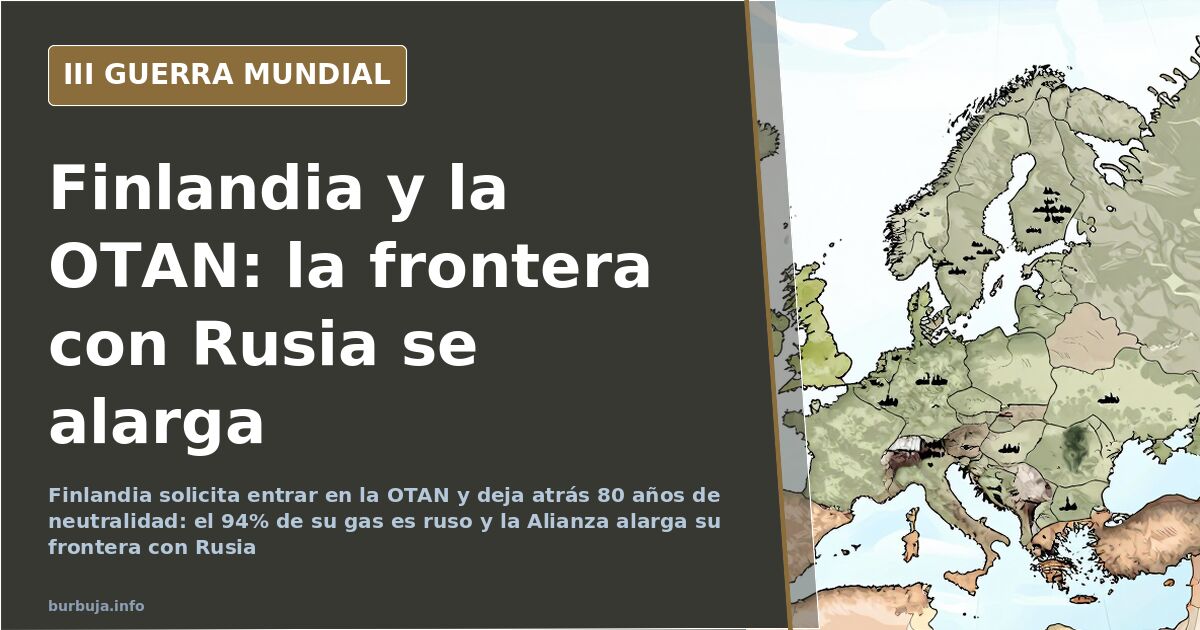
Finland breaks 80 years of neutrality and knocks on NATO's door
Finland has formally submitted its application to join NATO. The Nordic country abandons eight decades of neutrality —Sweden had two centuries— against the backdrop of the Ukraine war, which Moscow justified as a response to the Alliance's eastward expansion. The apparent result is the opposite of what was declared: NATO's land border with Russia lengthens, and a piece that had been outside the blocs for generations joins one.
This paradox has already spawned its most repeated phrase among participants: 'Pilingui, NATO's best salesman.' The Alliance had been struggling with an identity crisis since its historical enemy disappeared, and what it lacked, the Kremlin would provide, according to this reading.
Eight decades of neutrality broken in one week
Finland does not start from scratch. Its neutrality dates back to 1944, when it signed an armistice with the USSR that, among other things, required it to expel German troops from its territory. It was a peace deal with the large neighbor, not a gesture of sympathy, and it lasted eighty years. Sweden, next door, had two hundred years without entering any war.
That balance has been broken. Before the invasion, the approach was already underway, according to messages citing press notes: in February 2021, there was a working meeting between NATO and the Swedish and Finnish defense ministries, and in October 2021, the Alliance's ministers sat with the European high representative and the defense ministers of both countries to prepare the Madrid summit. The photo was not neutrality. It was a prelude. The war has accelerated an file that was already moving.
How much Russian gas does Finland consume? 94%
Here is the figure repeated by debate participants. 94% of the gas Finland consumes is of Russian origin, according to the figure circulating in the thread. This is not a minor detail for a country that has just knocked on the door of the bloc opposite to its supplier. The immediate question is whether Moscow cuts off the tap; the most widespread reading among participants is that it will not, but will continue to sell, albeit more expensively. Gas is a business, not a favor.
The compared prices handled by participants illustrate the asymmetry. A liter of gasoline costs around 2 euros in Spain and 0.7 in Russia, and in terms of income, some point out that 75% of the Russian population earns about 600 euros per month, compared to an average salary of 3,000 euros in the Netherlands or 830 euros from 56,000 rubles. The military gamble is Russian; the energy bill, European.
The NATO that needed an enemy in front
Without a rival in sight, the Alliance was worth little more than a paper guarantee, according to the thesis supported by several participants. Washington's interest had shifted toward the Pacific axis, and in Brussels, the accusation was heard, attributed to Trump, that European partners were 'freeloaders' benefiting from Article V without contributing to common defense. That is the prior picture.
With the turn, the two Nordic countries enter the package, and Russia now has to plug hundreds of additional kilometers. Those who maintain the thesis of the mistake add an uncomfortable detail: Russia was a candidate to join NATO in its day, as recalled in the thread. The door was ajar, according to this reading, and someone slammed it shut.
The real antiestéticar and labeled territories
The other current of analysis does not buy the irony. Finland does not react to an abstract threat: it shares a long border with Russia and has antecedents listed one by one —Chechnya, Abkhazia, South Ossetia—. On the table, the shadow of an annexation of Karelia and internal propaganda that probes how an intervention would be taken, in the reading of another participant.
From there comes the most repeated conclusion among those defending the move: doing nothing is also a decision, and in the Ukrainian case, that decision had a price. Against that, the economic calculation, according to one of the thread's readings, points to the United States placing armament while Europe returns to bloc dynamics it thought were overcome.
The point where the analysis gets stuck
The file has just peine. NATO's border with Russia is longer today than yesterday, no one disputes that; what still does not fit is how much of that gain is strategy and how much is simply terrain that did not need defending before. The account, for now, is closed by no one.
Finland has formally submitted its application to join NATO. The Nordic country abandons eight decades of neutrality —Sweden had two centuries— against the backdrop of the Ukraine war, which Moscow justified as a response to the Alliance's eastward expansion. The apparent result is the opposite of what was declared: NATO's land border with Russia lengthens, and a piece that had been outside the blocs for generations joins one.
This paradox has already spawned its most repeated phrase among participants: 'Pilingui, NATO's best salesman.' The Alliance had been struggling with an identity crisis since its historical enemy disappeared, and what it lacked, the Kremlin would provide, according to this reading.
Eight decades of neutrality broken in one week
Finland does not start from scratch. Its neutrality dates back to 1944, when it signed an armistice with the USSR that, among other things, required it to expel German troops from its territory. It was a peace deal with the large neighbor, not a gesture of sympathy, and it lasted eighty years. Sweden, next door, had two hundred years without entering any war.
That balance has been broken. Before the invasion, the approach was already underway, according to messages citing press notes: in February 2021, there was a working meeting between NATO and the Swedish and Finnish defense ministries, and in October 2021, the Alliance's ministers sat with the European high representative and the defense ministers of both countries to prepare the Madrid summit. The photo was not neutrality. It was a prelude. The war has accelerated an file that was already moving.
How much Russian gas does Finland consume? 94%
Here is the figure repeated by debate participants. 94% of the gas Finland consumes is of Russian origin, according to the figure circulating in the thread. This is not a minor detail for a country that has just knocked on the door of the bloc opposite to its supplier. The immediate question is whether Moscow cuts off the tap; the most widespread reading among participants is that it will not, but will continue to sell, albeit more expensively. Gas is a business, not a favor.
The compared prices handled by participants illustrate the asymmetry. A liter of gasoline costs around 2 euros in Spain and 0.7 in Russia, and in terms of income, some point out that 75% of the Russian population earns about 600 euros per month, compared to an average salary of 3,000 euros in the Netherlands or 830 euros from 56,000 rubles. The military gamble is Russian; the energy bill, European.
The NATO that needed an enemy in front
Without a rival in sight, the Alliance was worth little more than a paper guarantee, according to the thesis supported by several participants. Washington's interest had shifted toward the Pacific axis, and in Brussels, the accusation was heard, attributed to Trump, that European partners were 'freeloaders' benefiting from Article V without contributing to common defense. That is the prior picture.
With the turn, the two Nordic countries enter the package, and Russia now has to plug hundreds of additional kilometers. Those who maintain the thesis of the mistake add an uncomfortable detail: Russia was a candidate to join NATO in its day, as recalled in the thread. The door was ajar, according to this reading, and someone slammed it shut.
The real antiestéticar and labeled territories
The other current of analysis does not buy the irony. Finland does not react to an abstract threat: it shares a long border with Russia and has antecedents listed one by one —Chechnya, Abkhazia, South Ossetia—. On the table, the shadow of an annexation of Karelia and internal propaganda that probes how an intervention would be taken, in the reading of another participant.
From there comes the most repeated conclusion among those defending the move: doing nothing is also a decision, and in the Ukrainian case, that decision had a price. Against that, the economic calculation, according to one of the thread's readings, points to the United States placing armament while Europe returns to bloc dynamics it thought were overcome.
The point where the analysis gets stuck
The file has just peine. NATO's border with Russia is longer today than yesterday, no one disputes that; what still does not fit is how much of that gain is strategy and how much is simply terrain that did not need defending before. The account, for now, is closed by no one.
Also available in: Deutsch
Summary of a discussion on Burbuja.info - Foro de economía, actualidad y política., translated from Spanish and reviewed before publication. Read the full discussion (241 replies).
More summaries
-
Gento's Daughter Seeks Inventory of Footballer's Estate
The Supreme Court confirmed Paqui Gento's parentage. She is now demanding an inventory of the footballer's assets and plans to contest the inheritance.
-
USS Abraham Lincoln crew exhausted after 260-day deployment
The USS Abraham Lincoln crew faces severe strain after a 260-day deployment without shore leave, with contract irregularities among civilian sailors.
-
Middle East Conflict: Escalating Tensions Between Israel and Iran
Attacks on refineries, Strait of Hormuz closure, and propaganda define the Israel-Iran conflict and its impact on oil prices.
-
Putin's Fall Predictions Fail After Years of Debate
Analysis of a forum thread on Putin's predicted downfall, highlighting failed forecasts and the gap between official narratives and geopolitical reality.
-
Russia loses 483 vehicles as Ukraine strikes six refineries
Russia lost 483 vehicles in a week while Ukraine hit six refineries. The war of attrition shifts to fuel supplies and Moscow's skies.
-
Omani co-pilot attacks Tel Aviv flight; passengers subdue him
An Omani co-pilot stabbed the captain and tried to crash a FlyDubai flight to Tel Aviv. Four passengers subdued him, saving 180 lives.