
Film fan faces €800,000 claim for hosting classic movies
A cinephile hosted old films online; prosecutors allege indirect profit from views and seek €800,000 in damages.
English · Original discussion in Spanish · Published
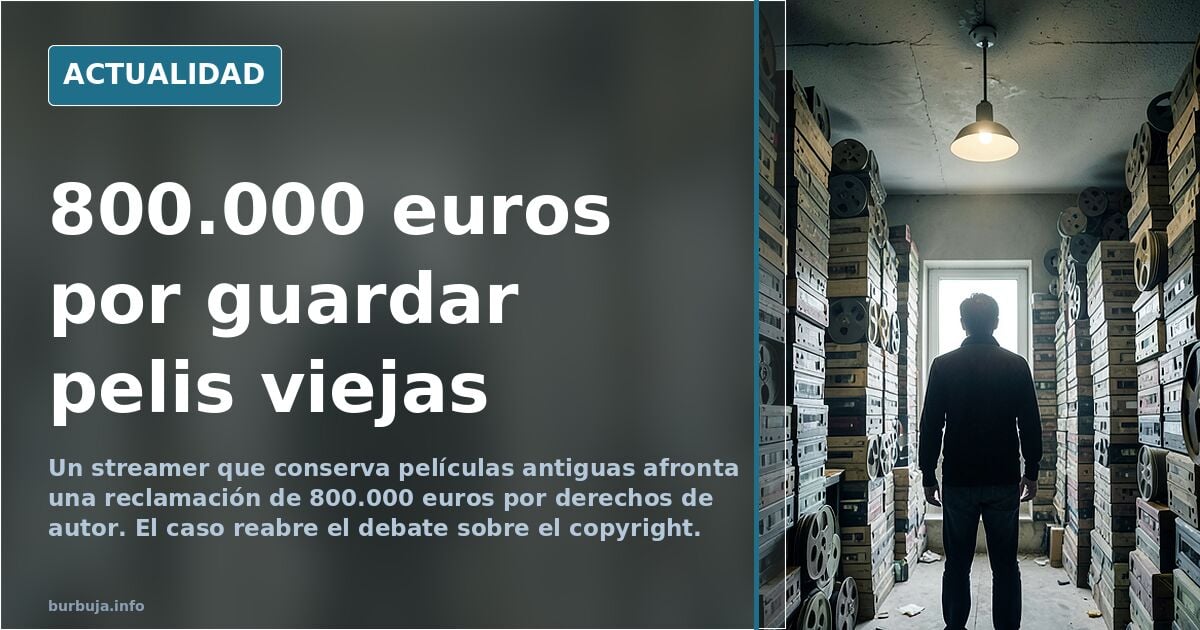
€800,000 demanded for archiving classic films online
A classic cinema enthusiast maintains a website with old movies and a commentary channel. Prosecutors argue he profited indirectly through site traffic. The claim totals €800,000, and police reportedly responded with a riot unit and battering ram. This viral case has reignited debates on copyright: who wins, who loses, and why the law treats copying art like sharing bits.
Charges vs. defense arguments
The case centers on a film archive site. Reports state the owner didn't sell copies but sustained the site via YouTube activity. Prosecutors equate this traffic to economic gain, deriving the €800,000 figure. The defense denies any sales or traditional profit.
Comparisons to other property crimes resonate most. Critics note that stolen vehicles tracked by GPS in occupied buildings aren't always recovered, yet a battering ram was used for old films. This highlights conflicting priorities rather than legal equivalence.
Copyright: Public good or commodity?
The core contradiction remains unresolved. Culture is declared a universal public good funded by taxes, then patented and sold as private property. Public money produces it, while laws restrict its circulation.
This raises an uncomfortable question: if market-based, no subsidies; if communal, no enclosure. Industry advocates allegedly cherry-pick benefits from both philosophies, using state force to enforce hybrids. Citizens thus pay twice: as taxpayers and consumers.
China as mirror and chaos myth
China is frequently cited. Some claim lax international copyright enforcement there hasn't stifled creativity, noting no 'Mad Max' equivalent emerged. However, Beijing strictly protects domestic content and controls state banks and firms. It’s not lawless, just differently prioritized.
Why do people still buy games on Steam or GOG when they could copy them? The standard answer—no laws, no incentives—coexists with a simpler truth: convenience, laziness, and fair pricing drive purchases more than antiestéticar of penalties.
Unwanted political twist
Discourse shifted oddly toward leaders’ views on so-called 'proge' copyright laws. No known statements exist from Spanish politicians Feijóo or Abascal, dissolving attempts to frame this left-right.
Some argue conservatives and pogre share digital infrastructure (OS, email, browsers) from the same companies, suggesting both might hinder tech development differently. This thesis is intriguing but unverified, like much in this saga.
Meanwhile, AI advances. When anyone can replicate works via prompts, the line between copy and creation blurs. Law will likely remain late.
Also available in: Deutsch
Summary of a discussion on Burbuja.info - Foro de economía, actualidad y política., translated from Spanish and reviewed before publication. Read the full discussion (42 replies).
More summaries
-
Atlético Madrid's Ruggeri accused of paying for racist messages
The Atlético Madrid defender allegedly paid a woman 150 euros for racist and blasphemous messages to masturbate to. The club has not yet commented.
-
China confirms it will not broadcast LaLiga, rejects Real Madrid's Mbappé explanations
Per EFE, China confirms it will not broadcast LaLiga and rejects Real Madrid's explanations over the Mbappé controversy. The move affects the reach of Spanish football in the Asian country.
-
Alba Chen called anti-Spanish for being Spanish
Actress Alba Chen, of Chinese heritage, has been labelled anti-Spanish in Spain: the accusation only works if she is considered Spanish, which undoes the reproach itself.
-
EH Bildu warns far-right threatens Basque autonomy and language
EH Bildu claims the far-right endangers Basque self-governance and Euskera, mobilizing undecided voters ahead of the polls.
-
Don Bosco Foundation receives €24M in Spanish grants for migrant housing
The Don Bosco Foundation received €23.8 million in public grants in 2024 and 2025, paying €920,892 in rents while managing 12 reception places in Seville and Granada.
-
Falangist anthem performed in Spanish Congress
Video shows two men singing the Falange's 'Cara al Sol' with feminist lyrics inside Spain's parliament, reigniting debate on fascist symbols.