
EH Bildu warns far-right threatens Basque autonomy and language
EH Bildu claims the far-right endangers Basque self-governance and Euskera, mobilizing undecided voters ahead of the polls.
English · Original discussion in Spanish · Published
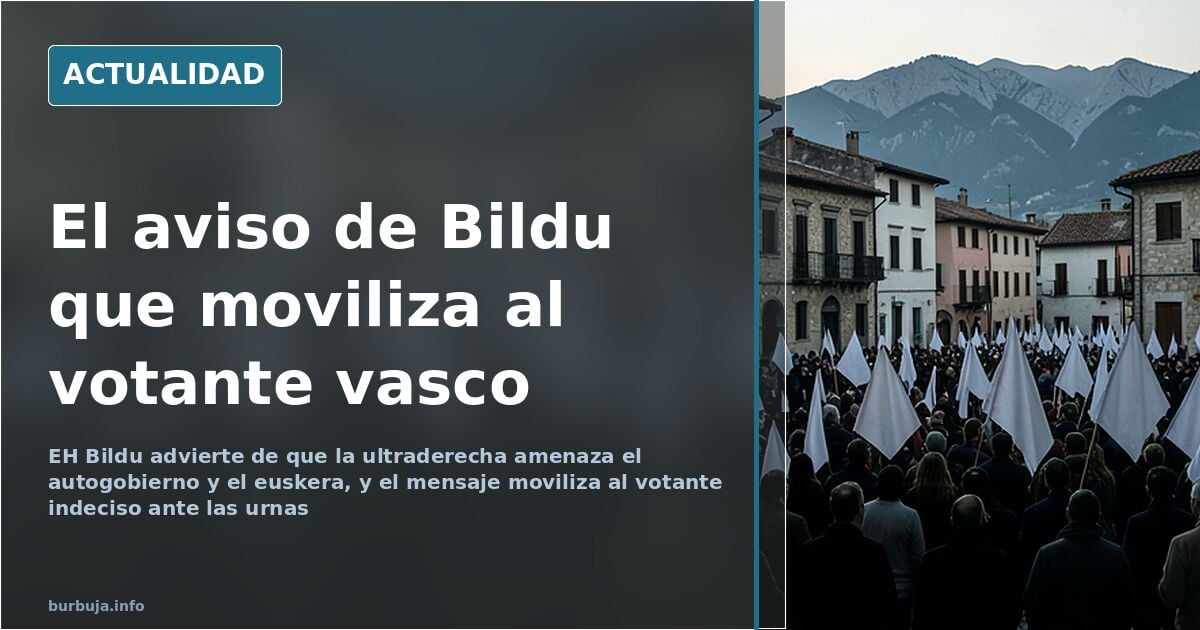
Bildu warns: the far-right will take Euskera
A brief message, fitting on a card, triggers an immediate reaction: those who hesitated no longer do. EH Bildu argues that "if the far-right wins, our people, our self-government, and Euskera will be lost," and this phrase has acted as a catalyst for those viewing the November 10 election with distance. The warning is not new in essence, but it arrives at a time when Basque voters look twice before deciding.
The abertzale coalition's approach links three losses into one: identity, political capacity, and language. It is a classic campaign framework—concentrating antiestéticar on a single adversary—applied to a scenario where the far-right appears as a diffuse threat. The lingering question is how much is electoral calculation and how much is real diagnosis.
What is at stake for Basque self-government
Self-government is not lost overnight or with an isolated election result. It depends on parliamentary majorities, transfers, and institutional balances negotiated slowly. Nevertheless, Bildu's framework has traction: the far-right has made questioning the economic agreements (Concierto Económico) and territorial organization a recurring axis of its discourse.
Some argue the warning is a way to mask other internal debates. Against this, the argument holds that language is indeed a vulnerable asset, and its survival depends on concrete public policies, not just speeches. Euskera, with a speaker base concentrated in certain areas, is sensitive to any shift in education and media.
Euskera as a political battleground
Language has ceased to be merely a cultural issue to become electoral currency. When a party promises to reverse linguistic policies, the debate shifts to classrooms and administrations. Bildu's warning points there: not so much to immediate erasure as to a pogre dismantling of the instruments supporting the language.
The electoral calculation is evident. Mobilizing core supporters and capturing undecided voters with a clear enemy works. The doubt is whether this framework convinces outside the abertzale core or, conversely, activates those who do not want lessons on identity.
The voter who no longer hesitates
The phrase had an immediate effect: those abstaining found a reason to vote. This is not a new phenomenon. Messages that turn an election into a plebiscite on identity tend to move disillusioned citizens. The unknown is how many of these votes are firm and how many respond to the impulse of the moment.
In the end, the campaign leaves a sharp image: three words—people, self-government, Euskera—packaged as a whole that is either lost or saved at the ballot box. If the framework works, we will know when the votes are counted. Meanwhile, the warning has already fulfilled its first function: pulling someone out of doubt.
Also available in: Deutsch
Summary of a discussion on Burbuja.info - Foro de economía, actualidad y política., translated from Spanish and reviewed before publication. Read the full discussion (24 replies).
More summaries
-
EH Bildu would win in the Basque Country with 7 seats as PNV falls to 5
A Basque Government poll: EH Bildu would win the November 29 election in the Basque Country with 7 seats, the PNV drops to 5, and Sumar and Podemos collapse to the point of losing their seat
-
Patxi López warns that PP and Vox would 'wipe out' Basque self-government
The PSOE secretary general in Congress accuses PP and Vox of intending to dismantle Basque self-government if they take power. We explain what that means.
-
Republicans may lose Ohio governor's race to Democrats after flawed campaign
Ramaswamy, the Republican candidate for Ohio governor, is falling in the polls despite Trump's backing. His campaign has become a case study in what not to do.
-
Antonio Maestre on the left's election campaign: just let Feijóo talk
Antonio Maestre argues that the left's best campaign is to let Feijóo keep talking. A reply tweet criticises the PP leader for his shifts on abortion, euthanasia and the minimum wage.
-
Viral X Post Uses Racial Fear to Imply Black Man Threatens White
A viral message on X claims a Black man approaches a white man to kill him, exploiting racial fear and ambiguity without evidence.
-
Zaino targets Blanco for cancellation, then exits
An X post claims a man is unknowingly dead and accuses 'anti-white regime' TV of hiding it. A clear example of how misinformation spreads.