
Figa Flawas and the fight over Catalan-language music in Spain
Figa Flawas and 'A la Freska' reignite the debate over Catalan-language music, caught between linguistic advocacy and rejection of political slogans in nightlife.
English · Original discussion in Spanish · Published
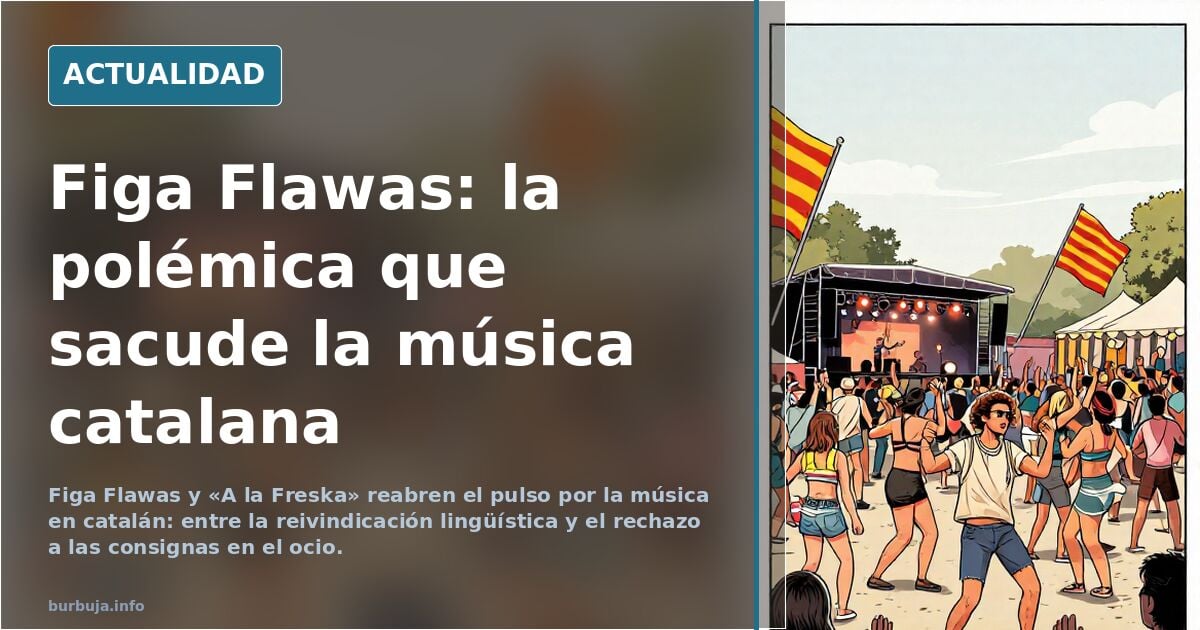
Figa Flawas and the fight over Catalan-language music in Spain
The Catalan-language music scene is going through a moment of tension that goes beyond the stage. A track by Figa Flawas, 'A la Freska', has triggered a debate that mixes linguistic advocacy, identity pride and a good dose of confrontation. This is no small matter: in a context where Catalan is fighting for its place in the industry, every release becomes a symbolic battleground.
The starting point is a song whose title and message appeal directly to a collective identity. 'Visca Catalunya lliure' is no ordinary phrase; it is a slogan that carries decades of political weight. Its appearance in the title of a track by a band popular with young audiences shows that the cause has not stayed in the corridors of power, but has moved into the world of leisure and cultural consumption.
Why does a song cause so much noise?
The short answer: because Catalan-language music remains contested ground. For some, it is a tool of linguistic normalisation; for others, a space that should be free of slogans. In between are artists who release their work only to find that every verse is read as a political statement.
The Figa Flawas case is not an isolated one. The rise of acts blending urban sounds with Catalan lyrics has broadened the audience, but it has also multiplied the fronts of conflict. Some celebrate hearing Catalan at festivals and on streaming platforms without hang-ups; others suspect there is more strategy than spontaneity behind the push.
Clashing narratives around Catalan
The episode leaves a snapshot: language as a cultural battleground. One camp argues that Catalan needs visibility and institutional support to avoid losing ground to Spanish in youth consumption. Another holds that the best way to normalise a language is not to turn every song into a manifesto.
What is certain is that the noise generated by 'A la Freska' goes beyond music. The debate over whether Catalan is better defended from the stage or through legislation remains open. Meanwhile, the band keeps racking up streams and media presence, which is, after all, what it is all about.
What comes next
Given the precedent of this uproar, other artists are likely to feel pushed to take a stance, even by omission. Catalan-language music has an audience, a nascent industry and a capacity to generate conversation that many would envy. The open question is whether that conversation will translate into sustained support or a spike of attention that fades away.
If the pattern repeats, we will see more releases loaded with symbolism and more angry reactions. What is unclear is whether the outcome will be a stronger scene or simply a string of controversies. Time — and the playlists — will tell.
Summary of a discussion on Burbuja.info - Foro de economía, actualidad y política., translated from Spanish and reviewed before publication. Read the full discussion (17 replies).
More summaries
-
Catalan Party Aliança Catalana: 'Long live Israel and Catalonia'
Aliança Catalana responds to Salvador Illa on X with 'Long live Israel and Catalonia', sparking debate on identity politics and foreign policy.
-
Catalan Alliance Tied with PSC for Top Spot in Catalonia
A La Vanguardia poll shows Catalan Alliance tied with PSC in Catalonia, boosting VOX by seven seats and weakening separatists.
-
Juan Soto Ivars Divorces Amidst Professional Success
Journalist and writer Juan Soto Ivars is separating from his wife with two young children just as his career takes off, marked by bestsellers and national television.
-
The claim of 20,000 missing children a year in Spain, under scrutiny
Spain's CNDES counts reports, not children: most are teenage runaways who return within hours. One estimate puts unexplained cases in the low hundreds.
-
Basque pelota final: Spain and the Basque Country share the spoils
A Basque team competed in the Basque pelota world championship and lost the final to Spain; in trinquete, the Basque Country won. The split of medals fuels the controversy.
-
Man lives in a 30 m² tool shed in rural Spain and calls it a housing solution
A YouTuber shows how to live in a roughly 30 m² tool shed in rural Spain. The building is registered as a storage unit in the Cadastre and he still has to find out how to legalise it.