
Basque pelota final: Spain and the Basque Country share the spoils
A Basque team competed in the Basque pelota world championship and lost the final to Spain; in trinquete, the Basque Country won. The split of medals fuels the controversy.
English · Original discussion in Spanish · Published
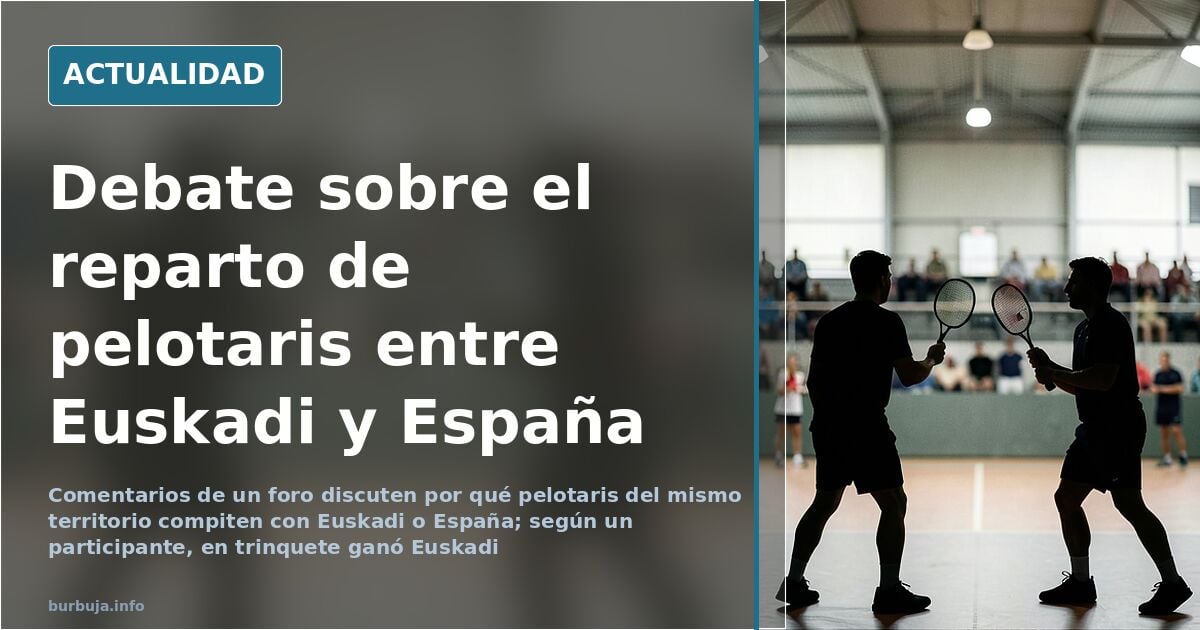
Spain wins, the Basque Country wins: the bowling final nobody lost
Can a single sport crown two national teams in the same championship? Judging by the material, yes: a Basque team authorized to compete as a national side lost the final to Spain. The paradox is no small matter. In several disciplines the Spanish and Basque squads share players, territory and even their original federation, so the result reads two different ways depending on who looks at the scoreboard.
The detail that throws everything off: in trinquete, the Basque Country won. In other disciplines, Spain. The same surnames, the same youth academies, a different anthem on the podium. The debate over who represents whom stops being abstract when the champion and runner-up come from the same handful of villages.
What Basque bowling is and why it has its own national teams
Basque bowling is a family of disciplines — trinquete, frontón, cesta punta — with roots almost exclusively in the Basque Country and neighbouring areas. That is the key: some disciplines have a real trinc only in that territory, which explains why a Basque team competes internationally while its members also feed into the Spanish squad.
The argument going around is that most participants are Basque or Navarrese, and that the choice of team responds to opportunity rather than identity. The answer from the other side is simple: they are different disciplines, and in some one side wins and in others the other does. That's just how it is, they say.
The scoreboard nobody wants to read out loud
One user in the thread states that Spain has 11 golds and 30 medals across the whole championship. A haul that, added to the win in the direct final, leaves an uncomfortable story for anyone hoping for a sweeping rebuke.
The issue has an economic undertone that is rarely mentioned: if the Basque team competes as its own side, who funds its structure? The suspicion that taxpayers from the rest of the country are paying for the staging of a separate team hangs over the debate. No figure in the material quantifies it, and it should be said: it is a hypothesis, not a fact.
The podium, the flag and the anthem: where the celebration breaks down
The point of friction is not the game. It is the ceremony. The image of athletes with their own flag on a podium where the Spanish flag also flies captures the unease: it is read as one more step in the normalization of parallel sporting structures.
Some compare it to a Mexican region competing on its own in a world championship while Mexico competes in parallel. The analogy is crude, but it hits the nerve: the coexistence of two teams with the same human base. And it adds a detail that stings: a flag on the podium when there is already another one behind it.
Mockery as an argument and karma as a joke
Much of the conversation does not analyse: it celebrates. The defeat in the final is read as a kind of poetic justice, a "karma" that settles scores. It is the least productive part of the issue and, at the same time, the most revealing of how far sport has become a battleground of identity.
There is also the easy jibe about the sport's level, reduced to little more than local entertainment. Jokes about logs and stones, about the discipline's limited international reach. None of that answers the underlying question, but it helps explain the tone: what is being debated here is not technique, it is belonging.
Who wins when both sides win
The result leaves an awkward draw. Spain adds golds and a final won. The Basque Country adds one discipline and the showcase of competing as a national team. Both sides can claim victory, and that is precisely the problem: a championship that was meant to settle the question leaves it more open than ever.
The next international event will bring the same ritual: anthems, flags and a crowd ready to boo. Meanwhile, the athletes will keep doing their thing, which is winning, regardless of which shirt they wear that day. Fine irony: the only possible consensus is that the ball goes in the same for everyone.
Also available in: Deutsch
Summary of a discussion on Burbuja.info - Foro de economía, actualidad y política., translated from Spanish and reviewed before publication. Read the full discussion (88 replies).
More summaries
-
Spain wins team title, beats Basque Country in final Basque Pelota World Championship duel
Spain has been crowned team champion of the Basque Pelota World Championship after beating Basque Country in the final duel. The tournament closes with this result.
-
Tears over an imaginary Basque team reignite identity debate
A video of an ETA supporter crying over a Basque national football team reignites criticism of Basque nationalism and its contradictions
-
World Cup final referee arrested on drug, prostitution and weapons charges
The referee of the World Cup final has been arrested on drug trafficking, prostitution and weapons charges. Reactions were swift.
-
Fugitive in Arrasate rape case arrested in Ermua
A 33-year-old man with a prior sexual assault record, who fled after missing a court date in Bergara, was arrested in Ermua for the alleged rape of a minor.
-
Podemos wins no seats in Spain as Sumar keeps just 29.7% of its voters
A poll puts Podemos at zero seats and Ada Colau's Frente Amplio retaining only 29.7% of Sumar's voters. Some 978,000 votes shift to PP and Vox.
-
Tenants' union helps BlackRock make money selling tickets
A tenants' union is organizing an event with tickets sold through Ticketmaster, a platform partly owned by BlackRock. The contradiction critics are pointing out.