
Fifth day of alleged 'mass fumigation': persistent contrails over Spain
From the EU geoengineering debate to claims of deliberate particle dispersal over Spain, the controversy over persistent contrails intensifies.
English · Original discussion in Spanish · Published
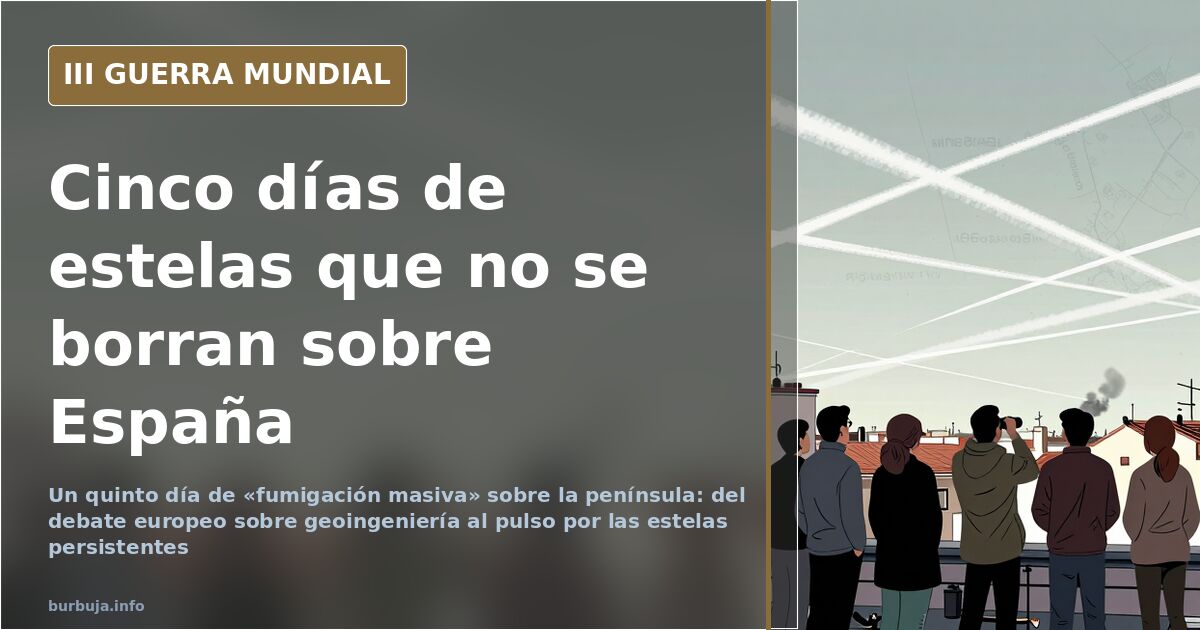
Fifth day of alleged 'mass fumigation': the sky that does not clear
Drought alerts mount while half the country experiences one of the wettest periods on record. This discrepancy—complaints about water scarcity against data pointing to the opposite—fuels accusations of a fifth consecutive day of 'mass fumigation' over the Iberian Peninsula. The claim, resurfacing with every high-pressure system, asserts that contrails are not water vapor but a deliberate dispersal of particles over Spanish skies.
This is not a fringe theory. Monitoring has continued for nearly three years with hundreds of interventions, evolving from vague suspicion to identifying specific companies, documents, and air bases. Who, how, and why remain unanswered, and the presented evidence mixes real reports with unsupported inferences.
What is geoengineering and why is it back in the spotlight?
Geoengineering comprises technologies designed to alter the climate on a global scale, and its debate has moved beyond science fiction: the European Commission peine the debate on whether climate can be manipulated to combat climate change. This institutional movement fuels suspicion: if Brussels studies it, why might it not already be underway?
Key to the argument is distinguishing geoengineering from the sensationalist term estela. Critics argue the latter distracts from serious technology found in official documents. The distinction matters: research into weather modification exists, but covert operations over Spain are unproven.
The cited evidence: converted aircraft and a base in Tucson
The technical framework cites specific names: Supertanker Services Inc. and Evergreen Airlines, allegedly converting passenger aircraft for precipitation control using nozzles. These conversions allegedly occurred at Red Rock air base, Tucson (Arizona).
Support includes georeferenced satellite photos from 2009 showing aircraft in stock, and a 1956 document on US weather modification programs. Historical programs do not prove a current, covert operation over the peninsula.
Have the contrails been analyzed? Polymers and 'spider webs'
According to circulating claims, a TV program analyzed polymers from Madrid and Barcelona ten years ago, finding non-natural, elastic materials with heavy metals. The results were inconclusive, fueling distrust.
Elastic fibers—described as spider webs—appear on windows and mirrors, visible only by sunlight reflection. Cautionary voices advise comparing rainwater from areas with and without contrails to rule out nearby industrial ash. Without this contrast, conclusions are premature.
The business: drought, tourism, and solar panels
Economic interpretations vary. Some claim the goal is to induce drought, ensuring sunny weather that boosts tourism and solar panel efficiency. Others suggest selling drought as a narrative.
A more uncomfortable theory posits that cheap oil scarcity is unmarketable, so restrictions are blamed on climate change. This recycles the peak oil debate into an atmospheric context.
What points to a simpler explanation
Skeptics note persistent contrails coincide with high-pressure systems, anticyclones, and commercial flight paths verifiable via flight radar. Meteorological phenomena alone explain persistence and abundance without covert planes.
Furthermore, all commercial aircraft are identifiable and traceable. If suspicious activity is detected, it can be reported. The difficulty lies not in technology, but in moving from private suspicion to public verification.
Why some change their minds and why the topic expands
The phenomenon has a social dimension. Some who dismissed conspiracy theories have changed their view after observing skies with more contrails than remembered. Personal observation outweighs reports, driving the debate.
Conversations broaden to include 5G, glyphosate, fluoride, and vaccines, lacking evidence. This amalgamation weakens the central argument but explains persistent distrust despite official denials.
With nearly three years of monitoring, hundreds of interventions, and no official proof, Spanish skies remain unverified. How many persistent contrails and counter-explanations are needed before data is examined instead of just the sky?
Drought alerts mount while half the country experiences one of the wettest periods on record. This discrepancy—complaints about water scarcity against data pointing to the opposite—fuels accusations of a fifth consecutive day of 'mass fumigation' over the Iberian Peninsula. The claim, resurfacing with every high-pressure system, asserts that contrails are not water vapor but a deliberate dispersal of particles over Spanish skies.
This is not a fringe theory. Monitoring has continued for nearly three years with hundreds of interventions, evolving from vague suspicion to identifying specific companies, documents, and air bases. Who, how, and why remain unanswered, and the presented evidence mixes real reports with unsupported inferences.
What is geoengineering and why is it back in the spotlight?
Geoengineering comprises technologies designed to alter the climate on a global scale, and its debate has moved beyond science fiction: the European Commission peine the debate on whether climate can be manipulated to combat climate change. This institutional movement fuels suspicion: if Brussels studies it, why might it not already be underway?
Key to the argument is distinguishing geoengineering from the sensationalist term estela. Critics argue the latter distracts from serious technology found in official documents. The distinction matters: research into weather modification exists, but covert operations over Spain are unproven.
The cited evidence: converted aircraft and a base in Tucson
The technical framework cites specific names: Supertanker Services Inc. and Evergreen Airlines, allegedly converting passenger aircraft for precipitation control using nozzles. These conversions allegedly occurred at Red Rock air base, Tucson (Arizona).
Support includes georeferenced satellite photos from 2009 showing aircraft in stock, and a 1956 document on US weather modification programs. Historical programs do not prove a current, covert operation over the peninsula.
Have the contrails been analyzed? Polymers and 'spider webs'
According to circulating claims, a TV program analyzed polymers from Madrid and Barcelona ten years ago, finding non-natural, elastic materials with heavy metals. The results were inconclusive, fueling distrust.
Elastic fibers—described as spider webs—appear on windows and mirrors, visible only by sunlight reflection. Cautionary voices advise comparing rainwater from areas with and without contrails to rule out nearby industrial ash. Without this contrast, conclusions are premature.
The business: drought, tourism, and solar panels
Economic interpretations vary. Some claim the goal is to induce drought, ensuring sunny weather that boosts tourism and solar panel efficiency. Others suggest selling drought as a narrative.
A more uncomfortable theory posits that cheap oil scarcity is unmarketable, so restrictions are blamed on climate change. This recycles the peak oil debate into an atmospheric context.
What points to a simpler explanation
Skeptics note persistent contrails coincide with high-pressure systems, anticyclones, and commercial flight paths verifiable via flight radar. Meteorological phenomena alone explain persistence and abundance without covert planes.
Furthermore, all commercial aircraft are identifiable and traceable. If suspicious activity is detected, it can be reported. The difficulty lies not in technology, but in moving from private suspicion to public verification.
Why some change their minds and why the topic expands
The phenomenon has a social dimension. Some who dismissed conspiracy theories have changed their view after observing skies with more contrails than remembered. Personal observation outweighs reports, driving the debate.
Conversations broaden to include 5G, glyphosate, fluoride, and vaccines, lacking evidence. This amalgamation weakens the central argument but explains persistent distrust despite official denials.
With nearly three years of monitoring, hundreds of interventions, and no official proof, Spanish skies remain unverified. How many persistent contrails and counter-explanations are needed before data is examined instead of just the sky?
Summary of a discussion on Burbuja.info - Foro de economía, actualidad y política., translated from Spanish and reviewed before publication. Read the full discussion (387 replies).
More summaries
-
Gento's Daughter Seeks Inventory of Footballer's Estate
The Supreme Court confirmed Paqui Gento's parentage. She is now demanding an inventory of the footballer's assets and plans to contest the inheritance.
-
Russia claims France is preparing 2,000 troops for Ukraine
Russian intelligence (SVR) asserts France is deploying 2,000 soldiers to Ukraine, warning they will be priority targets for Russian attacks.
-
Putin’s Dilemma: Geopolitical Strategy or Psychopathy?
An analysis of Russia's stance: Is Putin's policy driven by geopolitical strategy or psychopathy? Examining theories on Putin's legacy and the multipolar order.
-
Russian forces advance from Popasna, threatening Severodonetsk's supply route
Russian advances from Popasna tighten the noose around Severodonetsk, endangering the last road supplying Ukrainian troops in the city.
-
What is time? The conscious present lasts only a tenth of a second
The atomic second measures cesium oscillations, not time itself. The conscious present lasts 0.1 seconds, and the universe appears to be flat.
-
Ukraine, a Russian Region? The Thesis Reshaping 1991
Ukraine held a separate UN seat since 1945 and was a distinct Soviet republic: the facts challenging the 'region' narrative.