
Fertilizer, stockpiles and shotguns: the supply crunch everyone is debating
Two major fertilizer exporters have halted sales, and one circulating estimate puts 42% of the market out of action. The debate: real shortage or alarmism.
English · Original discussion in Spanish · Published
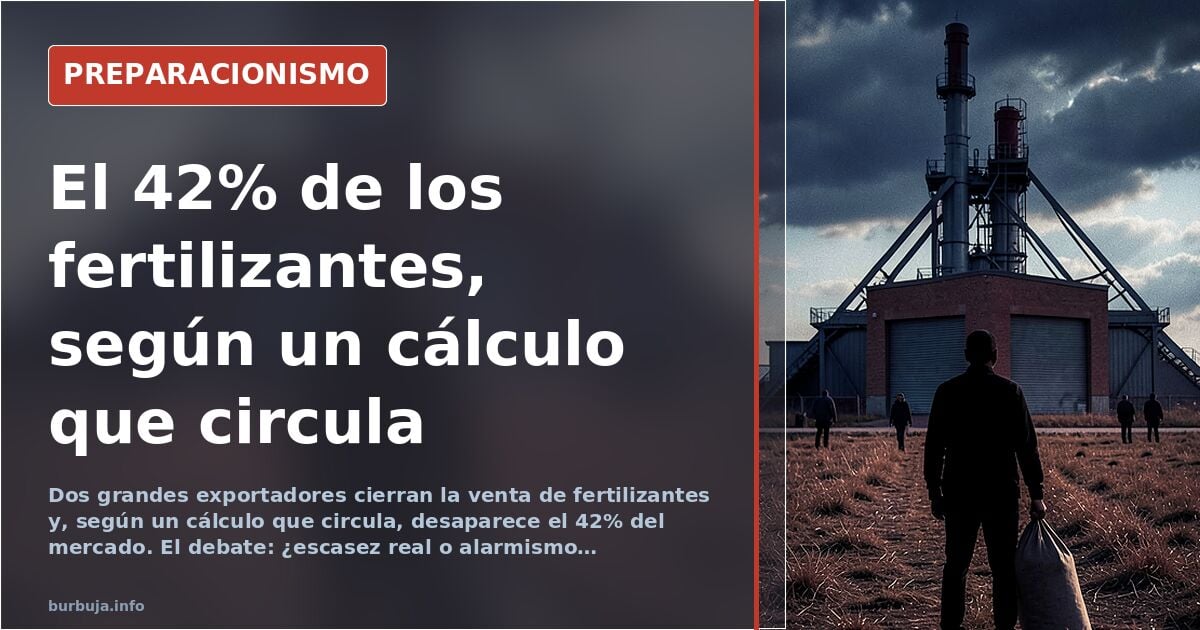
42% of the world's fertilizer gone from the market
Two of the planet's biggest fertilizer exporters have shut down their foreign sales. Adding Qatar to the mix, the estimate making the rounds is that 42% of these inputs vanished from the market overnight. No fertilizer means no harvest; no harvest means food shortages stop being a disaster movie and become a hypothesis people openly debate. The question hanging over all this is not whether there will be scarcity, but how much of what's being said is analysis and how much is just the latest episode of recycled alarmism.
Lagarde's remarks and the export ban
The strongest argument doesn't come from a YouTuber. It comes from Christine Lagarde, president of the European Central Bank, who, according to the discussion, warned of a "genuine shock" likely to go "beyond what we can imagine right now." That is the institutional anchor of the story. The second is the fertilizer export ban by the two largest sellers worldwide, plus Qatar: 42% of the market evaporated, according to the circulating estimate.
Some argue the chain is mechanical: less fertilizer, less agricultural output, less food on the shelves. Others reply that we've been hearing the same thing every five years, with Ukraine's food crisis as a recent precedent, and that back then "absolutely ing nothing peine." Both things can be true at once, which is what makes this so uncomfortable.
Why debate whether there are shortages if fertilizer is already scarce?
Because a supply crunch isn't a switch. The scenario being discussed is not sudden collapse but sustained price increases and the selective disappearance of products. There are already reports of fertilizer plants shut down in Asia and countries imposing fuel rationing. It's not famine: it's that the grocery bill keeps climbing and some items become hard to find.
Distrust of the messenger does the rest. The discussion spends more ink arguing about the pundit's looks and track record than checking the fertilizer data. A classic: staring at the finger instead of the moon.
From two weeks of stockpiles to a shotgun at the door
Here the discussion splits in two. A few point out that anyone who claims to be prepared but has only bought two weeks of food isn't prepared for anything. Others boast about their pantry, knowing how to hunt, fish and forage wild greens, a sturdy bicycle and knowledge that never runs out. And a third camp, the most uncomfortable one, admits their plan is simply taking what others have.
The response to that camp is the sharpest part of the exchange: anyone who breaks into someone else's home without knowing whether a shotgun awaits them inside is gambling heads or tails every time they need to eat. The full breakdown of why looting as a strategy has diminishing returns could fill an entire manual.
The Ukraine precedent and the underlying skepticism
The counterweight comes from the other side: the food crisis announced with the war in Ukraine, the 2022 headlines warning of millions starving to death, and a result that, in this reading, amounted to "very little." The argument goes that the third world is still working for a bowl of rice and no mobs are seen fighting over a scrap of bread. The conclusion of that camp: nothing will happen, just like nothing peine before.
The nuance that breaks the symmetry: past crises being overblown doesn't guarantee this one is. The mechanism is different. Before, the problem was the grain; now it's the input that produces the grain.
What remains is the domestic scene: the corner grocery store with a full pantry and the overweight neighbor as a protein reserve in the blackest of humor. And the question nobody closes: if 42% of the fertilizer is no longer on the market, how long before it shows up in the price of bread?
Also available in: Deutsch
Summary of a discussion on Burbuja.info - Foro de economía, actualidad y política., translated from Spanish and reviewed before publication. Read the full discussion (59 replies).
More summaries
-
Spain Prepper Debate Over Three-Week Blackout Rumor
Rumors of a three-week blackout divide Spaniards between armed preppers and skeptics. Analysis of the phenomenon.
-
Invega Hafyera: the six-month injection reigniting the psychiatric debate
Invega Hafyera, the Johnson & Johnson injection that works for six months with no antidote, reopens the debate between psychiatric treatment and forced chemical restraint
-
Spanish prepper Javier Azurmendi updates his index and defends saving with batteries
Javier Azurmendi publishes his prepping index with over one hundred entries and defends saving 100 euros a month with batteries
-
The prepper who says he's ready to kill: 'as soon as it's legal'
A debate on extreme prepping puts the spotlight on ethics: who would actually be willing to kill in a collapse, and who merely says they would?
-
Turning a phone into an emergency or TEOTWAWKI device
A rugged phone with a microSD card can hold offline maps, the full Wikipedia via Kiwix (around 40 GB) and first aid manuals. Here's what to load onto it.
-
Faraday cage for your phone: from tin foil to the microwave
Cases from €5.50 to €12, aluminium foil and old microwaves: what actually blocks a phone signal and what is just an emergency makeshift fix