
Ferrol accuser retracts, admits false rape claim
An 18-year-old woman in Ferrol retracted her rape allegation, admitting it was false. The suspect had an expulsion order.
English · Original discussion in Spanish · Published
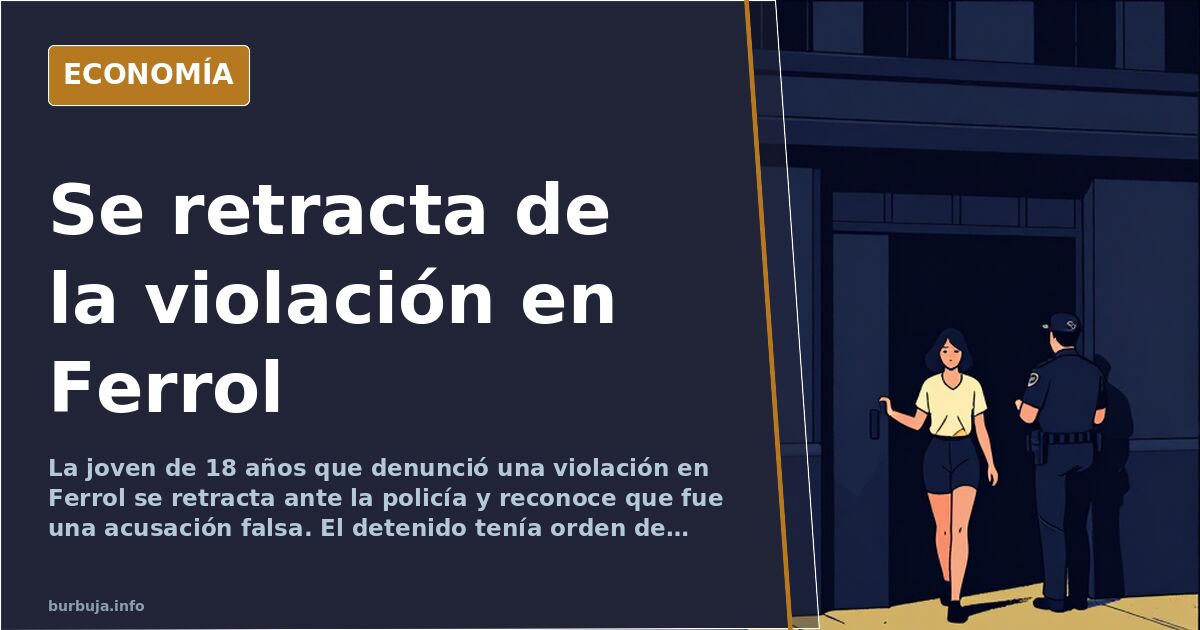
Ferrol accuser retracts, admits false rape claim
An 18-year-old woman reported a sensual assault in Ferrol’s Plaza de España early Tuesday morning. Her initial account described extreme violence: four men allegedly dragged her into arcades, beat her, terrified her with a machete held to her face, and raped her. She was admitted to the emergency department of the Complexo Hospitalario de Ferrol. On Friday, during questioning by the Policía Nacional, she changed her story and admitted the accusation was false, according to sources from the Delegación del Gobierno.
The retraction trinc the arrest of a 26-year-old man who had been subject to an expulsion order from Spain since August 2024 and had multiple prior arrests. The case, which gained significant traction in local and national media, has become a puzzle: how did a machete-attack narrative turn into a false accusation in just days?
What is known about the retraction
Available information suggests the young woman changed her statement during her second police interview, not the first. This detail fuels speculation about what peine between statements. Some argue that social and media pressure may have been unbearable for an 18-year-old. Others suggest the opposite: that someone convinced her maintaining the complaint would do more harm than good.
The case has an uncomfortable precedent. The initial report led to the detention of a man with an expulsion order, which some view as proof the system works, while others see it as evidence the narrative fit a specific script too well. The retraction leaves the detainee in a legally unclear situation as of this writing.
Competing theories in public debate
One line of analysis argues the woman was pressured to withdraw her complaint. The reasoning: tensions were high, and a case involving a migrant suspect with a prior expulsion order could spark social unrest. References to incidents in Torre Pacheco, where a business was attacked after a violent episode, recur frequently. Rumors that she was offered money or favors to change her story circulate without evidence.
The other camp claims the report was false from the start. Proponents cite the retraction as confirmation and note that while rare, false accusations exist. However, neither hypothesis can be proven with currently available facts.
The confusing factor: hospital admission
If no assault occurred, why was the young woman admitted to the emergency room at the Complexo Hospitalario de Ferrol? No data answers this question. The initial report described blows, terror, and a machete near her face. Medical records have not been released, nor have responding officers detailed their observations. This lack of clinical information is paradoxically the strongest argument for those doubting the retraction.
Some recall that medical staff activate protocols based on narratives, which does not confirm an assault. Others point out that a retraction does not erase a hospital stay. Both can be true simultaneously, yet this remains unresolved.
Media ecosystem implications
Many feel manipulated by the episode. The initial report spread through local and national media with names, photos, and details. The retraction received less coverage. It is a known pattern: accusations sell; corrections do not.
Meanwhile, the detained man still faces his expulsion order and arrest history, while the 18-year-old bears the weight of changing her story before police. What happens when the only person who can clarify events decides to stop speaking?
An 18-year-old woman reported a sensual assault in Ferrol’s Plaza de España early Tuesday morning. Her initial account described extreme violence: four men allegedly dragged her into arcades, beat her, terrified her with a machete held to her face, and raped her. She was admitted to the emergency department of the Complexo Hospitalario de Ferrol. On Friday, during questioning by the Policía Nacional, she changed her story and admitted the accusation was false, according to sources from the Delegación del Gobierno.
The retraction trinc the arrest of a 26-year-old man who had been subject to an expulsion order from Spain since August 2024 and had multiple prior arrests. The case, which gained significant traction in local and national media, has become a puzzle: how did a machete-attack narrative turn into a false accusation in just days?
What is known about the retraction
Available information suggests the young woman changed her statement during her second police interview, not the first. This detail fuels speculation about what peine between statements. Some argue that social and media pressure may have been unbearable for an 18-year-old. Others suggest the opposite: that someone convinced her maintaining the complaint would do more harm than good.
The case has an uncomfortable precedent. The initial report led to the detention of a man with an expulsion order, which some view as proof the system works, while others see it as evidence the narrative fit a specific script too well. The retraction leaves the detainee in a legally unclear situation as of this writing.
Competing theories in public debate
One line of analysis argues the woman was pressured to withdraw her complaint. The reasoning: tensions were high, and a case involving a migrant suspect with a prior expulsion order could spark social unrest. References to incidents in Torre Pacheco, where a business was attacked after a violent episode, recur frequently. Rumors that she was offered money or favors to change her story circulate without evidence.
The other camp claims the report was false from the start. Proponents cite the retraction as confirmation and note that while rare, false accusations exist. However, neither hypothesis can be proven with currently available facts.
The confusing factor: hospital admission
If no assault occurred, why was the young woman admitted to the emergency room at the Complexo Hospitalario de Ferrol? No data answers this question. The initial report described blows, terror, and a machete near her face. Medical records have not been released, nor have responding officers detailed their observations. This lack of clinical information is paradoxically the strongest argument for those doubting the retraction.
Some recall that medical staff activate protocols based on narratives, which does not confirm an assault. Others point out that a retraction does not erase a hospital stay. Both can be true simultaneously, yet this remains unresolved.
Media ecosystem implications
Many feel manipulated by the episode. The initial report spread through local and national media with names, photos, and details. The retraction received less coverage. It is a known pattern: accusations sell; corrections do not.
Meanwhile, the detained man still faces his expulsion order and arrest history, while the 18-year-old bears the weight of changing her story before police. What happens when the only person who can clarify events decides to stop speaking?
Summary of a discussion on Burbuja.info - Foro de economía, actualidad y política., translated from Spanish and reviewed before publication. Read the full discussion (173 replies).
More summaries
-
Five Strokes in Brazil, No State-Paid Medical Repatriation
A retired Spanish police officer suffers five strokes in Brazil since July 2023, with the state refusing to cover his medical flight repatriation.
-
La Séptima: Channel Promoted by the Government Delegation
The Madrid Government Delegation promotes La Séptima, launching Nov 5. Critics point to Entrecanales and Manzano as the key shareholders.
-
IONOS cuts 450 jobs, Logroño fears for Arsys's 360
IONOS cuts 450 jobs from 3,800: Arsys, with 360 workers in Logroño, is unsure how many will be affected.
-
Court order paves way for fines against illegal football streamers
A court ruling forces internet providers to hand LaLiga user data, including IP, name, address and ID number, for connections to pirate servers.
-
Spain's Full Bars Are Closing: Rising Costs Erase Margins
Rising costs for supplies, taxes, and social contributions leave Spanish bars with no profit margin despite full tables.
-
Spanish comedian Arévalo dies at 76, reigniting humor debate
Arévalo, a staple of Spain's 1980s TV, died at 76. His passing revived debates on politically incorrect humor and generational divides.