
Female truck drivers: why the '3 PM finish' claim is unrealistic
The narrative of office-style hours for female drivers clashes with reality: 9 hours of driving, 15 hours of availability, and salaries starting at €1,100.
English · Original discussion in Spanish · Published
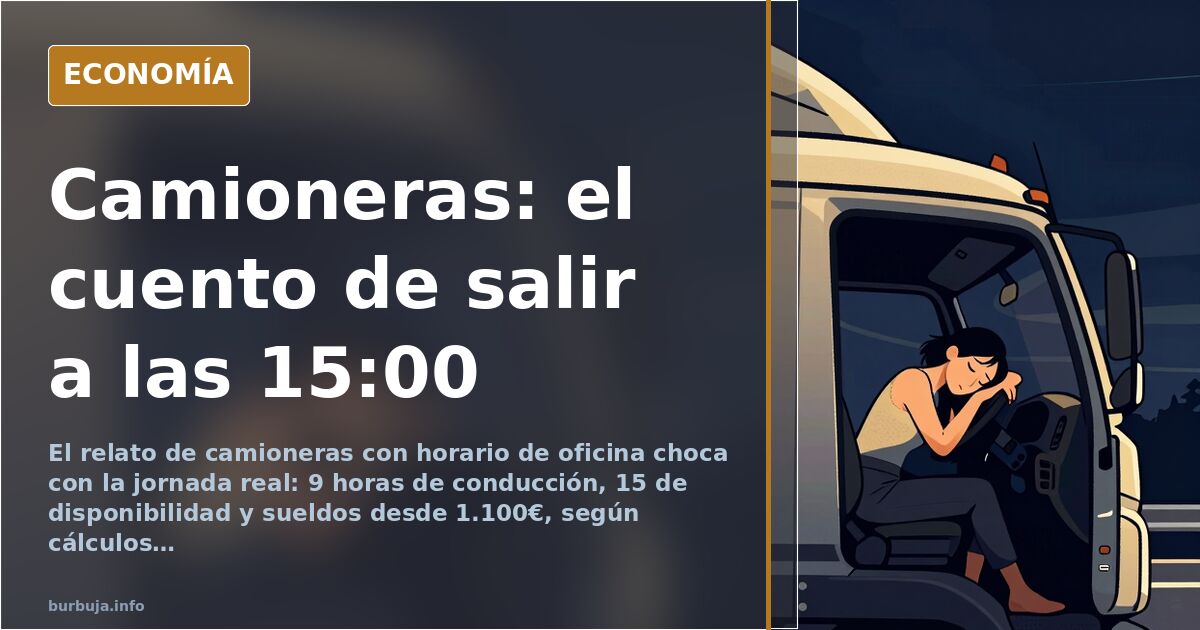
Female truck drivers and the 3 PM myth: the reality of the job
Can you really drive a truck and be home by 3:00 PM? That is the hook used in recent narratives promoting women's entry into the freight transport sector: "I have no one breathing down my neck, and at 3:00 PM, I'm done." This phrase, attributed to a driver, has sparked a storm of criticism from industry insiders. The consensus, with nuances, is that there is no such thing as a 9-to-5 schedule on the road.
The first sustancia ilegal appears in the actual working day. According to calculations circulating among drivers, European regulations allow nine hours of daily driving, extendable to ten twice a week, but availability—from the moment the tachograph card is inserted until it is removed—stretches to fifteen hours. You aren't driving the whole time; you are waiting. Two-hour loading times, endless unloading, and queues at factories and warehouses where the driver is always last in line. The result, according to these calculations, is a workday that rarely falls below ten hours and frequently exceeds it.
How much do female truck drivers in Spain actually earn?
The base salary in the sector is around €1,100, and anything above that comes via delivery commissions, according to some drivers. Under this scheme, someone completing only half a delivery a day stays at the minimum. Some point to ranges of €1,200-€1,300 for profiles with easy routes, while others argue that a driver with high billing can earn between €1,600 and €2,000 or more. The range is so wide that any generalization is misleading.
This leads to the most uncomfortable argument: if companies want to attract women to the wheel, why not raise wages instead of selling impossible schedules? There is a suspicion among critics that these promotional stories serve to fill driving school classrooms—rather than solving the driver shortage. This is not unlikely: the truck license and the CAP (Certificate of Professional Competence) are not cheap, and someone has to pay for them.
The problems omitted from the narrative
The list of what is left out is long and consistent across most accounts. Traffic jams, breakdowns, four-hour waits to load, pressure to meet deadlines, and sleeping wherever necessary. Driving is the easy part; the job is everything else. One driver summarizes it bluntly: driving is not availability, and availability is squeezed until the very last minute.
There are also those who remind us that there have always been female truck drivers, though often in smaller vehicles, and that the problem is not gender but a sugarcoated narrative. Reversing a trailer in an L-shaped junction is no joke: it requires maneuvers learned over years. Reducing the profession to "half an hour a day and then home" is a complete fabrication.
Freedom: both an attraction and a trap
There is a current that champions the real appeal of the job: freedom. No boss over your shoulder, no office colleagues, with the road as your office. It is a seductive argument that explains why many people continue to climb into a truck. But that freedom comes at a price: social life unravels, relationships suffer, and diets are improvised at service areas.
The most honest portrait of the sector includes warnings that don't fit in a promotional brochure: stress tolerance, the ability to sleep anywhere, tolerance for solitude, and, if you have a family, a partner who understands. Without those, the probationary period is an uphill battle. With them, the job makes sense.
When reality sets in
Those who know the trade predict that many of the newly recruited women will not survive the first clash with reality. Not due to a lack of ability, but because the showcase showed something else entirely. Turnover in freight transport is high, and the driver shortage is structural across Europe. Attracting talent with fictitious schedules is the fastest way to burn them out.
The question left hanging is not whether women can drive trucks. They can, and some have been doing it for decades. The question is whether the sector wants to solve its problem with better wages and conditions, or with brochures. For now, the brochure is winning.
Also available in: Deutsch
Summary of a discussion on Burbuja.info - Foro de economía, actualidad y política., translated from Spanish and reviewed before publication. Read the full discussion (101 replies).
More summaries
-
Sweden: 70% of non-European vote and 60% female support went to the left
In Sweden, 70% of non-European origin votes went to the left, and nearly 60% of women did too. The tie is decided by tenths.
-
EU 3.5% threshold rule unimplemented in Spain
An EU Council regulation sets a 3.5% threshold for large constituencies, but Spain has not transposed it despite mandates being issued.
-
Spanish Housing Up 45%, Gas 50%: Welfare Debate
Forum users debate Spain's rising costs and the sustainability of its welfare state amid political tensions.
-
The right and the pensions elephant: promises without numbers
An analysis argues that Spain's pension system is already being propped up by debt and that the right promises to pay pensions without saying how. The electoral dilemma nobody wants to face.
-
Do you have to send a burofax to your tenant to end a rental contract in Spain?
Is a burofax required to notify the end of a rental contract in Spain? We look at the legal requirements, deadlines and risks for landlords and tenants.
-
You have to pick one of these three sisters
Virgin erotic model, secret prostitute, or bestialist? The triplets dilemma pits moral values against practical risks. Discover the arguments.