
Feijóo’s photo with drug trafficker Dorado resurfaces in Spain's election
Photos of Feijóo with Marcial Dorado, published in 2013, reappear during the July 23 campaign and hit international headlines.
English · Original discussion in Spanish · Published
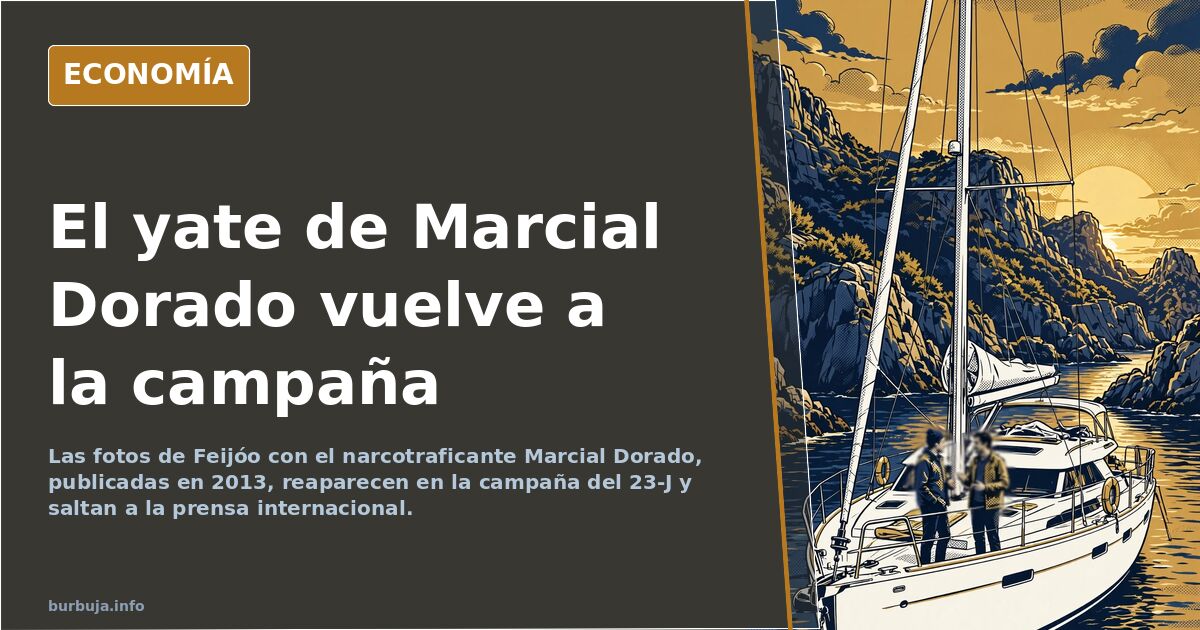
Yacht photo with Marcial Dorado returns mid-campaign
A yacht, two men sunbathing, and nearly three decades of silence. The image of Alberto Núñez Feijóo alongside Galician drug trafficker Marcial Dorado, published by El País in 2013, has circulated widely again during the July 23 electoral contest, when the People’s Party leader was polling as favorite and the left desperately sought a scandal to exploit. The issue crossed borders: international media reported on the conservative candidate’s «links to drug trafficking», while Sumar’s Yolanda Díaz used it as rally ammunition.
What is known about the relationship between Feijóo and Marcial Dorado
For years, Feijóo claimed he only knew Dorado casually. This version held up poorly. Spanish media documented that both traveled together to Ibiza, the Canary Islands, Portugal, and Andorra—a classic money-laundering territory—in the late 90s and early 2000s, when Feijóo already presided over the Xunta de Galicia (Galician regional government). Dorado, born in Cambados in 1950, started as a speedboat pilot for smuggler Vicente Otero «Terito» and ended up accumulating gas stations, wineries, and land. In 2003, he was arrested under orders from judge José Antonio Vázquez Taín.
The episode is not new. It dates back more than a decade. Here lies the paradox confusing allies and critics alike: a photo from almost thirty years ago that hasn’t shifted a single vote in Galicia yet reappears every time Feijóo climbs a rung.
Electoral calculation: why it is revived now
The arithmetic is simple. If polls are right, the PP will be the most voted force, and Feijóo will need Vox to govern. This scenario worries part of the electorate who sees Abascal’s party as an uncomfortable partner. The lingering question isn’t whether Feijóo was friends with a traficante—anyone reading press in 2013 knew that—but whether this material still serves to block an investiture.
Some argue friendship with Dorado is a sarracena burden disqualifying anyone from leading the government. Others counter that the PSOE carries its own scandals—the case of former deputy Juan Bernardo Fuentes, known as «Tito Berni», and the controversy over the «only yes means yes» law—and digging through archives is hypocritical. The debate has become an exchange of files: each side waves their folder hoping the other tires first.
From archives to rallies: chronology of a return
The story has three acts. First, 2013: El País publishes photos, Feijóo minimizes them. Second, trinc years: Galician press dismantles the casual friendship narrative with shared trips and stays. Third, the July 23 campaign: Yolanda Díaz challenges Feijóo to a debate to «tell Spaniards about his relationship with drug trafficking», and the topic jumps to foreign media.
The reaction among average PP voters has largely been a shrug. The photo is old, the trafficker is in prison, and the candidate hasn’t been charged with anything related to Dorado. But repetition has a cost: each time the issue resurfaces, it forces Feijóo to spend a campaign day explaining the same thing.
What defenders and attackers say
The most repeated defense is that Dorado was just another Galician businessman in an environment where smuggling was integrated into social life. The most repeated accusation is that Feijóo cannot present himself as corruption’s scourge after vacationing with someone laundering money. Between these extremes, a pragmatic current notes the real problem isn’t the yacht but management: according to critics, Galicia’s debt tripled during his term, and his public health law faced pushback from medical groups.
The result is a stalemate. Each side has its folder. Each folder has its photo. Meanwhile, voters watch the calendar.
Does rescuing a thirty-year-old friendship matter when what’s decided is who manages the next economic cycle?
Also available in: Deutsch
Summary of a discussion on Burbuja.info - Foro de economía, actualidad y política., translated from Spanish and reviewed before publication. Read the full discussion (109 replies).
More summaries
-
Jesús Cintora's gossipy take on the Feijóo and Marcial Dorado photo is pure mockery
An analysis of the recurring appearance of the Feijóo and Marcial Dorado photo on Spanish television and the exhaustion of political narratives in today's media.
-
Spain's PP rules out bringing back the 'sun tax'
Alberto Nadal, the PP's deputy secretary for the Economy, stated in 2026 that the party is dropping the so-called sun tax and instead proposes scrapping the 7% levy on electricity generation.
-
Feijóo-Dorado photo: Timeline clash with drug conviction
The 1995 Feijóo-Dorado photo predates the 2003 drug conviction. An eight-year gap fuels a political dispute over labels.
-
Mari Carmen Case: €158 Rent and Media Eviction in Madrid
A €158 monthly rent in central Madrid contrasts with €2,400 units in the same building, sparking a TV controversy.
-
Maricarmen, a former property and rental company executive, faces eviction
Maricarmen, the face of Spain's eviction debate, was the sole administrator of rental companies, according to the companies register. The narrative is falling apart.
-
Home buyer's guide: the costs nobody tells you about
Taxes when buying, owning, selling and inheriting, 10% deposits, insurance tied to the mortgage and property tax as a value benchmark: the fine print of buying a home.