
Feijóo: "You can't lead Spain without understanding Catalonia"
Feijóo says no one can govern Spain without understanding Catalonia. Part of his electorate reads it as a wink to Junts and recalls Aznar's shift towards...
English · Original discussion in Spanish · Published
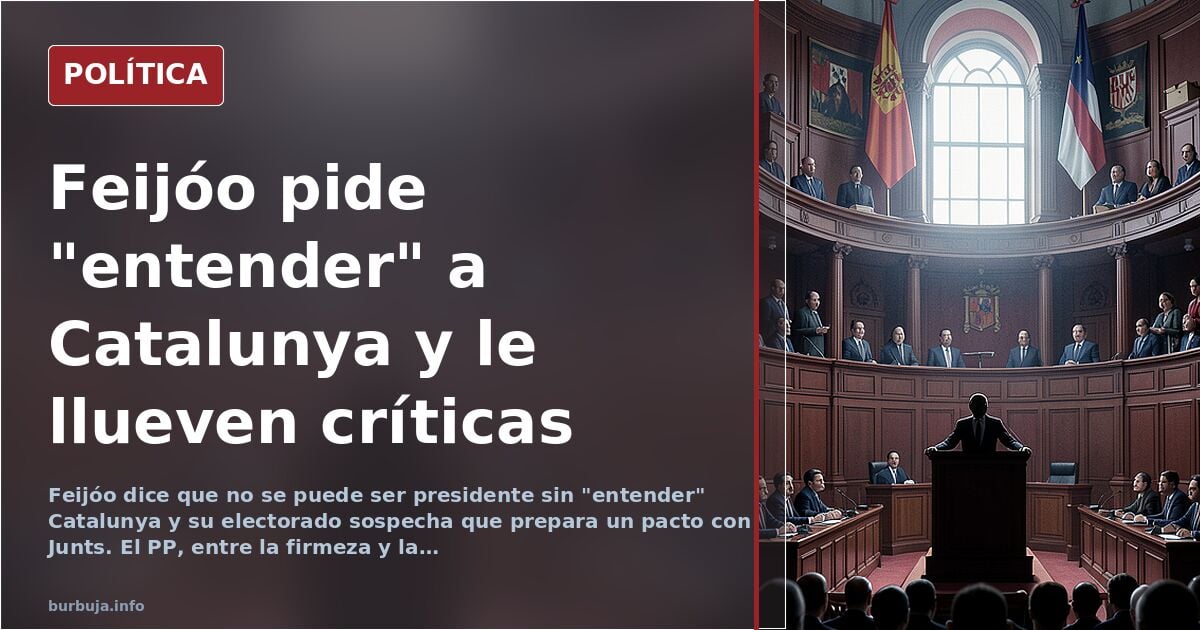
Feijóo says no one can govern Spain without understanding Catalonia
"You can't be president of Spain without understanding Catalonia." The remark, attributed to Alberto Núñez Feijóo, has peine the debate about the PP (Spain's conservative People's Party) and its relationship with Catalan nationalists. According to some participants in the discussion, the statement comes as polls give the right a comfortable majority, and yet the Popular Party leader insists on building bridges to the Catalan electorate. The gesture carries an immediate cost: part of his own political base reads it as a free concession.
What Feijóo said and why it sparks internal backlash
The argument attributed to the PP leader is that governing Spain requires understanding the Catalan reality, not just managing it from a distance. It is an institutional thesis that, on paper, sounds reasonable. The problem is the track record. Some recall that Aznar already did the same: he courted Jordi Pujol, sacrificed Vidal-Quadras, and the rest, they say, is history. The underlying suspicion is that the PP uses the rhetoric of understanding as a cover to strike a deal with Junts if the numbers demand it.
That reading is not marginal. Part of the conservative electorate holds that the PP would rather make deals with Junts, PNV, UPN and the Canary Island parties than with Vox, because it prefers peripheral forces to centralizing ones. It is the same logic that, according to these critics, led Feijóo to attempt an investiture with scattered support. The result, for his critics, is a party riddled with insecurity that sabotages itself.
The PP and Junts: what the numbers and the polls say
The contradiction that stings most within the Popular Party's camp is arithmetic. According to a calculation circulating in the discussion, if polls give the right nearly 350 seats between the PP and Vox, there is no need to look to Junts to govern. The question is whether Feijóo wants to avoid depending on the far right. There lies the knot: refusing to strike a deal with Vox would push the PP towards partners it had turned into adversaries during the campaign.
The most optimistic calculation for the PP assumes it can govern alone or with ad hoc support. The pessimistic scenario starts from the premise that any majority requires negotiating with pro-independence forces. And on that ground, the party's history works against it: el capón gallego, as its detractors call him, has a fruta for shifting with the wind.
The Feijóo style: management versus narrative
Feijóo presents himself as a manager, not an ideologue. That is both his strength and his curse. When he talks about understanding Catalonia, he speaks in administrative terms, not of political concessions. But in a party where part of the electorate demands identity-driven firmness, every nod to the Catalans is read as weakness. The remark about not forcing vaccination but fining those who refuse it —which his critics cite as an example of his style— sums up the method: effective measures in friendly wrapping.
The problem is that the wrapping no longer convinces everyone. Some outright doubt that Feijóo even wants to be president, attributing it to a lack of real ambition. Others believe he is simply playing both sides and that time will prove him right.
Where the analysis gets stuck
The question is not whether Feijóo understands Catalonia. It is whether his party lets him prove it without charging him the price in votes. With a right divided between firmness and management, every statement becomes an internal test. And for now, the test has no final grade.
Also available in: Deutsch
Summary of a discussion on Burbuja.info - Foro de economía, actualidad y política., translated from Spanish and reviewed before publication. Read the full discussion (16 replies).
More summaries
-
Aznar's comeback: the Spanish PP's nostalgia in the 2008 crisis
As the 2008 crisis hit Spain, debate resurfaced over whether José María Aznar should return. His record, the housing bubble and the 11M bombings clash in a no-holds-barred analysis.
-
Aznar: the legacy that still divides Spain
José María Aznar stirs controversy again: immigration, privatizations, the euro and the Iraq war. A legacy that continues to divide Spanish public opinion.
-
PP-Vox coalition: predicted tax hikes and pension freezes
Speculation on a PP-Vox government includes audits, spending cuts, higher VAT, lower IRPF, and frozen pensions.
-
Spain's Union of Fighting Parties Proposes Electoral Strategy Protocol
The Spanish party Unión de Partidos Luchadores replaces policy promises with decision-making checklists to define rivals and allies.
-
Spain shifts €105M from public transport to youth summer program
Spain's Transport Ministry reallocated €105 million meant for regional and local public transport subsidies to fund the Verano Joven initiative.
-
Spain: Former Sánchez Driver Arrested in Corruption Probe
Spain's UCO police arrested Pedro Sánchez's former driver and searched José Luis Ábalos' home over alleged public works rigging.