
Feijóo picks Cayetana Álvarez de Toledo as his number two
Alberto Núñez Feijóo confirms Cayetana Álvarez de Toledo as his number two in Spain, and the appointment sparks debate over spending cuts, pensions and the middle-class vote.
English · Original discussion in Spanish · Published
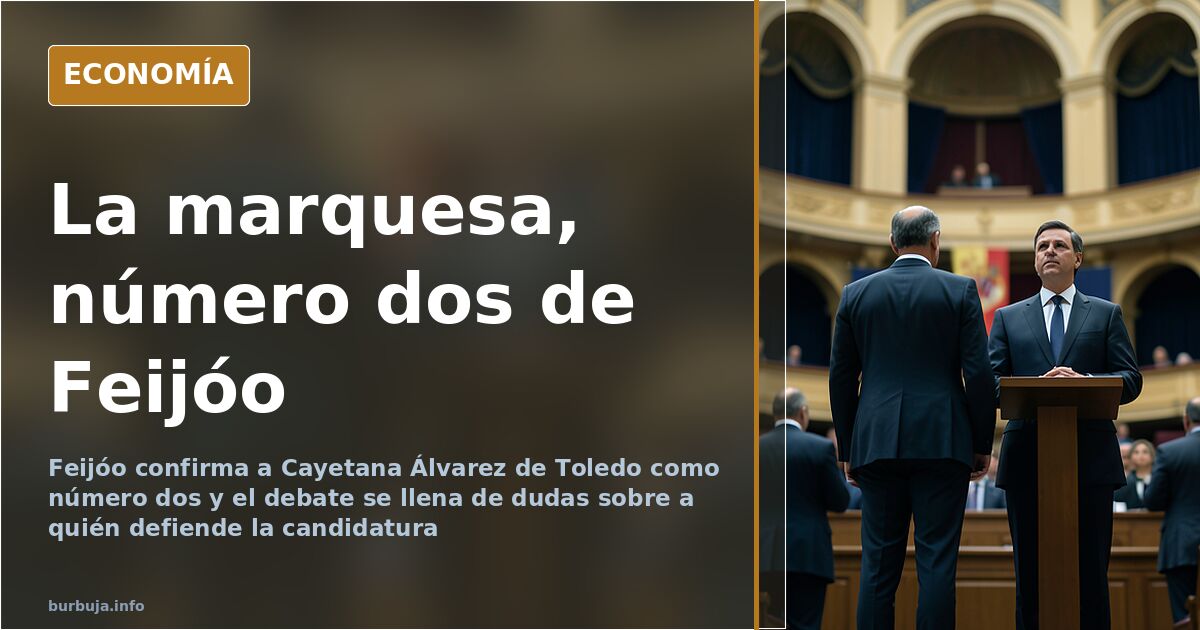
Feijóo picks Cayetana Álvarez de Toledo as his number two
The news broke in the morning and the echo has not stopped: Alberto Núñez Feijóo confirms Cayetana Álvarez de Toledo as number two on his slate. The announcement, released by El Mundo's account and immediately echoed by minister Óscar Puente with an ironic message —"The salaried worker, the sucker, the one who will truly defend him is the marchioness"— has lit up the day's economic conversation. This is no ordinary appointment. It is the signal many were waiting for to decide their vote, and the one others read as a miscalculation.
The move has both an electoral and an economic reading. The number two carries a track record of statements about cutting holidays and pensions that the opposition has no intention of letting slide. And in a context where groceries, energy bills and access to housing set the pulse of the middle-class voter, placing a profile of that kind in the second spot triggers an immediate short circuit.
The profile that sets off every alarm
The designation is not neutral. For part of the electorate, the number two represents exactly the opposite of what a country with inflation biting into wages needs. Some argue the choice is the Popular Party's slow-motion suicide, while others believe it is the final push to get out and vote. The conversation has polarized within hours.
The detail about her neck —turned into a meme and an easy joke— has served to divert attention from what matters: which economic policy the number two defends. Because behind the character lies the program. And the program, according to those who have trinc her career, includes cuts to holidays, pensions and labor rights.
The calculation nobody has denied
The numbers circulating in the debate are telling. A worker with a paycheck knows that income tax brackets have not been adjusted for inflation in eight years. They know that Social Security contributions have gone up. They know that electricity piles taxes on top of taxes. And they know that property tax or water bills have become a silent rip-off. Against that backdrop, having the Popular Party place in the number two spot a profile who promises more cuts does not seem like the best card to play.
Some argue the opposite: that the country needs an adjustment and that the number two is the only one with the nerve to say so. The debate is served. And underneath lies the question nobody answers: cut what, and for whom?
The coming crisis and the narrative of sacrifice
Minister Puente has struck again with another message: "The sacrifice they want to bring us," accompanied by a news item about the economic crisis in Chile and austerity policies. The connection is no coincidence. The narrative of sacrifice has taken hold in the conversation as the campaign's framing.
Meanwhile, employment and public spending figures still do not match the official discourse. The number two has denied nothing. And the electorate, which has already lived through eight years of broken promises, regards any new announcement with suspicion.
The appointment is done. The campaign is underway. And the middle-class voter —the one who pays the electricity bill, the mortgage and the groceries— is still waiting for someone to explain why the marchioness is the right person to defend them.
Also available in: Deutsch
Summary of a discussion on Burbuja.info - Foro de economía, actualidad y política., translated from Spanish and reviewed before publication. Read the full discussion (117 replies).
More summaries
-
Rental listings pulled from Idealista within 24 hours after call to action
Landlords remove their flats from Idealista in 24 hours: 80% of housing is in the hands of small owners, according to circulating estimates
-
The 90-day payment terms nobody factored into the price
A client accepts the quote on a Thursday and work starts on Monday, but the invoice is paid at 90 days. The collection period is also part of the price.
-
Mortgage life insurance in Spain: when the bank can require it and when it's optional
Spain's Law 5/2019 bans banks from making a mortgage conditional on taking out their insurance. They can discount the rate, but it pays to compare the real cost.
-
Medical cannabis arrives in Spanish hospitals
Curaleaf will supply CAN-1 and CAN-2 to around 50 clinics this week. Four approved indications and a specialist prescription are required to access the treatment.
-
Euribor: how your payment is recalculated at your variable-rate mortgage review
The 12-month Euribor plus your fixed margin sets the new rate at each annual review. Here's how the payment is recalculated using the outstanding balance and remaining term.
-
Work for food and housing, or benefits just to get by? Argentines debate
A viral tweet shows a woman saying people used to steal but she ate, and now she has to work. The debate over welfare and effort is back on the table.