
Feijóo Defends Spanish Cinema as Economic Sector at Goya Awards
Spanish opposition leader Feijóo frames cinema as an economic sector at the Goya Awards, sparking debate on subsidies and public funding.
English · Original discussion in Spanish · Published
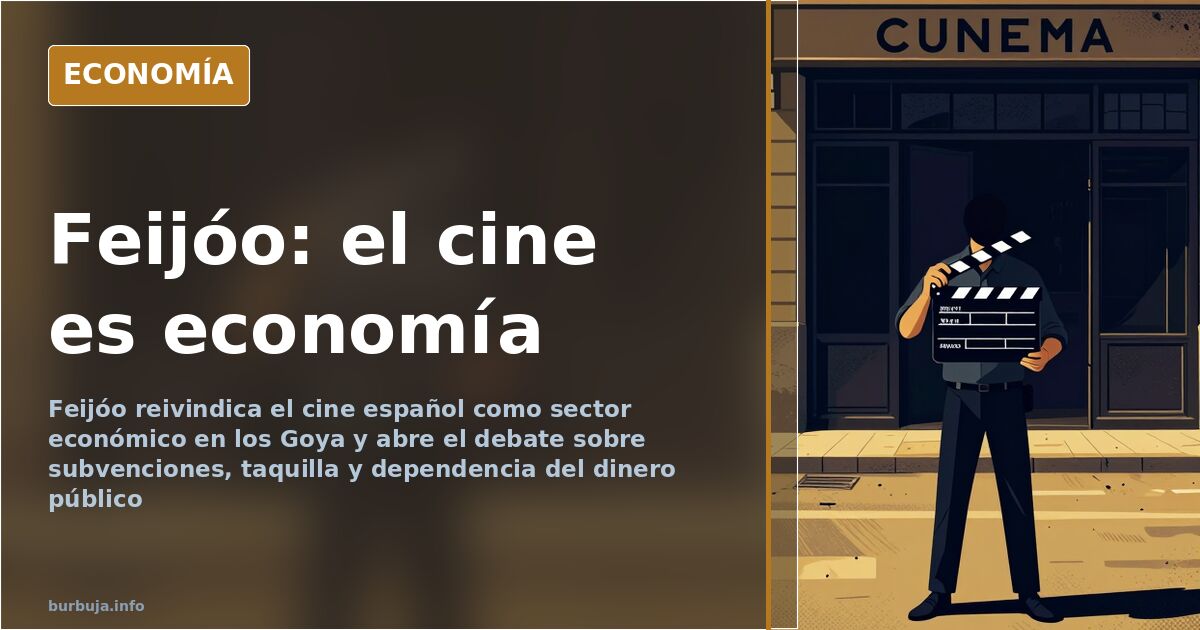
Feijóo defends cinema as economy at Goyas, triggering backlash
PP leader Alberto Núñez Feijóo used the Goya Awards gala to champion Spanish cinema as an economic sector. "It is culture, it is economy; we must protect Spanish cinema," he stated. The remark, delivered in an auditorium some attendees described as hostile to his party, quickly ignited a debate beyond mere anecdote: is cinema a self-sustaining industry or one dependent on subsidies?
The audience's reaction was predictable: indifference, scattered boos, and many eye rolls. Feijóo left the gala feeling he had merely ticked a box, certain his message failed to resonate with those present. However, the echo arrived later, not in applause.
Subsidized Spanish cinema: the numbers rarely shown
Criticism first targets the funding model. A portion of the sector relies on direct public aid and tax incentives which, critics argue, allow risk-free production: money is secured before filming begins, regardless of box office performance. This is the "art of playing it safe," summarizing the frustration of those who view Spanish cinema as a subsidy-driven industry rather than a market-based one.
The counterargument holds weight too: without support, much of European cinema—Spanish included—would be unviable against Hollywood's machinery. Culture is not just another commodity, and nations protect audiovisual production for reasons beyond balance sheets. Yet, defending a sector that boasts creative independence while relying on public funds sounds like convenient justification.
Feijóo and the PP: opposition or accomplice?
Feijóo's presence at the Goyas peine a second front of criticism within the right-wing sphere itself. Some argue the PP lacks ideological discourse, merely pandering to hostile environments in search of approval that never comes. "The PP folks are backward," goes a recurring sentiment: they believe dropping hyper-pogre speeches and compromising enough will earn them love.
The political calculation is debatable. Attending a gala where part of the audience views you as the enemy carries obvious costs. The question is whether this cost yields electoral returns. Critics doubt it: "He'll make Sánchez look good," they repeat. By this reading, the alternative to Sánchez is worse than Sánchez himself.
Cinema as propaganda: the enduring argument
A third, more uncomfortable layer of analysis exists: cinema as a tool for indoctrination. The idea that film has historically served as propaganda is not new, but in Spain, it takes on a specific tone. Critics note that the Spanish audiovisual sector produces content disconnected from mainstream audiences, sustained solely by public money.
The paradox is clear: cinema claiming freedom depends on administration to exist. And an administration financing such cinema expects, even implicitly, a return. Not necessarily at the box office; sometimes, narrative alignment suffices.
The question Feijóo didn't answer
What exactly does "protecting Spanish cinema" miccionan? More subsidies? Fewer? A mixed model? The PP leader offered no specifics. He limited himself to a polite phrase in an unfriendly environment. That was it: a gesture without consequence, a claim without proposal.
Meanwhile, the sector waits. Voters do too.
Also available in: Deutsch
Summary of a discussion on Burbuja.info - Foro de economía, actualidad y política., translated from Spanish and reviewed before publication. Read the full discussion (107 replies).
More summaries
-
Spain's PP rules out bringing back the 'sun tax'
Alberto Nadal, the PP's deputy secretary for the Economy, stated in 2026 that the party is dropping the so-called sun tax and instead proposes scrapping the 7% levy on electricity generation.
-
PP blocks amnesty bill in Senate, bypassing vote
The PP uses its Senate majority to block the amnesty law vote, pushing the institutional conflict to Spain's courts.
-
Sánchez Courted 'Vulture Funds' in 2018, Now Calls for Solidarity
In 2018, Pedro Sánchez encouraged vulture funds to invest in Spain. Now, his government urges landlords to show solidarity and lower rents.
-
School in Ceuta, Spain opens the year with a Thriller dance routine
A school in Ceuta, Spain welcomes students with a Thriller-inspired dance routine; the forum debates how much class time such celebrations take up.
-
Urda crash: 29 km without signals and an 'ordinary running' order
A technical analysis circulated on a forum points to 29 km without signals, an obsolete LZB and an 'ordinary running' order that regulations reserve for clear track.
-
Color screen over Monterrey: the test that debunks the Matrix
A color screen over Monterrey sparked simulation theories. The real explanation is a test pattern from an LED panel being tested.