
Feijóo announces 600 euros in aid for coeliacs
Feijóo promises coeliacs 600 euros for extra gluten-free costs. No deadline or criteria; pledge fuels debate over real cost and votes.
English · Original discussion in Spanish · Published
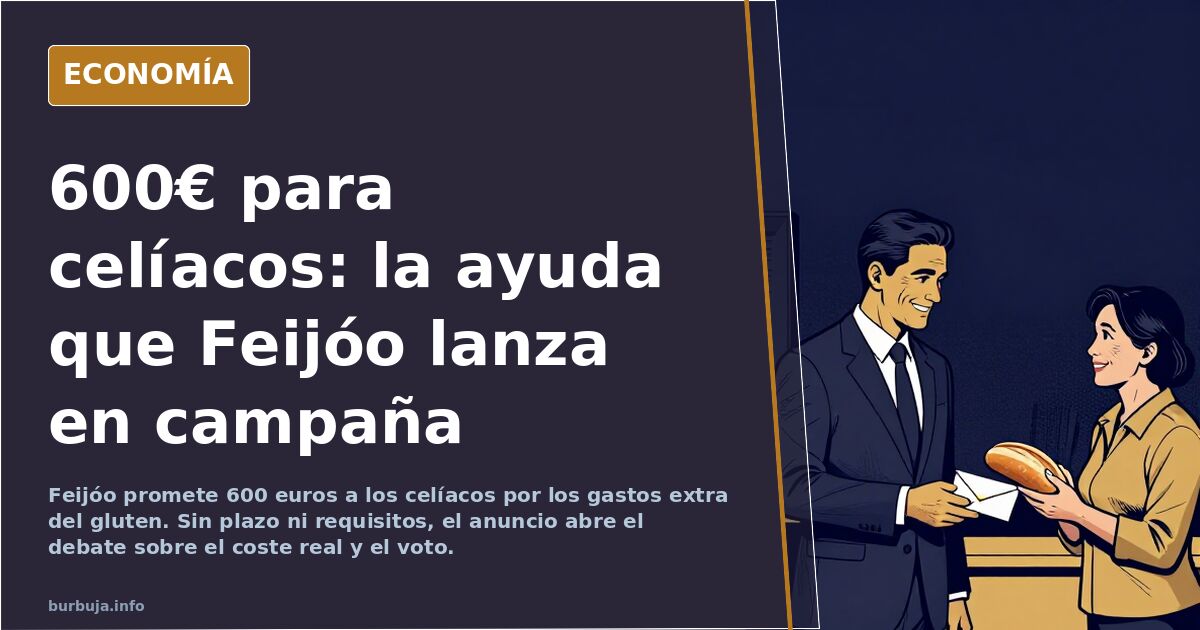
600 euros for coeliacs: the new aid Feijóo is putting on the campaign trail
Alberto Núñez Feijóo has promised 600 euros to offset the extra costs of coeliacs, and he did so on the social network X, with no deadline, no requirements, and no clarification on whether the payment is one-off or recurring. “We want to compensate coeliacs’ extra costs with 600 euros”, he wrote, ending with the slogan that “the change agenda is the agenda of real people.” In the shopping basket, the context is different: a gluten-free sliced bread costs around three euros and suitable biscuits are considerably more expensive than conventional ones.
600 euros a year or a month? The small print nobody has put in writing
This is where the problem begins. It is not known whether it is 600 euros a year, a month, or a one-off. Nor whether the aid is per person or per household, or what document must be submitted to claim it. Some assume it will be annual and require receipts: keep every supermarket receipt for twelve months and return the part that cannot be substantiated. And some read it as a campaign announcement destined to remain in the headline. Ambiguity, during an election period, rarely costs votes.
The real cost of eating gluten-free
The extra cost exists and can be seen in any supermarket. A gluten-free sliced bread starts at three euros; specialist biscuits and pastries are much the same, priced far above conventional products and with a taste that leaves something to be desired. However, the final amount depends on how each person eats. One school of thought holds that gluten-free does not have to be more expensive: eggs, ham, tuna, chicken, rice or simply fasting. Real, unprocessed food, cheaper than the industrial tray labelled suitable. The response from the other side is that giving up bread, pasta or biscuits for breakfast is not an option for everyone and that specialised products are expensive.
Cross-contamination: the cost no receipt can fix
There is a cost that does not show up at the till. A steak bought at a butcher's where meatballs or burgers prepared with breadcrumbs have been handled can be enough to ruin the afternoon. The same happens in a restaurant kitchen, with the same cutlery or the same griddle. That is why many coeliacs simply do not eat out. That extra cost is logistical and social, not a receipt, and no 600-euro compensation can cover it. When the problem is avoiding traces, reimbursement comes late and badly.
The war over aid: the PP (Partido Popular) finds its group
The political reading was immediate. Other parties already had their group: one had taken up rare diseases, another ALS. The PP was missing its own and has found it in coeliac disease. As one participant summarises, whoever starts paying ends up governing, and does so with other people's money. From that perspective, the announcement is not a social measure but another handout in a competition to see who gives out more. It has also been noted in the conversation that the Galician PP itself has for years handed out aid for extracurricular activities and smaller budget items, as proof that the subsidy culture does not care about party labels. The electoral calculation, in short, makes itself: ten thousand more coeliac voters, according to the calculation launched by one participant.
Diabetes, ALS, disability: the list of comparative grievances
The announcement has peine the catalogue of grievances. If there are 600 euros for gluten, why not for diabetes, where almost everything contains sugar? And for ALS, autism, Down syndrome or physical disability? And for those who need glasses or those who go bald? The list grows half-jokingly, half-seriously and, ultimately, points to the same thing: any aid granted to a specific group invites the next to ask for theirs. Without an explicit criterion for why some are chosen and not others, social policy becomes an auction.
A figure without the small print
The essential remains. If the announcement were a serious measure, it would come with an economic report, allocation criteria and a date it takes effect. There is none of that. Only a phrase on a social media site and a round figure. A sliced loaf still costs three euros, and anyone who wants toast for breakfast will still pay for it out of their own pocket. The question is not whether 600 euros helps. The question is how many people it helps and from when.
Alberto Núñez Feijóo has promised 600 euros to offset the extra costs of coeliacs, and he did so on the social network X, with no deadline, no requirements, and no clarification on whether the payment is one-off or recurring. “We want to compensate coeliacs’ extra costs with 600 euros”, he wrote, ending with the slogan that “the change agenda is the agenda of real people.” In the shopping basket, the context is different: a gluten-free sliced bread costs around three euros and suitable biscuits are considerably more expensive than conventional ones.
600 euros a year or a month? The small print nobody has put in writing
This is where the problem begins. It is not known whether it is 600 euros a year, a month, or a one-off. Nor whether the aid is per person or per household, or what document must be submitted to claim it. Some assume it will be annual and require receipts: keep every supermarket receipt for twelve months and return the part that cannot be substantiated. And some read it as a campaign announcement destined to remain in the headline. Ambiguity, during an election period, rarely costs votes.
The real cost of eating gluten-free
The extra cost exists and can be seen in any supermarket. A gluten-free sliced bread starts at three euros; specialist biscuits and pastries are much the same, priced far above conventional products and with a taste that leaves something to be desired. However, the final amount depends on how each person eats. One school of thought holds that gluten-free does not have to be more expensive: eggs, ham, tuna, chicken, rice or simply fasting. Real, unprocessed food, cheaper than the industrial tray labelled suitable. The response from the other side is that giving up bread, pasta or biscuits for breakfast is not an option for everyone and that specialised products are expensive.
Cross-contamination: the cost no receipt can fix
There is a cost that does not show up at the till. A steak bought at a butcher's where meatballs or burgers prepared with breadcrumbs have been handled can be enough to ruin the afternoon. The same happens in a restaurant kitchen, with the same cutlery or the same griddle. That is why many coeliacs simply do not eat out. That extra cost is logistical and social, not a receipt, and no 600-euro compensation can cover it. When the problem is avoiding traces, reimbursement comes late and badly.
The war over aid: the PP (Partido Popular) finds its group
The political reading was immediate. Other parties already had their group: one had taken up rare diseases, another ALS. The PP was missing its own and has found it in coeliac disease. As one participant summarises, whoever starts paying ends up governing, and does so with other people's money. From that perspective, the announcement is not a social measure but another handout in a competition to see who gives out more. It has also been noted in the conversation that the Galician PP itself has for years handed out aid for extracurricular activities and smaller budget items, as proof that the subsidy culture does not care about party labels. The electoral calculation, in short, makes itself: ten thousand more coeliac voters, according to the calculation launched by one participant.
Diabetes, ALS, disability: the list of comparative grievances
The announcement has peine the catalogue of grievances. If there are 600 euros for gluten, why not for diabetes, where almost everything contains sugar? And for ALS, autism, Down syndrome or physical disability? And for those who need glasses or those who go bald? The list grows half-jokingly, half-seriously and, ultimately, points to the same thing: any aid granted to a specific group invites the next to ask for theirs. Without an explicit criterion for why some are chosen and not others, social policy becomes an auction.
A figure without the small print
The essential remains. If the announcement were a serious measure, it would come with an economic report, allocation criteria and a date it takes effect. There is none of that. Only a phrase on a social media site and a round figure. A sliced loaf still costs three euros, and anyone who wants toast for breakfast will still pay for it out of their own pocket. The question is not whether 600 euros helps. The question is how many people it helps and from when.
Summary of a discussion on Burbuja.info - Foro de economía, actualidad y política., translated from Spanish and reviewed before publication. Read the full discussion (235 replies).
More summaries
-
Sol Square: Podemos Under 5% According to Forum, Shadow of New Party Looms
A housing protest in Sol Square, a Podemos party reportedly polling under 5% according to a forum user, and the suspicion of a new political party.
-
Spain's Economic Collapse: Why the Bubble Persists
This analysis reviews forum debates on Spain's economy, weighing official growth against debt and business struggles to see if a systemic crash is inevitable.
-
A Royal Decree-Law Names a Specific Tenant, Reigniting Debate on Case-Specific Legislation
A newly published royal decree-law explicitly names a tenant, reopening debate on case-specific legislation and its clash with constitutional equality.
-
Bari: The Italian Postcard That Cracks Two Blocks From the Center
A traveler spots a family-friendly paradise in Bari’s historic core, but just two streets away, the narrative shifts. Italy vs. Spain compared.
-
Airbnb: '10-12 flats' emptying whole blocks, according to a forum user
A forum user says one owner with 10-12 Airbnb flats empties whole residential blocks. In Lugo or Teruel, prices also rise without mass tourism.
-
Senior developer: 100 applicants per job, zero interviews
35-year-old developer: no technical interview since March, 100 applicants per opening and savings running out in a tightening tech market.