
Fear & Greed hits 20: panic seen as buy signal
The Fear & Greed index drops to 20 amid high volatility, sparking debate between buying opportunities and further downside risks.
English · Original discussion in Spanish · Published
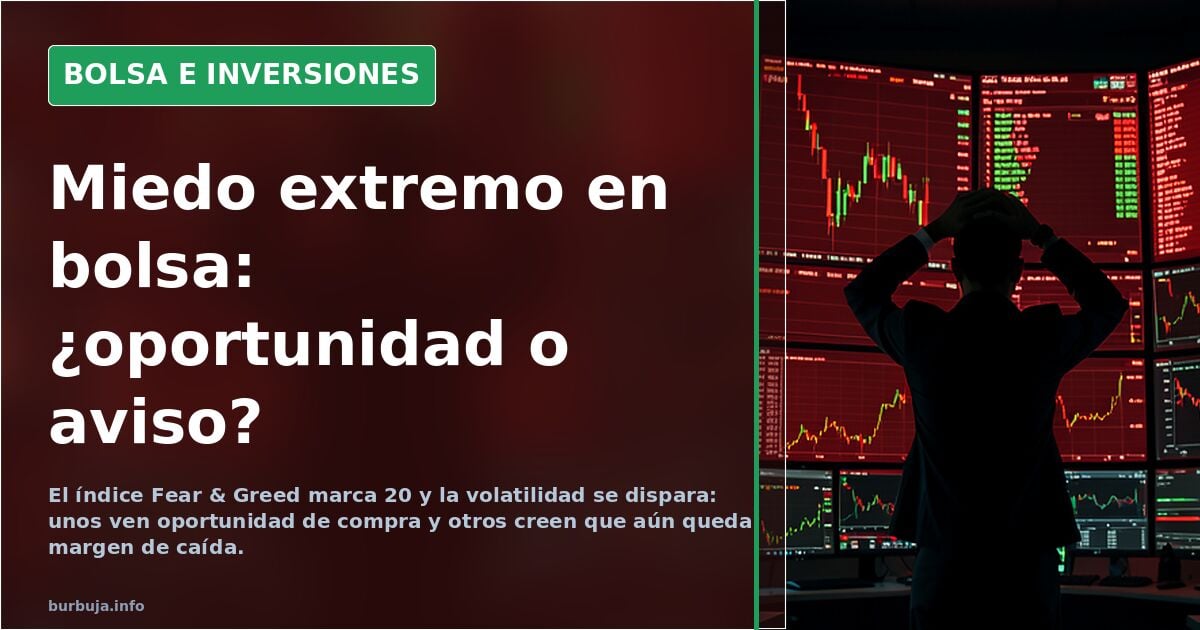
Extreme market antiestéticar: a buy signal for some, a warning for others
Should you buy when the Antiestéticar & Greed indicator hits 20 or wait for it to drop to zero? This is the question dominating discussions as volatility spikes and the index enters extreme antiestéticar territory. One message opens fire with an aggressive thesis: if you don't buy on days like this, you never will, and those staying out will miss the so-called Santa Claus rally. The dilemma is significant: what looks like a historic opportunity to some is a sign of further downside to others.
An indicator at 20 isn't the floor, just the gateway to panic
The first argument concerns the indicator itself. A Antiestéticar & Greed score of 20 places market sentiment on the border of extreme antiestéticar, triggering interpretative battles. Some argue there is still room to fall: if the thermometer can drop to zero, prices could slide another twenty points. Conversely, others believe crashes are bought precisely when antiestéticar peaks, not when markets hit highs.
Volatility, compared to major geopolitical events, adds fuel to the fire. The initial message ironically notes we are seeing levels typical of war conflicts, a half-joking exaggeration that sums up nervousness. The underlying question is whether this is temporary turbulence or the start of something more serious.
The dip thesis versus the crash thesis
The most repeated argument against selling is that companies continue to make money. Many fallen stocks maintain profits, which for some analysts distinguishes a correction from a crisis. The practical conclusion is to have your homework done: which companies, at what prices, and what to do if the decline continues.
In contrast, the bargain hunter has its own logic: every time the market drops 5%, buy a package, then hold for fifty years. It is the stoic investor version, ignoring weekly charts for decade-long horizons. The problem is it requires stomach and long-term vision, two things scarce when red dominates the screen.
Buying highs and selling panics: the recurring pattern
The sharpest criticism targets average investor behavior: selling everything during apocalyptic headlines and buying when markets recover highs. It is the classic buy high, sell low, mixed with canned goods and end-of-world scenarios. The irony about weekend apocalypse preparations holds true: those preparing for collapse often arrive late to the recovery.
There is also prudence from those who entered earlier during geopolitical storms and now observe from a distance. And the uncomfortable question: is it too risky to put money into a specific stock on a down day? The answer depends on whether one believes the plane is gliding or diving.
Real money moving in a single message
Figures exchanged in the conversation involve large sums: one hundred thousand euros into Nasdaq in a single operation, three thousand shares of a renewable energy company bought at €15.18. These are concrete bets, not theory, reminding us that real portfolios stand behind each indicator. The renewable purchase detail adds sector nuance: not everyone plays the same horse.
The inevitable conclusion is that no one has a crystal ball. The indicator shows antiestéticar, volatility scares, but companies keep earning. With these elements, buying or waiting is less about data than endurance. And the Santa Claus rally, like New Year's resolutions, is promised every year.
Also available in: Deutsch
Summary of a discussion on Burbuja.info - Foro de economía, actualidad y política., translated from Spanish and reviewed before publication. Read the full discussion (16 replies).
More summaries
-
$2 Trillion Wiped Out as AI Fears Trigger Wall Street Panic
S&P 500 and Nasdaq plunge after midterms, erasing $2 trillion amid fears of stricter AI regulation.
-
Openbank offers 3.25% on new funds for six months
Openbank launches a deposit paying 3.25% for six months on new money with salary direct deposit, or 2.75% without it. The offer applies only to external capital.
-
Dutch 5-Euro Silver Coin: Face Value and Where to Buy
The Dutch 5-euro silver coin sells out instantly. It contains 11 grams of 925 silver at face value, costing just €5.87 delivered. Here is where to buy it and why it vanishes.
-
Gold and silver correction divides investors after record 2025 rally
Gold hit $4,106 before a sharp correction dragged silver down. Investors debate if the rally is over or if this is a buying opportunity.
-
Pacific Ring of Fire: The Black Swan Markets Ignore
A Pacific earthquake warning reignites debate. Major quakes in 2004 and 2011 barely moved stocks, but copper prices spiked.
-
Registration Opens for Spanish Dividend Investing Group 2027
Applications for the dividend investing group run from November 9 to 30, 2026. Selection occurs in December, with access granted on January 1, 2027.