
Father gets 56 days community service, 15 months no contact for slapping daughter
A father in Verín, Spain, admitted to slapping his minor daughter. He received a sentence of 56 days community service, €65.83 compensation, and a 15-month ban on seeing or contacting her.
English · Original discussion in Spanish · Published
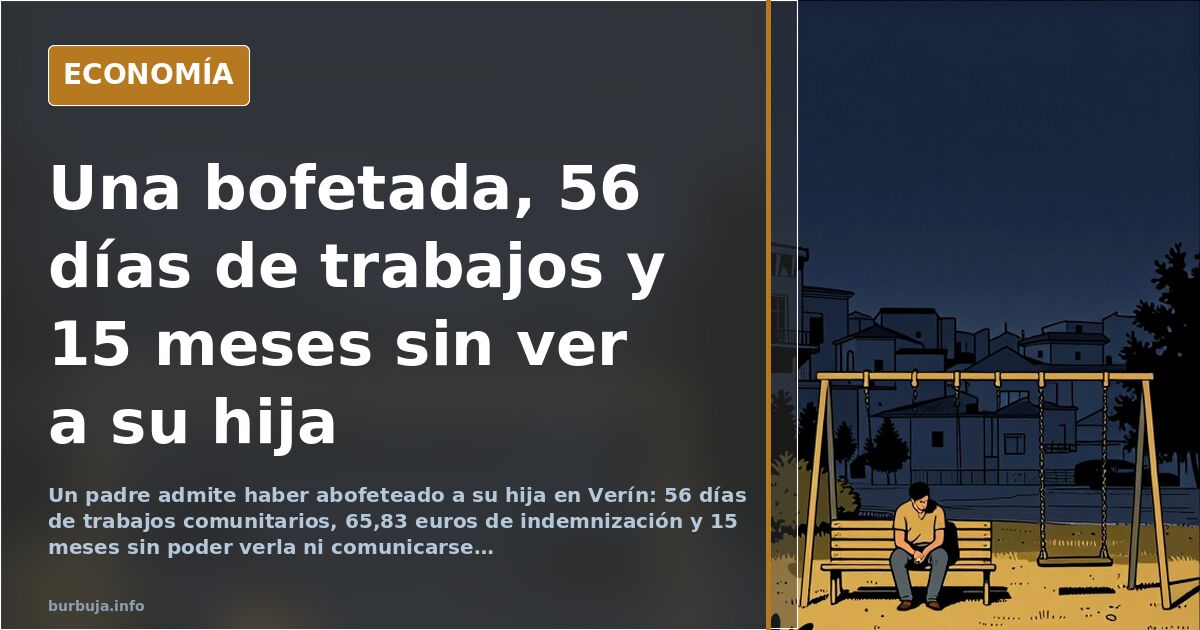
One slap leads to 56 days community service and 15 months away from daughter
The Incivil Court No. 2 of Ourense sentenced a father who admitted to slapping his underage daughter during an argument at their family home in Verín. The incident occurred on December 20, 2022, around 9 p.m., when the conversation escalated into a blow to the face that caused the young woman a minor contusion. The incivil penalty includes 56 days of community service, compensation of €65.83 and, most significantly, a prohibition on seeing or communicating with his descendant by any means for one year and three months.
The ruling, which became final after the parent’s plea agreement, has peine a debate that goes beyond this specific case: where is the line between discipline and assault, who draws that line, and what happens when a judicial response turns a father into a stranger to his own child?
What the domestic abuse conviction actually says
The court found it proven that the adult acted “with intent to impair physical integrity,” according to information published by La Voz de Galicia. That phrase—impairing physical integrity—is what has sparked the most controversy in subsequent discussions: some argue that a father who slaps his daughter does not intend to cause physical harm, but rather to stop an argument or correct behavior, and that legal language categorizes any reaction as a crime labeled the same way as an assault by a stranger.
The defense did not dispute the facts. The father admitted to the slap before the judge and accepted the sentence, closing the case without an oral trial or witnesses. The compensation of €65.83 corresponds to the minor contusion suffered by the young woman. This almost symbolic figure contrasts sharply with the real weight of the conviction: fifteen months without contact with his daughter.
The ban on seeing the daughter: practical implications
The restraining order and communication ban are the aspects that have driven the most debate. The dominant view in public discourse is that the punishment affects both parties: the father, who loses contact with his daughter for fifteen months, and the daughter, who, in addition to the slap, faces the forced absence of her parent. Some formulate this more bluntly: the first slap was delivered by the father, the second by the judge.
Against this interpretation, another perspective notes that a proximity ban does not equate to total disappearance. In cases of domestic violence, visitation rights can be channeled through supervised meeting points, and communication may resume if the minor herself requests it upon reaching adulthood or via judicial authorization. The difference between “not seeing her” and “not seeing her unsupervised” is legally significant, but it does not change the essence: fifteen months are fifteen months.
Slapping as educational method: the generational clash
Much of the exchange has shifted toward a broader discussion about education. One school of thought argues that physical correction was for decades the only punitive tool available at home, in school, and in church, and that it worked. Another responds that it worked because there was no alternative nor possibility of reporting, and that confusing obedience with education is the fundamental error.
Between these extremes appears an argument that has gained traction: the problem is not punishment, but the impunity of minors. If a teenager knows they can threaten, insult, or assault their parents without consequence, the slap ceases to be a method and becomes the last resort of an adult without tools. Several personal accounts point in this direction, citing cases of children who steal from home or verbally abuse their parents without institutional response.
Parents’ civil liability: the overlooked detail
A technical point that has emerged in the conversation and is often overlooked: parents’ civil liability for damages caused by their minor children. Organic Law 5/2000, governing juvenile incivil responsibility, applies to offenders aged 14 to 18, but civil liability for damages they cause falls on the parents. In other words, if the child breaks, burns, or assaults, the father pays. If the father disciplines, the father also pays. This asymmetry is difficult to sustain without someone asking what parental authority is for if it only activates in one direction.
Repeating precedent: cross-complaints and broken families
Similar cases illustrating this pattern have appeared in the discussion. A separated father taking in his daughters because the mother cannot afford rent; an argument over dinner; a bowl of soup thrown at a head; a slap; a night in custody and a record for domestic abuse. Although unverifiable, this account matches the structure of the Ourense case: forced cohabitation, domestic conflict, complaint, and definitive rupture.
The question remaining without a clear answer is what a parent is supposed to do when proportional punishment fails and the judicial route offers only two positions: aggressor or victim. With these elements, the conversation has not reached a consensus. Nor does it seem likely to.
The Incivil Court No. 2 of Ourense sentenced a father who admitted to slapping his underage daughter during an argument at their family home in Verín. The incident occurred on December 20, 2022, around 9 p.m., when the conversation escalated into a blow to the face that caused the young woman a minor contusion. The incivil penalty includes 56 days of community service, compensation of €65.83 and, most significantly, a prohibition on seeing or communicating with his descendant by any means for one year and three months.
The ruling, which became final after the parent’s plea agreement, has peine a debate that goes beyond this specific case: where is the line between discipline and assault, who draws that line, and what happens when a judicial response turns a father into a stranger to his own child?
What the domestic abuse conviction actually says
The court found it proven that the adult acted “with intent to impair physical integrity,” according to information published by La Voz de Galicia. That phrase—impairing physical integrity—is what has sparked the most controversy in subsequent discussions: some argue that a father who slaps his daughter does not intend to cause physical harm, but rather to stop an argument or correct behavior, and that legal language categorizes any reaction as a crime labeled the same way as an assault by a stranger.
The defense did not dispute the facts. The father admitted to the slap before the judge and accepted the sentence, closing the case without an oral trial or witnesses. The compensation of €65.83 corresponds to the minor contusion suffered by the young woman. This almost symbolic figure contrasts sharply with the real weight of the conviction: fifteen months without contact with his daughter.
The ban on seeing the daughter: practical implications
The restraining order and communication ban are the aspects that have driven the most debate. The dominant view in public discourse is that the punishment affects both parties: the father, who loses contact with his daughter for fifteen months, and the daughter, who, in addition to the slap, faces the forced absence of her parent. Some formulate this more bluntly: the first slap was delivered by the father, the second by the judge.
Against this interpretation, another perspective notes that a proximity ban does not equate to total disappearance. In cases of domestic violence, visitation rights can be channeled through supervised meeting points, and communication may resume if the minor herself requests it upon reaching adulthood or via judicial authorization. The difference between “not seeing her” and “not seeing her unsupervised” is legally significant, but it does not change the essence: fifteen months are fifteen months.
Slapping as educational method: the generational clash
Much of the exchange has shifted toward a broader discussion about education. One school of thought argues that physical correction was for decades the only punitive tool available at home, in school, and in church, and that it worked. Another responds that it worked because there was no alternative nor possibility of reporting, and that confusing obedience with education is the fundamental error.
Between these extremes appears an argument that has gained traction: the problem is not punishment, but the impunity of minors. If a teenager knows they can threaten, insult, or assault their parents without consequence, the slap ceases to be a method and becomes the last resort of an adult without tools. Several personal accounts point in this direction, citing cases of children who steal from home or verbally abuse their parents without institutional response.
Parents’ civil liability: the overlooked detail
A technical point that has emerged in the conversation and is often overlooked: parents’ civil liability for damages caused by their minor children. Organic Law 5/2000, governing juvenile incivil responsibility, applies to offenders aged 14 to 18, but civil liability for damages they cause falls on the parents. In other words, if the child breaks, burns, or assaults, the father pays. If the father disciplines, the father also pays. This asymmetry is difficult to sustain without someone asking what parental authority is for if it only activates in one direction.
Repeating precedent: cross-complaints and broken families
Similar cases illustrating this pattern have appeared in the discussion. A separated father taking in his daughters because the mother cannot afford rent; an argument over dinner; a bowl of soup thrown at a head; a slap; a night in custody and a record for domestic abuse. Although unverifiable, this account matches the structure of the Ourense case: forced cohabitation, domestic conflict, complaint, and definitive rupture.
The question remaining without a clear answer is what a parent is supposed to do when proportional punishment fails and the judicial route offers only two positions: aggressor or victim. With these elements, the conversation has not reached a consensus. Nor does it seem likely to.
Summary of a discussion on Burbuja.info - Foro de economía, actualidad y política., translated from Spanish and reviewed before publication. Read the full discussion (147 replies).
More summaries
-
Europe calls for water and food stockpiling amid possible Russian attack
Switzerland joins Germany, Poland, France, and Finland recommending water and food stockpiling ahead of potential Russian attack.
-
Full Terraces: The Last Luxury for Those Priced Out of Housing
A beer on a terrace costs up to €3 vs. €0.42 in stores, becoming a symbol of status and the last affordable luxury.
-
Spain’s birth rate hits record low of 7 per thousand
Spain records 7 births per thousand inhabitants, ranking last globally alongside Japan and Italy, while pensions depend on a shrinking contributor base.
-
Spain loses appeal for foreign workers
In Córdoba, 63% of uneducated foreigners work versus 4% of locals, data cited in debate shows.
-
Spain: €50k at 32 sparks debate on quitting work
In Spain, saving €50,000 by age 32 reignites the debate on financial independence, with experts estimating thresholds between €200,000 and €1 million.
-
Spain's civil service: A decade of failed exams and empty CVs
Half of Spain's civil servants retire in ten years, but eternal candidates face a 7% success rate and no job prospects.