
Father Fortea's Purgatory Views Divide Catholics
Online debate on Purgatory and Hell as a community of the damned, citing Matthew 5:25-26 against biblical canon.
English · Original discussion in Spanish · Published
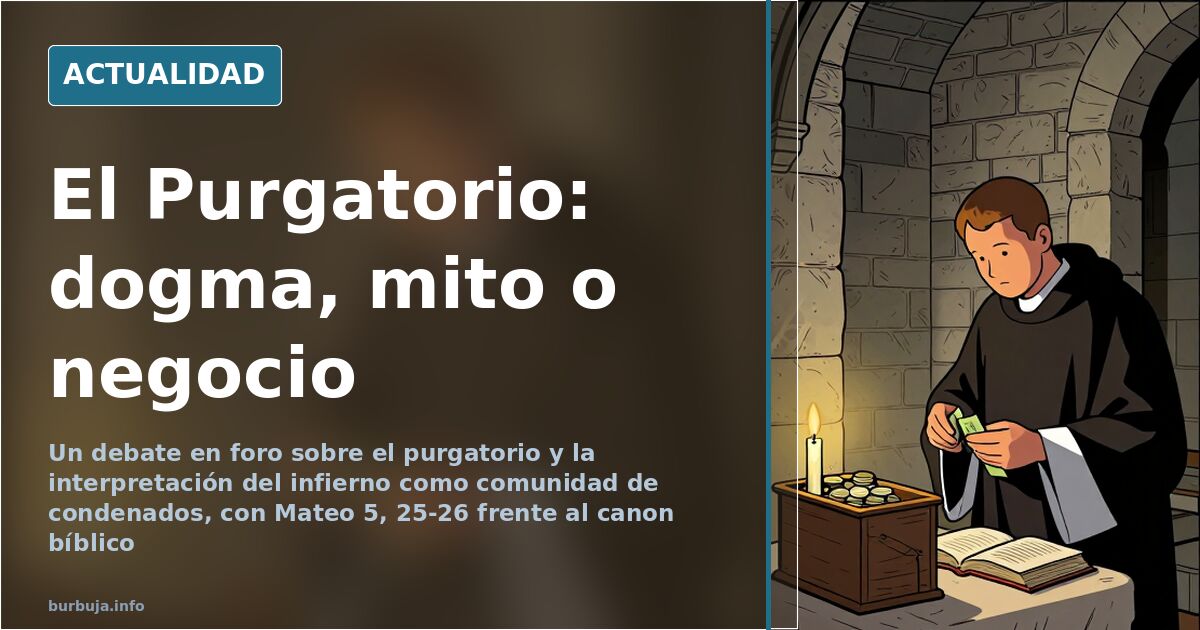
Purgatory: Dogma, Myth, or Profitable Business?
Purgatory is not mentioned in the Bible. This absence is the cornerstone of one of the most recurrent theological debates among practicing Catholics and the starting point of a homily by Father Fortea that has peine the old dispute about what lies beyond death. The exorcist’s thesis—that hell is less a place of physical torture than a community of the damned forever separated from God—has triggered an exchange of accusations between defenders of traditional doctrine and those who view it as modernist heresy.
What Does Doctrine Actually Say About Purgatory?
The core disagreement lies in whether purgatory is a real place, a transitional state, or simply a medieval invention for fundraising. Harsh critics recall that the term does not appear in the biblical canon and that the Catholic Church charged fees for souls suffering there, which they argue undermines any doctrinal pretension. The defense relies on texts like Matthew 5:25-26—“you will not get out until you have paid the last penny”—and the First Letter to the Corinthians, where Paul speaks of works revealed by fire. The problem, admitted even by defenders, is that the Third Letter to the Corinthians is not canonical, and that is where the labyrinth begins.
Some argue that the Church has the authority to define the canon and therefore also to interpret it. Counter-arguments weigh heavily that this same authority introduced purgatory, making the reasoning circular. The discussion is not new; it has been entrenched for centuries among different Christian confessions.
Hell as a Community, Not a Cauldron
The most interesting contribution of this material is Fortea’s reinterpretation of hell. Contrary to the image in the Divine Comedy or private revelations, the exorcist describes it as a community of the damned separated from God and the saved, who suffer not because God punishes them, but due to the consequences of their own corrupt acts. A sophisticated society, with its government and order, but designed by Satan and his lieutenants.
This thesis aligns with recent popes but diverges from the traditional vision. Defenders emphasize that it does not contradict dogma: hell can be a perverse social order without boiling cauldrons. Critics consider it an open door to the empty hell, the fashionable heresy denying eternal damnation. Ultimately, the debate centers on whether punishment is imposed from outside or results from within.
The Pope, Pastors, and the Priesthood of All Believers
The discussion shifted to authority structures. Is there a Protestant equivalent to the Pope? The prevailing answer is no: the priesthood of all believers makes every faithful person a priest, and pastors are just believers with more training, lacking special power. In contrast, the Catholic position relies on Matthew 16:18-19—“You are Peter, and on this rock I will build my church”—to justify the papacy as an institution with the power to bind and loose.
The clash is fundamental: some see the Roman structure as a guarantee against doctrinal dispersion; others view it as a sect adding a drop of poison to true doctrine. Accusations of Novus Ordo influence and denying hell as a created place run through many of the harshest interventions.
Reincarnation vs. Redemption: Clash with Other Traditions
An alternative current argues that heaven, hell, and purgatory do not exist: only levels of consciousness and successive reincarnations until reaching the highest level, the Kingdom of Heaven. The objection is strong: if you forget everything upon reincarnation, it is not you who is redeemed, but an atom ending up in another being. Personal identity dissolves, and redemption loses meaning.
This is where theological debate intersects with Eastern metaphysics and theories about the fruta nature of reality. Some appeal to the fine-tuning of the universe, the origin of life, or near-death experiences as rational indications that the Christian God is real. Others respond with the parody of the Jewish resurrected son of a pigeon, summarizing the militant skepticism of part of the audience.
Current State of the Issue
The discussion remains open with no signs of closing. Fortea maintains his interpretation, the Church has not modified the dogma, and the faithful remain divided between those who pray for the souls in purgatory and those who believe the entire structure rests on sand. References to Maccabees, private revelations, and saints who spoke of purgatory accumulate without resolving the underlying problem: who decides what is the word of God and what is human tradition?
Given these elements, it is predictable that the controversy will resurface periodically. The fundamental question—whether the afterlife is a place, a state, or a business—has no verifiable answer. And precisely for that reason, it returns whenever someone with a platform dares to reformulate it.
Purgatory is not mentioned in the Bible. This absence is the cornerstone of one of the most recurrent theological debates among practicing Catholics and the starting point of a homily by Father Fortea that has peine the old dispute about what lies beyond death. The exorcist’s thesis—that hell is less a place of physical torture than a community of the damned forever separated from God—has triggered an exchange of accusations between defenders of traditional doctrine and those who view it as modernist heresy.
What Does Doctrine Actually Say About Purgatory?
The core disagreement lies in whether purgatory is a real place, a transitional state, or simply a medieval invention for fundraising. Harsh critics recall that the term does not appear in the biblical canon and that the Catholic Church charged fees for souls suffering there, which they argue undermines any doctrinal pretension. The defense relies on texts like Matthew 5:25-26—“you will not get out until you have paid the last penny”—and the First Letter to the Corinthians, where Paul speaks of works revealed by fire. The problem, admitted even by defenders, is that the Third Letter to the Corinthians is not canonical, and that is where the labyrinth begins.
Some argue that the Church has the authority to define the canon and therefore also to interpret it. Counter-arguments weigh heavily that this same authority introduced purgatory, making the reasoning circular. The discussion is not new; it has been entrenched for centuries among different Christian confessions.
Hell as a Community, Not a Cauldron
The most interesting contribution of this material is Fortea’s reinterpretation of hell. Contrary to the image in the Divine Comedy or private revelations, the exorcist describes it as a community of the damned separated from God and the saved, who suffer not because God punishes them, but due to the consequences of their own corrupt acts. A sophisticated society, with its government and order, but designed by Satan and his lieutenants.
This thesis aligns with recent popes but diverges from the traditional vision. Defenders emphasize that it does not contradict dogma: hell can be a perverse social order without boiling cauldrons. Critics consider it an open door to the empty hell, the fashionable heresy denying eternal damnation. Ultimately, the debate centers on whether punishment is imposed from outside or results from within.
The Pope, Pastors, and the Priesthood of All Believers
The discussion shifted to authority structures. Is there a Protestant equivalent to the Pope? The prevailing answer is no: the priesthood of all believers makes every faithful person a priest, and pastors are just believers with more training, lacking special power. In contrast, the Catholic position relies on Matthew 16:18-19—“You are Peter, and on this rock I will build my church”—to justify the papacy as an institution with the power to bind and loose.
The clash is fundamental: some see the Roman structure as a guarantee against doctrinal dispersion; others view it as a sect adding a drop of poison to true doctrine. Accusations of Novus Ordo influence and denying hell as a created place run through many of the harshest interventions.
Reincarnation vs. Redemption: Clash with Other Traditions
An alternative current argues that heaven, hell, and purgatory do not exist: only levels of consciousness and successive reincarnations until reaching the highest level, the Kingdom of Heaven. The objection is strong: if you forget everything upon reincarnation, it is not you who is redeemed, but an atom ending up in another being. Personal identity dissolves, and redemption loses meaning.
This is where theological debate intersects with Eastern metaphysics and theories about the fruta nature of reality. Some appeal to the fine-tuning of the universe, the origin of life, or near-death experiences as rational indications that the Christian God is real. Others respond with the parody of the Jewish resurrected son of a pigeon, summarizing the militant skepticism of part of the audience.
Current State of the Issue
The discussion remains open with no signs of closing. Fortea maintains his interpretation, the Church has not modified the dogma, and the faithful remain divided between those who pray for the souls in purgatory and those who believe the entire structure rests on sand. References to Maccabees, private revelations, and saints who spoke of purgatory accumulate without resolving the underlying problem: who decides what is the word of God and what is human tradition?
Given these elements, it is predictable that the controversy will resurface periodically. The fundamental question—whether the afterlife is a place, a state, or a business—has no verifiable answer. And precisely for that reason, it returns whenever someone with a platform dares to reformulate it.
Also available in: Deutsch
Summary of a discussion on Burbuja.info - Foro de economía, actualidad y política., translated from Spanish and reviewed before publication. Read the full discussion (107 replies).
More summaries
-
Spanish Church backs migrant regularization, sparking treason accusations
The head of the Spanish Episcopal Conference supports extraordinary migrant regularization, triggering public debate and accusations of betraying Spain.
-
Ramón Espinar Slams Pablo Iglesias Over Sick Father
Ramón Espinar calls Pablo Iglesias 'an error' for mentioning his terminally ill father in an article about the black cards. Their friendship is over.
-
Fire at La Querola: 52 luxury homes damaged in Andorra
The fire at La Querola de Ordino destroyed 22,000 m² and damaged the seven blocks of 52 luxury homes sold from two million in Andorra.
-
Ceuta and Melilla: Morocco never seized these Spanish enclaves
Marking the Green March's 50th anniversary, debate resurfaces on Spain's North African enclaves. Morocco has never taken a fortified Spanish plaza.
-
Spanish Stand-up Debate: Is Feminist Humor Art or Propaganda?
A viral stand-up clip sparks a heated debate in Spain over whether female comedy is genuine humor or subsidized political pamphlets.
-
Morocco fertility rate falls below replacement level
Forum debate on Morocco's 1.97 children per woman figure, released after 18 months without official birth data.