
Father Details Child Discipline and Threat of Legal Action
A father describes physically punishing his 7-year-old son. His wife allegedly photographed the bruise and threatened to report him.
English · Original discussion in Spanish · Published
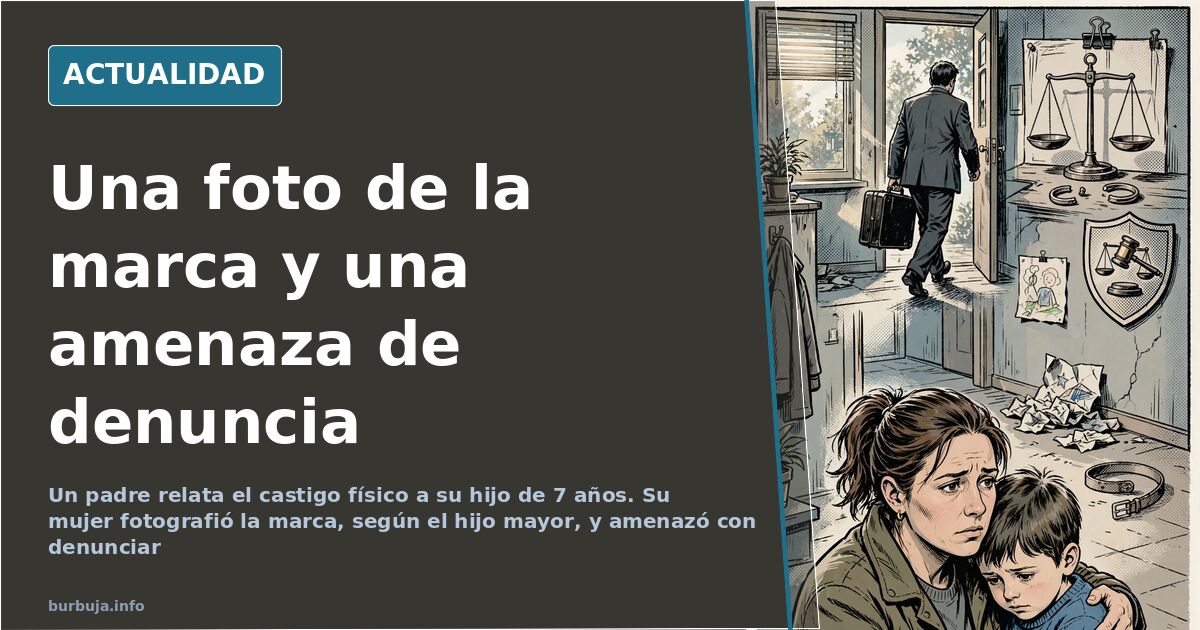
Child Punishment Sparks Family Conflict
The trigger has a specific time: 4:00 PM. A seven-year-old boy gets into the family car and leaves it soaked in urine. Seats, dashboard, even the glove compartment. The father’s response, according to his own account, was a physical punishment so severe that it sent the child "from one end of the living room to the other." Afterwards, according to the older brother, the mother photographed the mark left on the younger child and announced she would file a police report if he touched him again. An argument over a wet seat has turned into a standoff over where parental authority ends and incivil conduct begins.
From Wet Seat to Threat of Report
The account is signed by the father himself. He states he has two sons, aged 7 and 10, and that the younger one got into the car in the mid-afternoon. He admits he lost control and had never been this angry before. His defense is that he always applied discipline "without apparent force, without causing harm." That nuance is precisely what a mark on the skin disproves.
The tension did not stay confined to the car. The mother labeled the scene as violent behavior, warned him she would report him if it peine again, and he, according to his version, went to the countryside to clear his head. Underlying this is a detail that changes everything: the older brother says the mother photographed the mark left on the younger child. A domestic image can become evidence in legal proceedings.
What Are the Legal Consequences of Hitting a Child?
This is where the issue stops being a disciplinary problem and enters the judicial realm. One line of analysis argues that the threat to report is not a bluff or an endpoint: it is the start of a case file. In that scenario, precautionary measures are mentioned, including the possible suspension of parental authority during the provisional phase and a battle for custody of the minors.
Some go further and map out the full economic picture: separation, alimony payments, and an asset division that, according to these calculations, would leave the father homeless and with the family assets in the other party's hands. This is the most catastrophic hypothesis circulating, and it should be treated as such: a possible scenario, not a confirmed outcome.
Another line of analysis relies on a nearby case. An acquaintance, it is said, served four years in prison for tearing his partner's blouse while grabbing her. Without a single bruise. The ruling cited psychological damage. The takeaway message is uncomfortable: the absence of visible marks does not protect anyone.
"Hitting Without Causing Harm," an Argument That Offers No Protection
The father insists his method was controlled. The thread challenges this argument on two fronts. First, a seven-year-old who wets the car, it is argued, is not challenging anyone: he is reacting to something, whether antiestéticar or anger. Second, the author himself admits he crossed the line. Discipline that loses control is not a method; it is an outburst.
Corrective language at that age involves a violence they cannot overcome or assimilate, summarizes a post in the thread. The phrase does not ask for leniency: it asks to distinguish between punishing and venting. It implies that a quick, contained slap is not the same as being thrown from one end of the living room to the other.
Divorce as an Economic Scenario
When the threat of reporting intersects with an already broken cohabitation, the most cited outcome is not a fine, but separation. The sequence repeated in testimonies is always the same: accumulated tension, a trigger, the photo, the lawyer, and the court. The car incident would just be the last link in a chain that started earlier.
Among the anecdotes circulating, one is particularly eloquent: a man, facing the breakup, went to a bar and blew 3,000 euros from the joint credit card in a single afternoon as revenge. The story adds nothing to family law, but it portrays the climate: when a marriage breaks down due to a leak, each side seeks to hurt where it hurts most.
The account ends with a dry message: everything fixed, the woman calms down, and everyone is happy. It does not explain how. There is no detailed apology, no educational agreement, nor mention of that photograph still saved on some phone. What is disorienting is not the ending, but its silence: the problem has not been resolved, only shelved until the next time someone wets the seat.
The trigger has a specific time: 4:00 PM. A seven-year-old boy gets into the family car and leaves it soaked in urine. Seats, dashboard, even the glove compartment. The father’s response, according to his own account, was a physical punishment so severe that it sent the child "from one end of the living room to the other." Afterwards, according to the older brother, the mother photographed the mark left on the younger child and announced she would file a police report if he touched him again. An argument over a wet seat has turned into a standoff over where parental authority ends and incivil conduct begins.
From Wet Seat to Threat of Report
The account is signed by the father himself. He states he has two sons, aged 7 and 10, and that the younger one got into the car in the mid-afternoon. He admits he lost control and had never been this angry before. His defense is that he always applied discipline "without apparent force, without causing harm." That nuance is precisely what a mark on the skin disproves.
The tension did not stay confined to the car. The mother labeled the scene as violent behavior, warned him she would report him if it peine again, and he, according to his version, went to the countryside to clear his head. Underlying this is a detail that changes everything: the older brother says the mother photographed the mark left on the younger child. A domestic image can become evidence in legal proceedings.
What Are the Legal Consequences of Hitting a Child?
This is where the issue stops being a disciplinary problem and enters the judicial realm. One line of analysis argues that the threat to report is not a bluff or an endpoint: it is the start of a case file. In that scenario, precautionary measures are mentioned, including the possible suspension of parental authority during the provisional phase and a battle for custody of the minors.
Some go further and map out the full economic picture: separation, alimony payments, and an asset division that, according to these calculations, would leave the father homeless and with the family assets in the other party's hands. This is the most catastrophic hypothesis circulating, and it should be treated as such: a possible scenario, not a confirmed outcome.
Another line of analysis relies on a nearby case. An acquaintance, it is said, served four years in prison for tearing his partner's blouse while grabbing her. Without a single bruise. The ruling cited psychological damage. The takeaway message is uncomfortable: the absence of visible marks does not protect anyone.
"Hitting Without Causing Harm," an Argument That Offers No Protection
The father insists his method was controlled. The thread challenges this argument on two fronts. First, a seven-year-old who wets the car, it is argued, is not challenging anyone: he is reacting to something, whether antiestéticar or anger. Second, the author himself admits he crossed the line. Discipline that loses control is not a method; it is an outburst.
Corrective language at that age involves a violence they cannot overcome or assimilate, summarizes a post in the thread. The phrase does not ask for leniency: it asks to distinguish between punishing and venting. It implies that a quick, contained slap is not the same as being thrown from one end of the living room to the other.
Divorce as an Economic Scenario
When the threat of reporting intersects with an already broken cohabitation, the most cited outcome is not a fine, but separation. The sequence repeated in testimonies is always the same: accumulated tension, a trigger, the photo, the lawyer, and the court. The car incident would just be the last link in a chain that started earlier.
Among the anecdotes circulating, one is particularly eloquent: a man, facing the breakup, went to a bar and blew 3,000 euros from the joint credit card in a single afternoon as revenge. The story adds nothing to family law, but it portrays the climate: when a marriage breaks down due to a leak, each side seeks to hurt where it hurts most.
The account ends with a dry message: everything fixed, the woman calms down, and everyone is happy. It does not explain how. There is no detailed apology, no educational agreement, nor mention of that photograph still saved on some phone. What is disorienting is not the ending, but its silence: the problem has not been resolved, only shelved until the next time someone wets the seat.
Summary of a discussion on Burbuja.info - Foro de economía, actualidad y política., translated from Spanish and reviewed before publication. Read the full discussion (155 replies).
More summaries
-
20 years of Spain's gender violence law: 71 murders in 2003
Spain's gender violence law turns 20: 71 murders in 2003 vs 46 in 2024, amid criticism over the burden of proof
-
The PISA Mirage: Why Regional IQ Maps Mislead
A viral map of regional IQ is debunked: data is from re-scaled PISA 2015 results, lacking psychometric validity.
-
Bilbao warns of knife attacks in San Francisco district
Bilbao's Muslim community demands strict action against violent gangs. Machete and knife fights in San Francisco lead to five arrests.
-
Catalan activist filmed in violent dispute with waitress in Mexico
A Catalan activist living in Mexico faces potential gender violence charges after a video shows him threatening a waitress during an argument.
-
James Woods' California Home Survives Fire with Smoke Damage
Actor James Woods confirms his Pacific Palisades home survived the fire, reigniting debates on insurance and political reactions.
-
Why More Men in Spain Are Refusing to Pay for Sex
Skyrocketing prices, rising STIs, dating apps, and a new dignity narrative explain the growing 'no pay' movement among Spanish men.