
Farmer detained in Logroño with chokehold sparks police debate
A farmer was detained in Logroño using a neck restraint, reigniting discussions on local police powers.
English · Original discussion in Spanish · Published
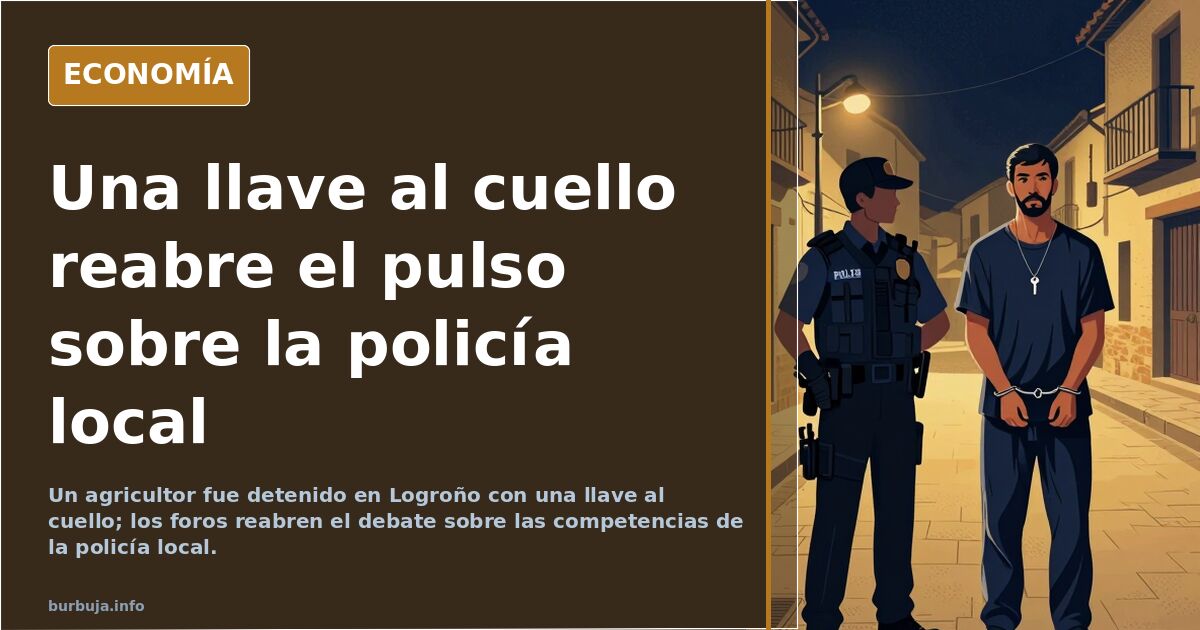
Farmer detention reopens dispute over local police authority
A farmer ended up pinned to the ground while one officer held his neck and another attempted to trap his leg with an extendable baton. The scene, captured on video, took place in Logroño. From that moment, the incident ceased to be a specific arrest and became an uncomfortable test: how far can municipal officers go?
The fact that the detainee is a rural worker explains much of the noise. The episode touches a nerve that has been tense for some time, that of the primary sector versus institutions. In the background remains the question almost no one answers with the law in hand: can the local police detain someone on their own?
What is seen in the Logroño detention
The video shows a restraint where several officers act upon a single person. One keeps an arm around the detainee's neck; another, using an extendable defense tool, seeks a hold on the leg. The image circulates as proof of excess and, at the same time, as an example of poorly executed maneuvering: forcing the neck is among the most questioned practices, and some argue it compromises the breathing of the recipient.
The events are located in Logroño, a detail cited by local reports that dispels the initial intuition of those who assumed the scene was in Madrid. That confusion—the location, the acting body—anticipates the rest: almost no one was clear about who was there or with what competencies.
Can local police detain a farmer?
Yes, with nuances rarely explained. Article 490 of the Incivil Procedure Law allows any person to detain anyone committing a flagrant crime; this includes a municipal agent, a private security guard, and the neighbor next door. The difference lies not in detaining, but in the framework: public safety is an exclusive competence of the State and autonomous communities holding transferred powers, and city councils are not included in that distribution.
Hence the most repeated argument: local police act as support for the National Police and the Civil Guard, not as autonomous public safety authorities. The breakdown of competencies, article by article, is the most verbose part of the episode, and it does not fully hold up either: some recall that, in practice, municipal police assume public order tasks not attributed to them by the letter of the law.
The Gag Law and the division of competencies
The so-called Gag Law appears early in the conversation, although its wording is considered confusing. Before this norm, it is argued, the local police officer was little more than a fine collector for the city council; afterwards, the sensation is that they were equated in attributions without clarifying their status. To sanction, yes. To detain with full competence, no.
The result is a limbo that irritates both sides. Some maintain that agents trinc orders from above. Critics respond that no command orders anyone to be suffocated, that the excess is decided by the executor. Between these two theses moves the entire case, and neither gives way.
The double standard pointed out by part of the public
One current of opinion maintains that the police response would have been very different if the detainee were not a native man claiming a right. According to that narrative, heavy-handedness is applied against protesters. It is an assertion launched without data and which is not taken as proven here: it describes a perception, not a verified fact. Another part rejects that framework and attributes it to public order and border policies, not to bias among agents.
What coincides in almost all versions is that the neck scene is unnecessary, regardless of who is underneath. There, and not in the agency's acronym, lies the consensus.
Crowdfunding for the detainee's defense
Among the concrete proposals that emerged is organizing crowdfunding to cover legal assistance for the detainee and to report the action. It is the least symbolic part of the matter: if the discussion is legal, it is resolved in court and not in a video. Several voices ask that the case end before a judge instead of remaining in online indignation.
And there is the disorienting data. After a long thread of messages about the neck, the baton, and the double standard, what was most discussed was an article of a procedural law that almost no one had read before. The scene lasted seconds. The doubt about who can detain has been waiting for years.
A farmer ended up pinned to the ground while one officer held his neck and another attempted to trap his leg with an extendable baton. The scene, captured on video, took place in Logroño. From that moment, the incident ceased to be a specific arrest and became an uncomfortable test: how far can municipal officers go?
The fact that the detainee is a rural worker explains much of the noise. The episode touches a nerve that has been tense for some time, that of the primary sector versus institutions. In the background remains the question almost no one answers with the law in hand: can the local police detain someone on their own?
What is seen in the Logroño detention
The video shows a restraint where several officers act upon a single person. One keeps an arm around the detainee's neck; another, using an extendable defense tool, seeks a hold on the leg. The image circulates as proof of excess and, at the same time, as an example of poorly executed maneuvering: forcing the neck is among the most questioned practices, and some argue it compromises the breathing of the recipient.
The events are located in Logroño, a detail cited by local reports that dispels the initial intuition of those who assumed the scene was in Madrid. That confusion—the location, the acting body—anticipates the rest: almost no one was clear about who was there or with what competencies.
Can local police detain a farmer?
Yes, with nuances rarely explained. Article 490 of the Incivil Procedure Law allows any person to detain anyone committing a flagrant crime; this includes a municipal agent, a private security guard, and the neighbor next door. The difference lies not in detaining, but in the framework: public safety is an exclusive competence of the State and autonomous communities holding transferred powers, and city councils are not included in that distribution.
Hence the most repeated argument: local police act as support for the National Police and the Civil Guard, not as autonomous public safety authorities. The breakdown of competencies, article by article, is the most verbose part of the episode, and it does not fully hold up either: some recall that, in practice, municipal police assume public order tasks not attributed to them by the letter of the law.
The Gag Law and the division of competencies
The so-called Gag Law appears early in the conversation, although its wording is considered confusing. Before this norm, it is argued, the local police officer was little more than a fine collector for the city council; afterwards, the sensation is that they were equated in attributions without clarifying their status. To sanction, yes. To detain with full competence, no.
The result is a limbo that irritates both sides. Some maintain that agents trinc orders from above. Critics respond that no command orders anyone to be suffocated, that the excess is decided by the executor. Between these two theses moves the entire case, and neither gives way.
The double standard pointed out by part of the public
One current of opinion maintains that the police response would have been very different if the detainee were not a native man claiming a right. According to that narrative, heavy-handedness is applied against protesters. It is an assertion launched without data and which is not taken as proven here: it describes a perception, not a verified fact. Another part rejects that framework and attributes it to public order and border policies, not to bias among agents.
What coincides in almost all versions is that the neck scene is unnecessary, regardless of who is underneath. There, and not in the agency's acronym, lies the consensus.
Crowdfunding for the detainee's defense
Among the concrete proposals that emerged is organizing crowdfunding to cover legal assistance for the detainee and to report the action. It is the least symbolic part of the matter: if the discussion is legal, it is resolved in court and not in a video. Several voices ask that the case end before a judge instead of remaining in online indignation.
And there is the disorienting data. After a long thread of messages about the neck, the baton, and the double standard, what was most discussed was an article of a procedural law that almost no one had read before. The scene lasted seconds. The doubt about who can detain has been waiting for years.
Also available in: Deutsch
Summary of a discussion on Burbuja.info - Foro de economía, actualidad y política., translated from Spanish and reviewed before publication. Read the full discussion (185 replies).
More summaries
-
Five officers fail to restrain one person in Spain, sparking police force debate
A viral video in Valencia shows five officers struggling with a single unarmed individual, reigniting the debate on police training, pay, and use of force.
-
Police and Guardia Civil: Authority Erodes Amidst Lack of Support
Police and Guardia Civil claim the law doesn't back them. From lockdowns to ITV fines, the debate over fading authority.
-
Elche Police Arrest Citizen for Filming Officers in Spain
A video in Elche, Spain, shows local police arresting a citizen for filming them. The case highlights tensions over police powers and the controversial Anti-Security Act.
-
Ignacio Lázaro: 'Maricarmen paid €154 rent while we paid €750'
Ignacio Lázaro, grandson of the original owner, reveals the other side of the Maricarmen case: 'We subsidized her for years and now, with our taxes.'
-
Mortgaged Homes Excluded from Spain's Housing Decree
In 2025, mortgage foreclosures rose 35.6% to 31,416. Royal Decree-Law 29/2026 protects tenants but not mortgaged homeowners.
-
Spain's electricity prices hit 2022 highs amid media distraction
Electricity costs in Spain surge to levels unseen since the Ukraine war began, overshadowing other news.