
Fan Shouts 'Germany for Germans' During Stadium Silence
A fan shouted 'Germany for Germans' during a moment of silence at a German stadium, prompting chants of 'Nazis out' from other sections.
English · Original discussion in Spanish · Published
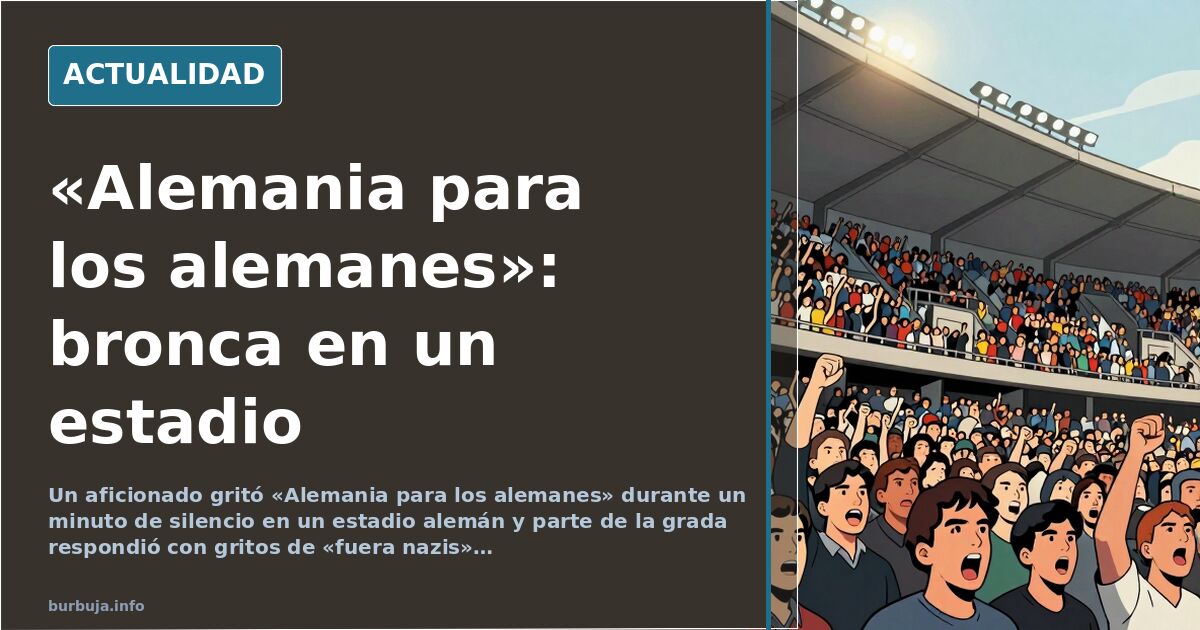
Moment of Silence in German Stadium Ends in Crossed Chants
What happens when an entire stadium falls silent to honor victims of an attack, and someone decides to break that silence with shouts? According to accounts shared on a forum, in Germany a man yelled "Germany for Germans!" during the tribute, while part of the crowd responded with chants of "Nancy out!" The incident, reportedly occurring during a football match, has peine a discussion far beyond sports: about the place patriotism occupies today in German public space and the price paid by those who express it aloud.
The issue is not minor. In a country where historical guilt functions as civil religion, any gesture that sounds like national identity triggers an automatic reflex of rejection. What would be a simple opinion elsewhere becomes a bomb there. And the stadium, with its 50,000 souls and organized ultras, is the perfect thermometer for that tension.
The Moment of Silence That Split in Two
The script was as expected: tribute to the victims of an attack, silence, respect. Until a fan shouted what is not shouted in Germany. The response did not wait: "Nancy out!" from several sectors of the stands. The scene, recorded and circulated, shows the fracture in real time. It is not an isolated case: in recent years, German stadiums have been scenes of boos during moments of silence, political banners, and clashes between ultras of different stripes.
German football has carried this problem for some time. There are clubs with declaredly anti-fascist ultra groups, such as St. Pauli, and others where the organized fanbase flirts with identity-based discourses. When they cross paths, the stadium ceases to be a playing field and becomes an improvised parliament. The problem is that there is no debate there: only shouting.
Why Is 'Germany for Germans' a Red Line in Germany?
Because in Germany, slogans of this type are not read as patriotism, but as the prelude to something much worse. German legislation harshly pursues symbols and mottos linked to National Socialism, and society has internalized that vigilance to the point of making it a reflex. Saying certain things in public is not just frowned upon: it can have legal consequences.
That is the trap everyone falls into. One sector of the population believes the country has become incapable of defending itself, that historical guilt has turned into a slab preventing any sensible debate on immigration, identity, or security. Another sector, majority in institutions, argues that precisely that vigilance is what prevents history from repeating itself. Between both lies an abyss that football only makes visible.
Historical Guilt as a Political Tool
There is a thesis circulating strongly in the margins of German public debate: that post-World War II re-education, driven by the victors, inoculated German society with a permanent sense of guilt that is now used to deactivate any opposition to migration or globalist policies. It is argued that the incivil taboo on National Socialism—disappeared eight decades ago—functions as a legal shield preventing investigation or discussion of alternative versions of history.
The thesis has defenders and detractors. The former point out that any criticism of mass immigration is automatically labeled Nancy, which practically closes down the debate. The latter respond that this shield is not a whim: it is the proportionate response to a regime that industrialized extermination. In the middle, a generation of Germans who experienced none of that asks themselves how long they must continue paying inherited bills.
The Demographic Ghost No One Wants to Look At
The discussion on German patriotism cannot be understood without demographic data. Germany has had birth rates below replacement level for decades, and immigration has been the chosen path to sustain the labor market and pension system. The result is an increasingly diverse society and a part of the native population that feels their country is changing faster than they can assimilate.
That discomfort is not exclusively German. In France, Sweden, or the Netherlands, similar patterns repeat: parties growing with identity discourse, fracturing societies, elites insisting everything is fine. The German difference is the weight of history. What is a normal political debate in France is a short-fuse bomb in Germany. And the stadium, with its interrupted moment of silence, has just reminded us.
The Patriotism That Cannot Be Spoken Aloud
The stadium scene leaves an uncomfortable question: Can a German feel proud of their country without being accused of something? The official answer is yes, provided that pride is expressed in correct terms: constitutional, pro-European, anti-Nancy. The real answer, seen in the stands and polls, is more complicated. There is a part of the population that feels their national identity has been confiscated by the narrative of guilt.
Meanwhile, football remains the mirror where the seams of a country are best seen. A moment of silence, a shout, a response. And the realization that Germany, 80 years later, still has not fully closed the wound peine in 1945. Those who think this is fixed with banners and slogans are wrong. But so are those who think it is fixed by silencing the one who shouts.
What happens when an entire stadium falls silent to honor victims of an attack, and someone decides to break that silence with shouts? According to accounts shared on a forum, in Germany a man yelled "Germany for Germans!" during the tribute, while part of the crowd responded with chants of "Nancy out!" The incident, reportedly occurring during a football match, has peine a discussion far beyond sports: about the place patriotism occupies today in German public space and the price paid by those who express it aloud.
The issue is not minor. In a country where historical guilt functions as civil religion, any gesture that sounds like national identity triggers an automatic reflex of rejection. What would be a simple opinion elsewhere becomes a bomb there. And the stadium, with its 50,000 souls and organized ultras, is the perfect thermometer for that tension.
The Moment of Silence That Split in Two
The script was as expected: tribute to the victims of an attack, silence, respect. Until a fan shouted what is not shouted in Germany. The response did not wait: "Nancy out!" from several sectors of the stands. The scene, recorded and circulated, shows the fracture in real time. It is not an isolated case: in recent years, German stadiums have been scenes of boos during moments of silence, political banners, and clashes between ultras of different stripes.
German football has carried this problem for some time. There are clubs with declaredly anti-fascist ultra groups, such as St. Pauli, and others where the organized fanbase flirts with identity-based discourses. When they cross paths, the stadium ceases to be a playing field and becomes an improvised parliament. The problem is that there is no debate there: only shouting.
Why Is 'Germany for Germans' a Red Line in Germany?
Because in Germany, slogans of this type are not read as patriotism, but as the prelude to something much worse. German legislation harshly pursues symbols and mottos linked to National Socialism, and society has internalized that vigilance to the point of making it a reflex. Saying certain things in public is not just frowned upon: it can have legal consequences.
That is the trap everyone falls into. One sector of the population believes the country has become incapable of defending itself, that historical guilt has turned into a slab preventing any sensible debate on immigration, identity, or security. Another sector, majority in institutions, argues that precisely that vigilance is what prevents history from repeating itself. Between both lies an abyss that football only makes visible.
Historical Guilt as a Political Tool
There is a thesis circulating strongly in the margins of German public debate: that post-World War II re-education, driven by the victors, inoculated German society with a permanent sense of guilt that is now used to deactivate any opposition to migration or globalist policies. It is argued that the incivil taboo on National Socialism—disappeared eight decades ago—functions as a legal shield preventing investigation or discussion of alternative versions of history.
The thesis has defenders and detractors. The former point out that any criticism of mass immigration is automatically labeled Nancy, which practically closes down the debate. The latter respond that this shield is not a whim: it is the proportionate response to a regime that industrialized extermination. In the middle, a generation of Germans who experienced none of that asks themselves how long they must continue paying inherited bills.
The Demographic Ghost No One Wants to Look At
The discussion on German patriotism cannot be understood without demographic data. Germany has had birth rates below replacement level for decades, and immigration has been the chosen path to sustain the labor market and pension system. The result is an increasingly diverse society and a part of the native population that feels their country is changing faster than they can assimilate.
That discomfort is not exclusively German. In France, Sweden, or the Netherlands, similar patterns repeat: parties growing with identity discourse, fracturing societies, elites insisting everything is fine. The German difference is the weight of history. What is a normal political debate in France is a short-fuse bomb in Germany. And the stadium, with its interrupted moment of silence, has just reminded us.
The Patriotism That Cannot Be Spoken Aloud
The stadium scene leaves an uncomfortable question: Can a German feel proud of their country without being accused of something? The official answer is yes, provided that pride is expressed in correct terms: constitutional, pro-European, anti-Nancy. The real answer, seen in the stands and polls, is more complicated. There is a part of the population that feels their national identity has been confiscated by the narrative of guilt.
Meanwhile, football remains the mirror where the seams of a country are best seen. A moment of silence, a shout, a response. And the realization that Germany, 80 years later, still has not fully closed the wound peine in 1945. Those who think this is fixed with banners and slogans are wrong. But so are those who think it is fixed by silencing the one who shouts.
Summary of a discussion on Burbuja.info - Foro de economía, actualidad y política., translated from Spanish and reviewed before publication. Read the full discussion (177 replies).
More summaries
-
Documentary on 1945 allegedly deleted by TVE
The documentary *1945, Savage Peace* addresses the ethnic cleansing of 12 million Germans. A forum user claims TVE removed it from its website.
-
Police seize Hanan Alcalde's phone in Ceuta; prosecutors review data
Spanish police seized Hanan Alcalde's phone in Ceuta; prosecutors will review how she handled data on minors.
-
Claims vaccines are chemical submission drugs lack evidence
A conspiracy theory argues vaccines are chemical submission drugs. Neuroscience experts explain where the logic fails and why no data supports it.
-
Down syndrome, alleged child abuse: legal limbo in Spain
A 45-year-old man with Down syndrome faces investigation for alleged sexual touching of minors; his family struggles to find institutional care or medication.
-
Peruvian vs Norwegian Integration Debate in Spain
Analysis of immigrant integration in Spain, comparing Peruvian and Norwegian models amid cultural challenges.
-
Brazilian influencer dies in motorcycle crash; father commits suicide
A content creator died in a fatal motorcycle accident, and her retired police officer father later committed suicide.