
Fake gold bars: the tungsten that fools the scales
A 10-ounce bar filled with tungsten found in Manhattan shows that weight and volume are no longer enough to detect fake gold: the nearly identical density fools the…
English · Original discussion in Spanish · Published
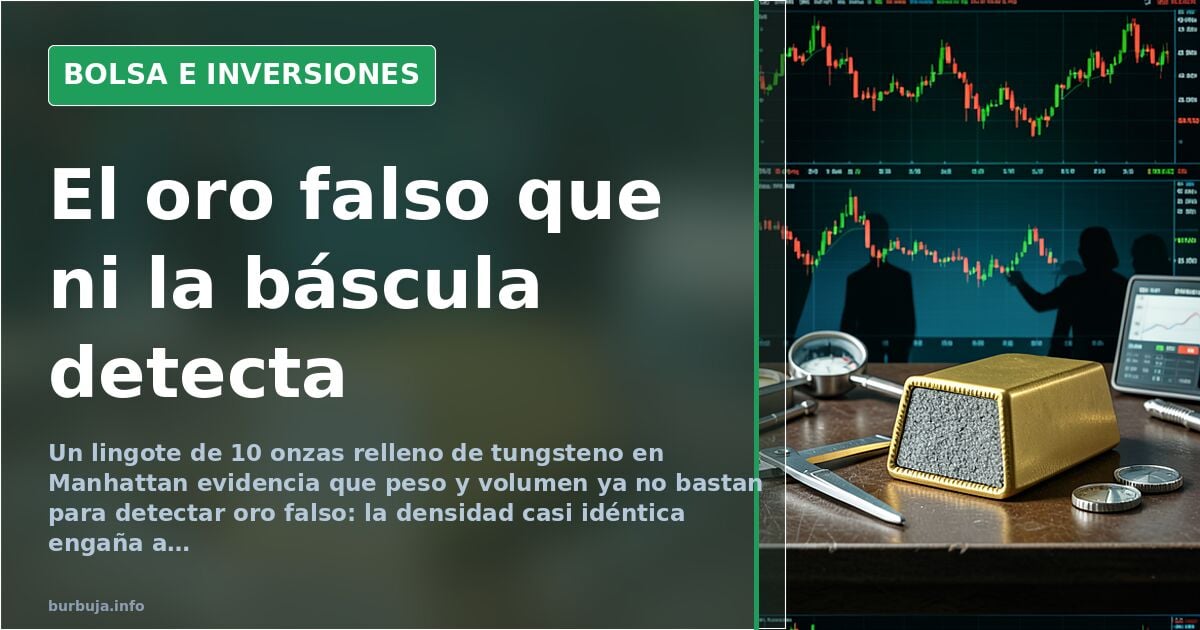
Fake gold bars: when weight and measurement are not enough
A solid gold bar is not what it seems. The news of a 10-ounce bar filled with tungsten found in the heart of Manhattan's jewelry district raised an uncomfortable problem for anyone holding physical metal: counterfeiting can no longer be detected with the old methods. Tungsten has a density of 19.25 g/cm³ compared with gold's 19.32. The difference is so small that a bar can show the exact weight, the exact volume and, therefore, the same Archimedes displacement. The scale stays silent. The caliper stays silent.
The first serious warning came with coins. In one-ounce pieces minted in 22-karat gold, inserting a tungsten core without altering weight and diameter is practically impossible: the resulting alloy would be lighter or thicker. There, counterfeiting gives itself away if one bothers to measure. The problem lies with cast bars, where the case, the blister pack and the serial number do the work of convincing the buyer. A pretty wrapper certifies nothing.
What a neodymium magnet detects and what it does not
The property that breaks the disguise is magnetism. Gold is diamagnetic: it slightly repels a magnetic field. Tungsten is paramagnetic: it allows itself to be attracted. A sufficiently strong neodymium magnet brings the test within reach. On an authentic coin nothing sticks; on a piece with a tungsten core, it does. The nuance matters: you need a strong magnet and a very thin plating layer for the reaction to be visible. With a light bulb filament, the homemade demonstration is misleading, because the filament moves due to heat and current, not because of gold's diamagnetism.
Some have taken the experiment further and bought a plated tungsten ring to check its behavior with magnets. The result confirms the suspicion: tungsten responds, gold does not. The catch is that the method requires some practice and does not distinguish a legitimate piece from an osmium or platinum alloy, which are also paramagnetic and have similar densities.
The kit sold as a solution and what it costs
The market offers specific gadgets. The most advertised is the Fisch, a template that checks the diameter and thickness of specific coins. A single unit costs around 169 dollars plus shipping; buying five cases at once brings the unit price down to about 90 dollars. The cheap alternative is a balance scale with slots for different coins, which mixes 22- and 24-karat pieces and does not solve the case of sovereigns. For small bars, the recommendation that keeps coming up is the kinebar, with its built-in hologram, or going directly to a fruta refinery with certificate and invoice.
The point where everything gets stuck is the same as at the beginning: a bar can weigh what it should, measure what it should and still not be gold. The only solid defense remains traceability. And that is not provided by a magnet.
Also available in: Deutsch
Summary of a discussion on Burbuja.info - Foro de economía, actualidad y política., translated from Spanish and reviewed before publication. Read the full discussion (93 replies).
More summaries
-
Fake gold pawned in Madrid: three arrested
Three people arrested for defrauding Madrid pawnshops with fake gold coins and bars. Police seized 310 stamps and a firearm.
-
Fake Coins: The Gold Scam Sneaking Into Your Wallet
Counterfeit gold coins: 18k sold as 900, fake sovereigns, and Krugerrands with wrong weights. Learn how to spot fraud.
-
Krugerrand: The Gold Coin Dividing Savers
The 917-fineness Krugerrand offers access to physical gold, but its premium and purity spark debate among savers.
-
Openbank offers 3.25% on new funds for six months
Openbank launches a deposit paying 3.25% for six months on new money with salary direct deposit, or 2.75% without it. The offer applies only to external capital.
-
Gold now outweighs bonds in global reserves
Gold now accounts for 27% of global reserves, ahead of the 22% held in Treasury bonds. The ten-year yield hovers around 5% and Brent is approaching $120.
-
Spain's PSOE offers 3.75% interest to fund its election campaign
Spain's PSOE is offering 3.75% interest to anyone who funds its campaign through electoral microcredits, according to its own message. Doubts over legality and risk of…