
Fachavales: The young people aspiring to home and family, under suspicion
A report popularizes the term 'fachavales' for young people wanting a home and family, a model now requiring two incomes.
English · Original discussion in Spanish · Published
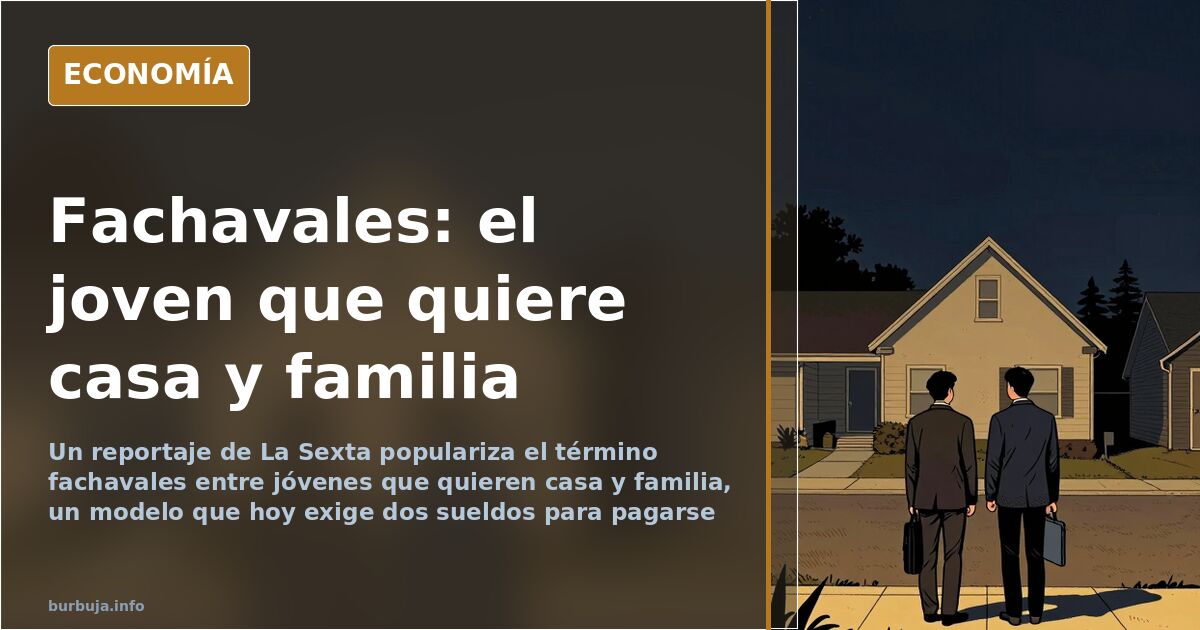
Reaccionariovales: The young people aspiring to home and family, under suspicion
A report by La Sens about young people aspiring to be a "tradwife" (a traditional vvife dedicated to the home) has popularized the term reaccionariovales. This might seem like just another chapter in a culture war, but it touches on a core economic issue: the lifestyle these young men aspire to—home, stable job, and family—is currently unattainable for a large portion of the very youth being portrayed. The paradox was highlighted at the very start of the discussion: the possibility of being a stay-at-home parent is out of reach for the vast majority of young people, who are forced to work just to make ends meet.
Behind the headline lies a lengthy discussion, over 230 entries long, that jumps from a news report to the country's salary structure and the 1996 peseta money laundering. Almost no one disputes the core issue. The core issue is salary.
What 'reaccionarioval' means and where the term comes from
The neologism combines two elements: a political label and the noun referring to young men. It describes young men who vote right-wing, go to the gym, try to save money, and fantasize about a partner who stays at home. For some analyses, it's simply a new label for an old phenomenon: suspicion cast upon those who don't conform to the dominant narrative.
Another viewpoint argues the opposite, that the term names something real. The profile of a young right-wing voter exists, is more male than female, and has grown; giving it a name helps to understand it. The problem, they point out, is that the name comes after the diagnosis, not before.
The most frequent criticism isn't against the term itself, but against those who use it. The argument is that portraying a young man wanting a home and family as suspicious explains the disaffection towards the labeler better than towards the labeled.
The salary that doesn't add up: 1,200 euros versus 900
Here, the debate shifts from ideology to payroll. The most common calculation contrasts a salary of 1,200 euros for hard work with a benefit of "over 900 euros" for doing nothing. The conclusion drawn is uncomfortable for those defending the system: if the difference is 300 euros, the incentive is evident.
Weighed against this is a simple argument. These young men aren't refusing to work; they're rejecting jobs that don't allow them to become independent. Housing costs have eaten into the margin: with these salaries, getting a mortgage is a pipe dream, and rent consumes half of the paycheck. The full calculation, broken down item by item, leaves such a narrow margin that it makes you think.
And here lies the symmetry that no one wants to face. If the salary barely covers living expenses, the stay-at-home parent model attributed to them isn't nostalgia: it's a luxury. Only those who already have everything else sorted can afford it.
Can a woman afford to be a stay-at-home mother?
No, answers the thesis that opens the discussion. Not due to lack of desire, but due to arithmetic. Maintaining a household on a single income requires a salary that is now the exception, not the norm, so the choice between staying home or working ceases to be a choice.
The nuance is important because it dismantles both sides simultaneously. To those who defend the traditional model, it reminds them that this model requires an economic capacity that is no longer available to the majority. And to those who criticize it, it reminds them that they are attacking an aspiration that almost no one can fulfill anyway.
One question remains unanswered: what is offered to these young people in return. The answer that runs through the discussion is nothing, except the label.
From a single income to two: what has changed since the 1970s
The historical contrast is the most frequently repeated and hardest-to-refute argument. A carpenter with two children could support the family, education, and buy a flat with the mother staying at home. There are even accounts of families raising six children on a single salary, including free education.
Today, according to the same comparison, two qualified salaries would be needed just to pay rent. This is the deterioration that the term reaccionarioval doesn't explain, but which it feeds.
The trap of nostalgia is twofold and worth pointing out. In those years, people also worked from sunrise to sunset from the age of ten or twelve under conditions no one would accept today. The past wasn't better. It was more affordable.
What does 1996 have to do with the current discourse?
Less than it seems and more than you might think. A personal account places the moment in 1996, with the imminent introduction of the euro, when amounts from questionable origins were laundered into pesetas. Large sums of money without questions asked, envelopes of black money, and ridiculously low official salaries.
According to this version, the government of the time turned a blind eye, and not just to drug trafficking. The bitter consequence drawn is that this liquidity ended up fueling the real estate sector and part of the subsequent property boom.
The objection is obvious and is also formulated: none of that justifies bypassing capital controls today, and anyone who defends it reveals themselves. The matter rests there, without a verdict, like almost everything involving black money.
The electoral calculation the term doesn't hide
Young right-wing voters exist, they vote, and their numbers have grown. A poll by Sigma2 for PRISA showed Vox's best result since the general elections, with better performance among contributors and the active population, more among men than women, and more among young people than older ones.
This leaves the diagnosis in an uncomfortable place for whoever coined the label. The new right-wing voter isn't an old man with nostalgia: it's someone who gets up early, pays contributions, and sees their salary not stretching to the end of the month. Calling them reaccionarioval doesn't answer them. It confirms them.
And as happens every time a term is born from above, it ends up being turned on its head. The nickname is already circulating unashamedly among those who received it as an insult. That's the nature of borrowed vocabulary.
The prognosis, with logical reservations: if the gap between 1,200 and 900 euros persists and housing costs don't decrease, the label won't lose traction, but it won't convince anyone either. It's foreseeable that it will survive for a while, like all campaign jargon, and die, without glory, the next time someone comes up with another one.
A report by La Sens about young people aspiring to be a "tradwife" (a traditional vvife dedicated to the home) has popularized the term reaccionariovales. This might seem like just another chapter in a culture war, but it touches on a core economic issue: the lifestyle these young men aspire to—home, stable job, and family—is currently unattainable for a large portion of the very youth being portrayed. The paradox was highlighted at the very start of the discussion: the possibility of being a stay-at-home parent is out of reach for the vast majority of young people, who are forced to work just to make ends meet.
Behind the headline lies a lengthy discussion, over 230 entries long, that jumps from a news report to the country's salary structure and the 1996 peseta money laundering. Almost no one disputes the core issue. The core issue is salary.
What 'reaccionarioval' means and where the term comes from
The neologism combines two elements: a political label and the noun referring to young men. It describes young men who vote right-wing, go to the gym, try to save money, and fantasize about a partner who stays at home. For some analyses, it's simply a new label for an old phenomenon: suspicion cast upon those who don't conform to the dominant narrative.
Another viewpoint argues the opposite, that the term names something real. The profile of a young right-wing voter exists, is more male than female, and has grown; giving it a name helps to understand it. The problem, they point out, is that the name comes after the diagnosis, not before.
The most frequent criticism isn't against the term itself, but against those who use it. The argument is that portraying a young man wanting a home and family as suspicious explains the disaffection towards the labeler better than towards the labeled.
The salary that doesn't add up: 1,200 euros versus 900
Here, the debate shifts from ideology to payroll. The most common calculation contrasts a salary of 1,200 euros for hard work with a benefit of "over 900 euros" for doing nothing. The conclusion drawn is uncomfortable for those defending the system: if the difference is 300 euros, the incentive is evident.
Weighed against this is a simple argument. These young men aren't refusing to work; they're rejecting jobs that don't allow them to become independent. Housing costs have eaten into the margin: with these salaries, getting a mortgage is a pipe dream, and rent consumes half of the paycheck. The full calculation, broken down item by item, leaves such a narrow margin that it makes you think.
And here lies the symmetry that no one wants to face. If the salary barely covers living expenses, the stay-at-home parent model attributed to them isn't nostalgia: it's a luxury. Only those who already have everything else sorted can afford it.
Can a woman afford to be a stay-at-home mother?
No, answers the thesis that opens the discussion. Not due to lack of desire, but due to arithmetic. Maintaining a household on a single income requires a salary that is now the exception, not the norm, so the choice between staying home or working ceases to be a choice.
The nuance is important because it dismantles both sides simultaneously. To those who defend the traditional model, it reminds them that this model requires an economic capacity that is no longer available to the majority. And to those who criticize it, it reminds them that they are attacking an aspiration that almost no one can fulfill anyway.
One question remains unanswered: what is offered to these young people in return. The answer that runs through the discussion is nothing, except the label.
From a single income to two: what has changed since the 1970s
The historical contrast is the most frequently repeated and hardest-to-refute argument. A carpenter with two children could support the family, education, and buy a flat with the mother staying at home. There are even accounts of families raising six children on a single salary, including free education.
Today, according to the same comparison, two qualified salaries would be needed just to pay rent. This is the deterioration that the term reaccionarioval doesn't explain, but which it feeds.
The trap of nostalgia is twofold and worth pointing out. In those years, people also worked from sunrise to sunset from the age of ten or twelve under conditions no one would accept today. The past wasn't better. It was more affordable.
What does 1996 have to do with the current discourse?
Less than it seems and more than you might think. A personal account places the moment in 1996, with the imminent introduction of the euro, when amounts from questionable origins were laundered into pesetas. Large sums of money without questions asked, envelopes of black money, and ridiculously low official salaries.
According to this version, the government of the time turned a blind eye, and not just to drug trafficking. The bitter consequence drawn is that this liquidity ended up fueling the real estate sector and part of the subsequent property boom.
The objection is obvious and is also formulated: none of that justifies bypassing capital controls today, and anyone who defends it reveals themselves. The matter rests there, without a verdict, like almost everything involving black money.
The electoral calculation the term doesn't hide
Young right-wing voters exist, they vote, and their numbers have grown. A poll by Sigma2 for PRISA showed Vox's best result since the general elections, with better performance among contributors and the active population, more among men than women, and more among young people than older ones.
This leaves the diagnosis in an uncomfortable place for whoever coined the label. The new right-wing voter isn't an old man with nostalgia: it's someone who gets up early, pays contributions, and sees their salary not stretching to the end of the month. Calling them reaccionarioval doesn't answer them. It confirms them.
And as happens every time a term is born from above, it ends up being turned on its head. The nickname is already circulating unashamedly among those who received it as an insult. That's the nature of borrowed vocabulary.
The prognosis, with logical reservations: if the gap between 1,200 and 900 euros persists and housing costs don't decrease, the label won't lose traction, but it won't convince anyone either. It's foreseeable that it will survive for a while, like all campaign jargon, and die, without glory, the next time someone comes up with another one.
Summary of a discussion on Burbuja.info - Foro de economía, actualidad y política., translated from Spanish and reviewed before publication. Read the full discussion (230 replies).
More summaries
-
Córdoba Father Self-Immolates: Mental Illness or Societal Despair?
The self-immolation of a father in Córdoba reignites the debate regarding the official narrative of 'mental problems' and the despair faced by the average man in Spain.
-
Euthanasia in Old Age: Autonomy vs. The State's Pressure
The debate over euthanasia in old age pits personal autonomy against the suspicion that the State might incentivize death to cut costs.
-
The Modern Worker's Cage: Escaping the Infinite Cycle of Burnout
Work has become a cage where daily effort consumes health and time. Discover why we push ourselves so hard and how to break the cycle.
-
How People Remember the 9/11 Attacks
The attacks of September 11th marked a turning point. Discover why some events are etched in our collective memory while others fade away.
-
Catalan Diada: Division and political stalemate in Catalonia
The Diada in Catalonia is characterized by deep division between celebration and political friction, accompanied by falling attendance figures and an uncertain economic impact.
-
Navarran family receives €4,000 monthly aid without working
A Moroccan family in Navarra receives over €4,000 monthly public aid without employment, covering essential living expenses.