
«Fachapobre»: The insult alienating working-class voters
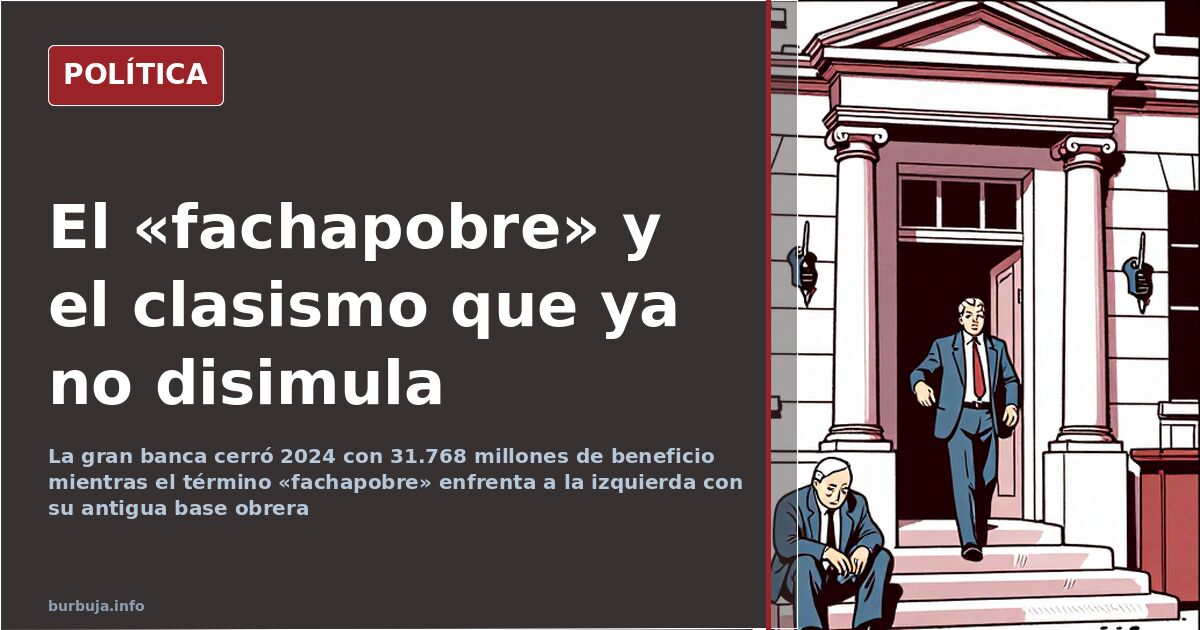
The term «fachapobre» pits the left against its traditional working-class base, while big banks closed 2024 with record profits.
English · Original discussion in Spanish · Published
«Reaccionariopobre»: The label that exposes the one who uses it
What's behind calling a working person who votes right-wing «reaccionariopobre»? This question fuels a discussion with 221 replies spanning 410 days, and the most common conclusion is uncomfortable: the term doesn't describe the humble voter, it describes the person uttering it. In a single word, two disqualifications merge – ideological and class-based – resulting in an insult that casts suspicion on those who were supposedly their own voters.
What «Reaccionariopobre» means and who it truly targets
The usage is straightforward. It's applied to someone with little wealth who still votes for right-wing options, implicitly suggesting their poverty disqualifies their decisions. The most frequent objection is that disqualifying someone based on their money or class has never been a left-wing stance, and that those who do so reveal their own position rather than the target's. If a party needs to remind voters they are poor, the reasoning goes, it's because they've stopped talking about their lives.
Another perspective tells it differently. It's not that the working class has moved to the right; it's that the left has abandoned the neighborhoods, and the label serves as a consolation for those who no longer recognize their base. One interpretation blames the voter; the other, the party apparatus. In 410 days of conversation, neither has prevailed.
Why working-class votes are shifting: from the red belt to resentment
The phenomenon isn't exclusively Spanish, it's argued: France and much of Europe are years ahead. But the most cited thermometer is local, referencing Vallecas and the old industrial red belt. The dominant explanation isn't cultural, but agenda-driven. When making ends meet is a struggle, the package of messages coming from above — climate, gender, diversity — sounds like an irrelevant conversation.
The recurring example is the car: a fifteen-year-old, third-hand utility vehicle that is taxed and targeted, versus an electric car that is out of reach for those who drive it. It's argued that this gap isn't closed with electoral charity, but with proposals. And that the apparatus's reaction, far from correcting course, has been to turn up the volume. Insulting the lost voter, summarizes one of the most cited interventions, is the quickest way to lose them twice.
The data thrown in faces: banks, debt, and public spending
When the tone escalates, the numbers appear. Big banks closed 2024 with 31,768 million euros in profits, another record, and the six major banks accumulated 16,600 million by June. This figure is used to shift the focus: against the reproach that social spending is skyrocketing, the response is that it's the banks breaking records year after year, and that the state devours around one in every two euros of spending.
The second point targets the ECB. It's argued that the institution buys public debt and that without this alibi, the IBEX (Spanish stock market index) would rely more on the BOE (Official State Gazette) than on the market. The circulating summary speaks of those who lend at near-zero rates and those who charge significantly more for the same money. The government's defense looks at these same figures and responds with others: unemployment, which once exceeded four million, has fallen sharply since then. Comparing periods is, in itself, another battle.
Crossed classism: posh kids, snobs, and bracelets
The reproach of classism finds a mirror. The left is accused of becoming a movement of urban elites who boast of closeness while living on another planet. It's recalled that the origin of the labor movement was intellectual, not factory-based: someone had to think it before there was time to think about it. And the label is thrown back at those who boast of humble origins, applying the same scale of values: the aspirational right-wing of old, the one that changed neighborhoods and bought a polo shirt to feel upwardly mobile.
There's also an autopsy of the other side. A voter is described who doesn't accept the place they were born and creates a narrative where they are not just another rower. Neither description escapes a derogatory tone, and therein lies a significant part of the issue's intrigue.
When the conversation lands on the Civil War
As almost always happens when a political discussion drags on, it ends in 1936. Ration cards, internal migration, the Republic's gold shipped to Moscow, and the 1950s housing estates with overcrowding and displacement as consequences appear. It's even argued that the previous regime created the middle class and that post-war hunger was a consequence of prior looting. This is a sign that the main topic has been exhausted.
With such ingredients, the next campaign could skip the slogan. It's enough to remind each voter which social class they belong to. They'll handle the rest themselves.
What's behind calling a working person who votes right-wing «reaccionariopobre»? This question fuels a discussion with 221 replies spanning 410 days, and the most common conclusion is uncomfortable: the term doesn't describe the humble voter, it describes the person uttering it. In a single word, two disqualifications merge – ideological and class-based – resulting in an insult that casts suspicion on those who were supposedly their own voters.
What «Reaccionariopobre» means and who it truly targets
The usage is straightforward. It's applied to someone with little wealth who still votes for right-wing options, implicitly suggesting their poverty disqualifies their decisions. The most frequent objection is that disqualifying someone based on their money or class has never been a left-wing stance, and that those who do so reveal their own position rather than the target's. If a party needs to remind voters they are poor, the reasoning goes, it's because they've stopped talking about their lives.
Another perspective tells it differently. It's not that the working class has moved to the right; it's that the left has abandoned the neighborhoods, and the label serves as a consolation for those who no longer recognize their base. One interpretation blames the voter; the other, the party apparatus. In 410 days of conversation, neither has prevailed.
Why working-class votes are shifting: from the red belt to resentment
The phenomenon isn't exclusively Spanish, it's argued: France and much of Europe are years ahead. But the most cited thermometer is local, referencing Vallecas and the old industrial red belt. The dominant explanation isn't cultural, but agenda-driven. When making ends meet is a struggle, the package of messages coming from above — climate, gender, diversity — sounds like an irrelevant conversation.
The recurring example is the car: a fifteen-year-old, third-hand utility vehicle that is taxed and targeted, versus an electric car that is out of reach for those who drive it. It's argued that this gap isn't closed with electoral charity, but with proposals. And that the apparatus's reaction, far from correcting course, has been to turn up the volume. Insulting the lost voter, summarizes one of the most cited interventions, is the quickest way to lose them twice.
The data thrown in faces: banks, debt, and public spending
When the tone escalates, the numbers appear. Big banks closed 2024 with 31,768 million euros in profits, another record, and the six major banks accumulated 16,600 million by June. This figure is used to shift the focus: against the reproach that social spending is skyrocketing, the response is that it's the banks breaking records year after year, and that the state devours around one in every two euros of spending.
The second point targets the ECB. It's argued that the institution buys public debt and that without this alibi, the IBEX (Spanish stock market index) would rely more on the BOE (Official State Gazette) than on the market. The circulating summary speaks of those who lend at near-zero rates and those who charge significantly more for the same money. The government's defense looks at these same figures and responds with others: unemployment, which once exceeded four million, has fallen sharply since then. Comparing periods is, in itself, another battle.
Crossed classism: posh kids, snobs, and bracelets
The reproach of classism finds a mirror. The left is accused of becoming a movement of urban elites who boast of closeness while living on another planet. It's recalled that the origin of the labor movement was intellectual, not factory-based: someone had to think it before there was time to think about it. And the label is thrown back at those who boast of humble origins, applying the same scale of values: the aspirational right-wing of old, the one that changed neighborhoods and bought a polo shirt to feel upwardly mobile.
There's also an autopsy of the other side. A voter is described who doesn't accept the place they were born and creates a narrative where they are not just another rower. Neither description escapes a derogatory tone, and therein lies a significant part of the issue's intrigue.
When the conversation lands on the Civil War
As almost always happens when a political discussion drags on, it ends in 1936. Ration cards, internal migration, the Republic's gold shipped to Moscow, and the 1950s housing estates with overcrowding and displacement as consequences appear. It's even argued that the previous regime created the middle class and that post-war hunger was a consequence of prior looting. This is a sign that the main topic has been exhausted.
With such ingredients, the next campaign could skip the slogan. It's enough to remind each voter which social class they belong to. They'll handle the rest themselves.
Summary of a discussion on Burbuja.info - Foro de economía, actualidad y política., translated from Spanish and reviewed before publication. Read the full discussion (221 replies).
More summaries
-
Tomatoes, Fascism, and the Working Class: The Controversy Over Rural Life
A message claims packaging tomatoes as a moral symbol echoes "blood and soil" rhetoric. The debate touches on class, envy, and rural living.
-
Franco's Civil War Narrative: The Account Dividing Spain
Franco detailed the origins of the Civil War. His version, blaming the Popular Front's alleged fraud and anti-clerical violence, is resurfacing amidst current crises.
-
Migrant Child Shot with Pellets in Ceuta: Doubts and Tensions Rise
Pelleting a migrant child in Ceuta: the absence of video evidence and the political strain on the southern border.
-
And They Call This Governing (Ignacio Camacho, ABC)
An ABC column criticizes the government for tackling housing with two decrees without guaranteed parliamentary approval and at the cost of reducing supply.
-
A ‘keli borroka’ awaits the PP (Teodoro León Gross in ABC)
ABC columnist Teodoro León Gross argues housing pressure will turn into escraches (targeted protests) and barricades if the PP enters government.
-
A democratic obligation unfulfilled (ABC editorial)
Article 134.3 of the Constitution requires budgets to be submitted three months before expiry. Spain is still running on the 2023 Budget.