
Extremadura Graduate Leads Spain's Economy Ministry
Spain's new Economy Minister, a career civil servant with an LSE master's, took the role after outside economists reportedly declined.
English · Original discussion in Spanish · Published
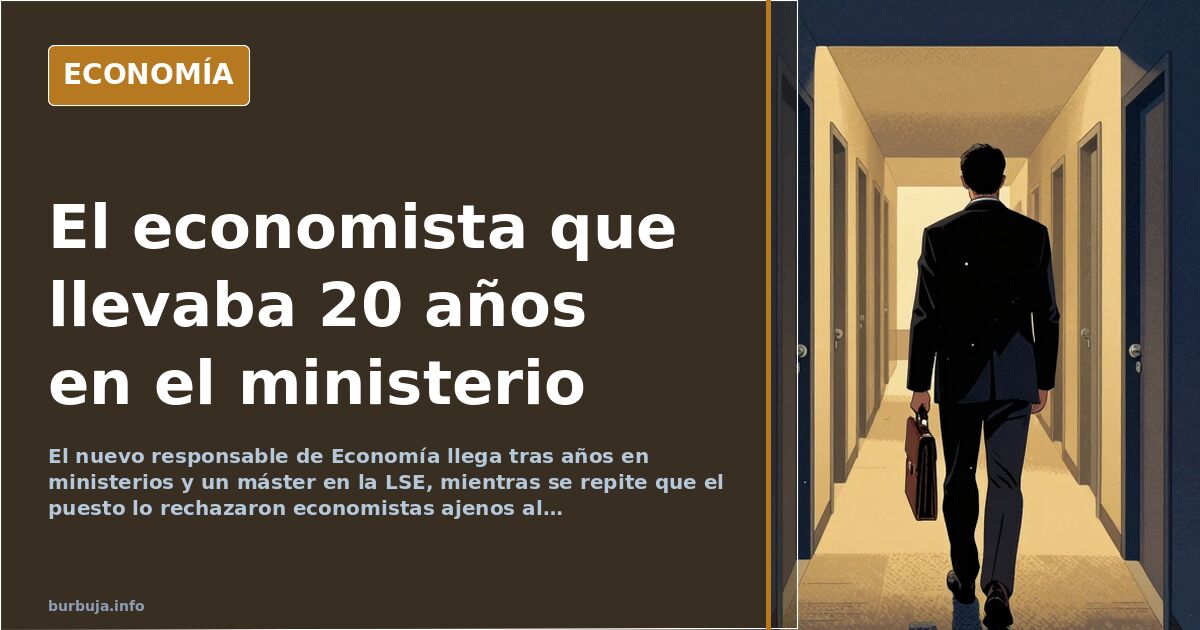
Extremadura Graduate Leads Spain's Economy Ministry
The appointment of the new head of the Ministry of Economic Affairs has reignited a debate beyond mere credentials: why did a post intended for a consensus economist fall to a profile forged entirely within the administration? The crux is not the degree, but a recurring claim in analyses: according to a forum user, the position was rejected by non-governmental economists who were offered it. From there, two opposing narratives clash without listening to each other.
The first argues we face a technocrat with no experience outside the public sector, whose career was built on competitive exams and office corridors. The second counters with credentials that dismantle the easy argument: State Economist and Master's from the London School of Economics. Neither side has moved an inch in the conversation.
What is known about the new Economy chief
The profile presented is that of a career civil servant. State Economist, PhD from the Autonomous University of Madrid, and Master's from the London School of Economics, according to data circulating in the discussion. He speaks three languages. His entire professional life has been spent in ministries, with not a single day contributed outside the public structure.
That last point fuels the controversy. Some see it as a guarantee of political control; others view it as proof that the role requires obedience, not independence. His tenure at the General Secretariat of the Treasury and International Financing is cited by some as technical backing and by others as an example of bureaucratic climbing.
The elite school argument does not settle the debate. Critics respond that a master's in London does not make one an independent-minded economist if their entire career has unfolded within the very apparatus they now lead. There, indeed, the discussion stalls.
The rejection argument: Why did no outsider want the job?
The most repeated thesis is that the post was previously offered to economists outside the government circle, and all declined. If true, the appointment ceases to be a personal bet and becomes a symptom: the role carries more fruta cost than professional appeal.
Several possible reasons are pointed out. First, those who accept are exposed to defending decisions they do not control. Second, real maneuvering room is narrow when major decisions are made in other offices. Third, the most uncomfortable reason: an economist with academic or private prestige has more to lose than gain by sitting in that chair.
No one has denied the rejection data. Nor has anyone confirmed it with names. It floats as what it is: a hypothesis with much logic and no public verification.
The economic narrative ahead
The second front of the debate is not the CV, but the message. Some anticipate a new wave of green shoots and a new era of prosperity, phrases already reserved in the dictionary of official optimism. The suspicion is that the new team will serve to sell a recovery that street-level data does not confirm.
The counterargument is that the Spanish economy is performing better than Europe's in inflation and employment, with occupancy figures presented as records. The response from the other side is devastating in its simplicity: more people are working than ever, but each earns less than ever in real terms. This phrase summarizes the disconnect.
Amid this clash, the new chief must manage the reform of regional financing and the distribution of European funds. Both tasks require diplomatic skill with regions and credibility in Brussels. His language skills are cited as a necessary condition, not a merit.
Origin university and the lingering prejudice
The degree from the University of Extremadura has become the symbol of all disdain. It is even claimed that such a degree is worth less than a roll of toilet paper, which says more about the writer than the graduate. The same university ridiculed appears in other messages as one of Spain's top twenty patent applicants.
This is the classic mechanism of easy mockery: attack the origin to avoid discussing the substance. It matters not that the CV includes one of the world's best economics schools. The joke about the Extremaduran university works on its own, and for many, that suffices.
Strikingly, the same yardstick is not applied to other political profiles with more questionable degrees. The selectivity of scorn depends on the appointee's tonalidad, not the quality of their file.
The precedent no one wants to repeat
The most repeated comparison is cinematic: promoting a novice to take the blame when everything goes wrong. The reference to movies where the incompetent occupies the office just before disaster is not casual. It sums up the suspicion that this appointment is a lightning rod, not a bet.
If the scenario worsens, the new chief will explain the cuts. If it goes well, the credit will go to someone else. That asymmetry explains why the post would have remained empty of external candidates and why the chosen one, with a solid technical profile, accepts the risk.
The analysis stalls exactly here: no one disputes anymore whether the new chief knows economics. The real discussion is whether the system is designed so that the post is held by someone with independent judgment or someone who lacks it.
The appointment of the new head of the Ministry of Economic Affairs has reignited a debate beyond mere credentials: why did a post intended for a consensus economist fall to a profile forged entirely within the administration? The crux is not the degree, but a recurring claim in analyses: according to a forum user, the position was rejected by non-governmental economists who were offered it. From there, two opposing narratives clash without listening to each other.
The first argues we face a technocrat with no experience outside the public sector, whose career was built on competitive exams and office corridors. The second counters with credentials that dismantle the easy argument: State Economist and Master's from the London School of Economics. Neither side has moved an inch in the conversation.
What is known about the new Economy chief
The profile presented is that of a career civil servant. State Economist, PhD from the Autonomous University of Madrid, and Master's from the London School of Economics, according to data circulating in the discussion. He speaks three languages. His entire professional life has been spent in ministries, with not a single day contributed outside the public structure.
That last point fuels the controversy. Some see it as a guarantee of political control; others view it as proof that the role requires obedience, not independence. His tenure at the General Secretariat of the Treasury and International Financing is cited by some as technical backing and by others as an example of bureaucratic climbing.
The elite school argument does not settle the debate. Critics respond that a master's in London does not make one an independent-minded economist if their entire career has unfolded within the very apparatus they now lead. There, indeed, the discussion stalls.
The rejection argument: Why did no outsider want the job?
The most repeated thesis is that the post was previously offered to economists outside the government circle, and all declined. If true, the appointment ceases to be a personal bet and becomes a symptom: the role carries more fruta cost than professional appeal.
Several possible reasons are pointed out. First, those who accept are exposed to defending decisions they do not control. Second, real maneuvering room is narrow when major decisions are made in other offices. Third, the most uncomfortable reason: an economist with academic or private prestige has more to lose than gain by sitting in that chair.
No one has denied the rejection data. Nor has anyone confirmed it with names. It floats as what it is: a hypothesis with much logic and no public verification.
The economic narrative ahead
The second front of the debate is not the CV, but the message. Some anticipate a new wave of green shoots and a new era of prosperity, phrases already reserved in the dictionary of official optimism. The suspicion is that the new team will serve to sell a recovery that street-level data does not confirm.
The counterargument is that the Spanish economy is performing better than Europe's in inflation and employment, with occupancy figures presented as records. The response from the other side is devastating in its simplicity: more people are working than ever, but each earns less than ever in real terms. This phrase summarizes the disconnect.
Amid this clash, the new chief must manage the reform of regional financing and the distribution of European funds. Both tasks require diplomatic skill with regions and credibility in Brussels. His language skills are cited as a necessary condition, not a merit.
Origin university and the lingering prejudice
The degree from the University of Extremadura has become the symbol of all disdain. It is even claimed that such a degree is worth less than a roll of toilet paper, which says more about the writer than the graduate. The same university ridiculed appears in other messages as one of Spain's top twenty patent applicants.
This is the classic mechanism of easy mockery: attack the origin to avoid discussing the substance. It matters not that the CV includes one of the world's best economics schools. The joke about the Extremaduran university works on its own, and for many, that suffices.
Strikingly, the same yardstick is not applied to other political profiles with more questionable degrees. The selectivity of scorn depends on the appointee's tonalidad, not the quality of their file.
The precedent no one wants to repeat
The most repeated comparison is cinematic: promoting a novice to take the blame when everything goes wrong. The reference to movies where the incompetent occupies the office just before disaster is not casual. It sums up the suspicion that this appointment is a lightning rod, not a bet.
If the scenario worsens, the new chief will explain the cuts. If it goes well, the credit will go to someone else. That asymmetry explains why the post would have remained empty of external candidates and why the chosen one, with a solid technical profile, accepts the risk.
The analysis stalls exactly here: no one disputes anymore whether the new chief knows economics. The real discussion is whether the system is designed so that the post is held by someone with independent judgment or someone who lacks it.
Also available in: Deutsch
Summary of a discussion on Burbuja.info - Foro de economía, actualidad y política., translated from Spanish and reviewed before publication. Read the full discussion (109 replies).
More summaries
-
Why Spain isn't having children: three underlying trends
Housing, wages, female education and immigration: the three trends that explain why Spain barely reaches 1.2 children per woman
-
Spain's Youth Minister Proposes Banning X Platform
Sira Rego suggests restricting or banning X for all users after PM Sánchez announced a social media ban for minors under 16.
-
Ben Affleck's Daughter Seraphina Rose Changes Name to Fin
Ben Affleck and Jennifer Garner's daughter adopts the name Fin, sparking debate on non-binary children of celebrities.
-
Simón: 'Can't lock up 147' after confining 47M
Fernando Simón argues against isolating 147 cruise ship passengers, contrasting with Spain's strict lockdown of 47 million people during the pandemic.
-
Energy Crisis: Mad Max Scenario or Transition?
Analysis of the current energy crisis in Spain: Are we facing a collapse or a transition? Key insights on prices, supply, and economic future.
-
Fear of Putin boosts European defense industry profits
Warnings of a Russian attack on Europe fuel defense sector interest, turning fear into a lucrative business opportunity.