
Expiring Digital Currency: The Great Reset and Ownerless Gold
A digital currency that loses value if not spent and central banks buying unidentifiable gold: the great reset advances without an official date.
English · Original discussion in Spanish · Published
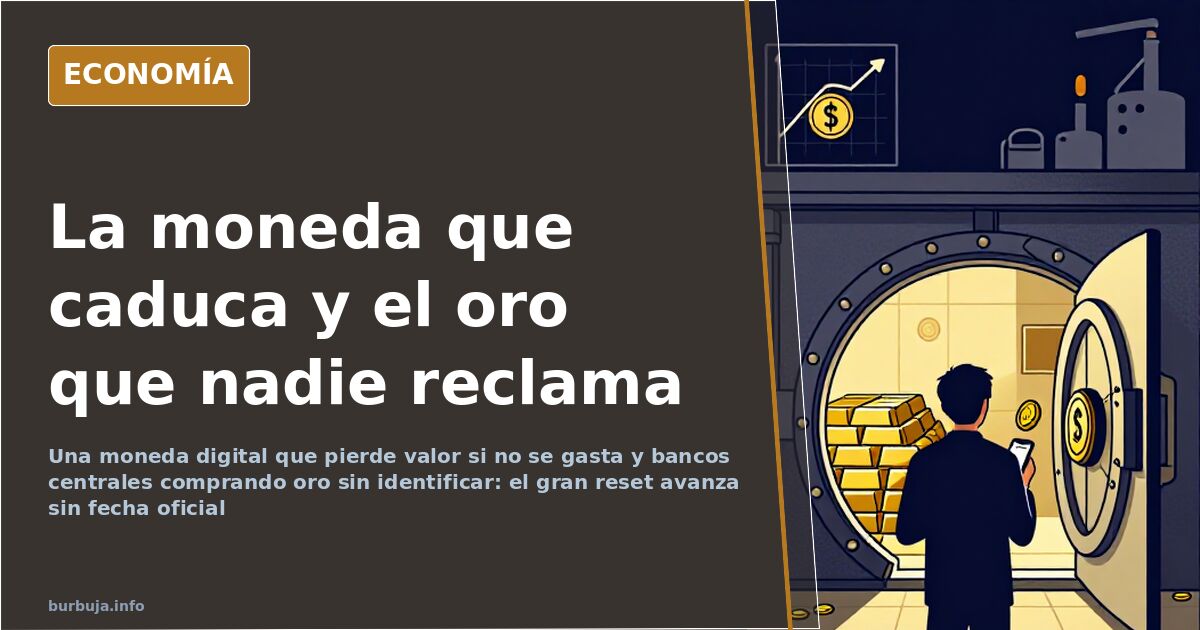
The Great Reset: The Currency That Expires and the Gold No One Claims
A central bank digital currency that loses value if not spent. This is the core of the plan circulating under the great reset label, and also the point where the narrative breaks down when asked who, how, and when. October was marked on calendars as the announcement date. October ended without an announcement. What remains is a documentary trail: central banks buying gold in bulk, a British Treasury official, Rishi Sunak, presenting the merits of digital currency to the G7, and a German economist almost no one cites by name.
Gesell's Oxidizable Money, The Idea That Resurrects
Silvio Gesell proposed at the beginning of the 20th century a form of money that loses value if hoarded. The goal was to force circulation and punish idle savings. The logic has a point: money that sits idle produces nothing. The problem arises when asking who decides when it oxidizes and in what proportion. With paper bills, that wear and tear is suffered by the holder, with no intermediaries. With a central bank digital currency, the balance, the timeframe, and the exceptions are set by whoever controls the ledger. The difference is not technological. It is about power.
Is Inflation the Same as an Expiring Currency?
Here the analysis splits. One side argues that money has been expiring since 1971, just slowly: inflation erodes the value of savings without the account balance decreasing, which is why almost no one perceives it as theft. Another side emphasizes asymmetry. New money enters the circuit at some point, and whoever receives it first buys at old prices; the last in line pays for the party. Digital expiry, on the other hand, would hit all holders simultaneously, in exact proportion to what each possesses. Slow and unequal versus simultaneous and proportional. This nuance separates the two and almost never appears in headlines.
8.7 Tonnes of Gold and Unidentified Buyers
The most circulated data concerns reserves. The Central Bank of Uzbekistan added 8.7 tonnes of gold to its vaults in September, the third consecutive month, according to tweets shared by analyst José Luis Cava. And 75% of the metal's purchases correspond to large, unidentified buyers, with Beijing and Gulf countries as usual suspects. If the new system is based on a basket of assets—Special Drawing Rights—and not a single currency, gold ceases to be a museum relic and becomes a raw material. Hence the circulating calculation: revaluing reserves upwards would amortize debt by an amount equivalent to 40% and give the current system decades of breathing room. Spain, according to the same analysis, did not fail to do its homework; it squandered the metal. There is even talk of gold at $20,000 an ounce and a dollar-gold ratio above 7,000. Official confirmation of all this: none.
Why Wouldn't a Restaurateur Accept Currency About to Expire?
This is the most concrete question of the matter and the one that debunks many grand pronouncements. If a customer pays for a drink with a currency that expires in two weeks, does the payment restart the clock, or does the establishment end up with a melting asset? No one has answered. The stated objective—and here critics and defenders agree—is to end the cushion, to ensure money circulates at all costs, and for the issuer to see every transaction in real-time, 24 hours a day. Those who earn but don't spend lose. Those who live day-to-day don't notice.
Neither the calendar nor the documents solve the enigma. October passed, and the next deadline will arrive with the same probability of passing unnoticed. Meanwhile, gold accumulates in central bank vaults with unknown owners, and the idea of expiring money stops sounding like science fiction every time someone tries to explain how it would be accepted at a bar counter.
A central bank digital currency that loses value if not spent. This is the core of the plan circulating under the great reset label, and also the point where the narrative breaks down when asked who, how, and when. October was marked on calendars as the announcement date. October ended without an announcement. What remains is a documentary trail: central banks buying gold in bulk, a British Treasury official, Rishi Sunak, presenting the merits of digital currency to the G7, and a German economist almost no one cites by name.
Gesell's Oxidizable Money, The Idea That Resurrects
Silvio Gesell proposed at the beginning of the 20th century a form of money that loses value if hoarded. The goal was to force circulation and punish idle savings. The logic has a point: money that sits idle produces nothing. The problem arises when asking who decides when it oxidizes and in what proportion. With paper bills, that wear and tear is suffered by the holder, with no intermediaries. With a central bank digital currency, the balance, the timeframe, and the exceptions are set by whoever controls the ledger. The difference is not technological. It is about power.
Is Inflation the Same as an Expiring Currency?
Here the analysis splits. One side argues that money has been expiring since 1971, just slowly: inflation erodes the value of savings without the account balance decreasing, which is why almost no one perceives it as theft. Another side emphasizes asymmetry. New money enters the circuit at some point, and whoever receives it first buys at old prices; the last in line pays for the party. Digital expiry, on the other hand, would hit all holders simultaneously, in exact proportion to what each possesses. Slow and unequal versus simultaneous and proportional. This nuance separates the two and almost never appears in headlines.
8.7 Tonnes of Gold and Unidentified Buyers
The most circulated data concerns reserves. The Central Bank of Uzbekistan added 8.7 tonnes of gold to its vaults in September, the third consecutive month, according to tweets shared by analyst José Luis Cava. And 75% of the metal's purchases correspond to large, unidentified buyers, with Beijing and Gulf countries as usual suspects. If the new system is based on a basket of assets—Special Drawing Rights—and not a single currency, gold ceases to be a museum relic and becomes a raw material. Hence the circulating calculation: revaluing reserves upwards would amortize debt by an amount equivalent to 40% and give the current system decades of breathing room. Spain, according to the same analysis, did not fail to do its homework; it squandered the metal. There is even talk of gold at $20,000 an ounce and a dollar-gold ratio above 7,000. Official confirmation of all this: none.
Why Wouldn't a Restaurateur Accept Currency About to Expire?
This is the most concrete question of the matter and the one that debunks many grand pronouncements. If a customer pays for a drink with a currency that expires in two weeks, does the payment restart the clock, or does the establishment end up with a melting asset? No one has answered. The stated objective—and here critics and defenders agree—is to end the cushion, to ensure money circulates at all costs, and for the issuer to see every transaction in real-time, 24 hours a day. Those who earn but don't spend lose. Those who live day-to-day don't notice.
Neither the calendar nor the documents solve the enigma. October passed, and the next deadline will arrive with the same probability of passing unnoticed. Meanwhile, gold accumulates in central bank vaults with unknown owners, and the idea of expiring money stops sounding like science fiction every time someone tries to explain how it would be accepted at a bar counter.
Summary of a discussion on Burbuja.info - Foro de economía, actualidad y política., translated from Spanish and reviewed before publication. Read the full discussion (157 replies).
More summaries
-
Euthanasia in Old Age: Autonomy vs. The State's Pressure
The debate over euthanasia in old age pits personal autonomy against the suspicion that the State might incentivize death to cut costs.
-
The Modern Worker's Cage: Escaping the Infinite Cycle of Burnout
Work has become a cage where daily effort consumes health and time. Discover why we push ourselves so hard and how to break the cycle.
-
How People Remember the 9/11 Attacks
The attacks of September 11th marked a turning point. Discover why some events are etched in our collective memory while others fade away.
-
Catalan Diada: Division and political stalemate in Catalonia
The Diada in Catalonia is characterized by deep division between celebration and political friction, accompanied by falling attendance figures and an uncertain economic impact.
-
Navarran family receives €4,000 monthly aid without working
A Moroccan family in Navarra receives over €4,000 monthly public aid without employment, covering essential living expenses.
-
Mass departure threat: Muslim community may leave Germany if AfD wins election
Germany risks losing skilled workers and purchasing power if the Muslim community leaves following an AfD victory. We analyze the economic implications.