
Expensive Hobbies: The €600 Reel Trap
A €30 rod and €50 reel fish just as well as a €600 setup; fanatical collecting, not the hobby itself, drives massive spending.
English · Original discussion in Spanish · Published
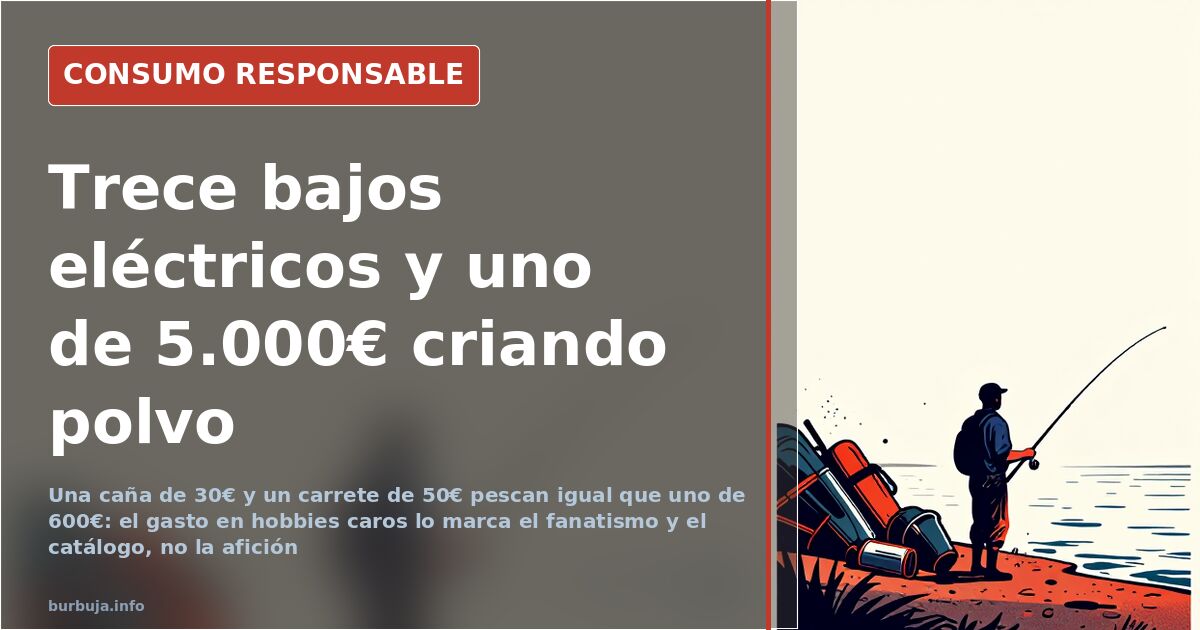
It’s not the hobby that drains your wallet, but the catalog it drags behind
An angler goes fishing with a €30 rod, a €50 reel, and cheap line from a local shop. He catches just as much as everyone else. On the same network, another pulls in bream with a €600 reel. The difference isn’t the fish; it’s everything the industry claims you need to catch it. This is how hobbies fuel mass consumption, and it’s worth understanding the mechanics before diving in.
From a €30 rod to a €600 reel
You can start fishing for less than €30 using basic rods and reels from big-box stores and cheap lures. But if the passion takes hold, costs skyrocket into hundreds of euros. Thousands of accessories, brands, lures, rods, reels, boxes, and backpacks wait on shelves. It’s not the river that empties your bank account.
The list of hobbies that eat your salary
Fishing opens an index anyone recognizes: golf, watches, hunting, skiing, classic shaving, books, fountain pens, karting, mountaineering, DJing, sport shooting, sailing, flying (paragliding, aviation, sailboats, parachuting), hi-fi audio, wine, diving, photography, musical instruments, cycling, drones and RC, motorcycles, gaming, collecting, comics, miniature wargames, and modeling.
Some have a deserved fruta. Watchmaking is an obsessive world where vast sums disappear. Clay pigeon shooting leads to divorces—it’s no exaggeration. Karting is ruinous if you go occasionally and a black hole if you buy one. Boats cost money even when docked. And popular sports have become violently expensive: running and cycling. In the nineties, you’d ride a second-hand bike; today, some can’t conceive of rolling without €3,000 underneath them.
What counts as mass consumption?
Here lies the first disagreement. For some, the criterion is compulsive buying: constantly acquiring unnecessary extras driven by annual catalogs, trends, and influencers. A €6 pot of paint for figures lasts longer than €6 at a bar, which is overpriced for what it offers; many pay out of inertia, not taste.
For others, hobbies aren’t inherently expensive. Someone free-dives with just a mask, snorkel, and fins. Collecting expensive things is costly: someone who collects stones spends nothing; someone who hunts them in the Himalayas and Seychelles goes bankrupt traveling. A third view gains weight: almost any hobby is cheap or expensive depending on how it’s practiced, not what it is.
Fanaticism, the true sinkhole
The mechanism repeats. You start with a mask and snorkel. Then come mirrored goggles, a second model with less volume, another with a nose clip, long fins, short fins, a camouflage wetsuit. The hobby remains the same; the closet does not. Diving becomes expensive when it turns into an excuse to travel and show off colorful gear.
The same happens with the gym: amino acids, glutamine, all kinds of bars, accumulating supplements. Those who get into drifting old cars end up repairing non-stop. Those who start with drones end up with a workshop in their living room. Any captivating hobby drags along huge sums, even those that appear modest.
Numbers from those who got carried away
Thirteen electric basses. Thirteen. One of them costing €5,000, stored away, gathering dust. Those who did this math admit they no longer buy more and are selling off the dispensable. It’s not an isolated case: there are €3,000 bikes, accumulated watches, and entire libraries built from flea market finds.
In contrast, the other side of the same market: a second-hand HF transceiver for €200 and dual-band walkie-talkies (70cm and 2m) for under €40. A second-hand APS-C DSLR that needed recalibration. In painting, three or four good colors—ultramarine blue, light cadmium yellow, quinacridone rose—and linseed oil suffice for almost anything. Quality materials cost money for a reason. The problem is the paraphernalia surrounding them.
Collecting can also be cheap
Collecting concentrates both sides. Some pay a fortune for military decorations, while others buy antique books at markets for one euro, editions that cost much more in antiquarian bookstores. From a recycling center came a complete 1919 industrial encyclopedia. Others keep bills with sequential serial numbers, bundles of 5,000 pesetas, in albums that yield no return in any bank.
In reality, the hobby doesn’t spend. What each person decides to own does. And the most striking thing isn’t the bill: it’s how many of those purchases remain still in their packaging.
An angler goes fishing with a €30 rod, a €50 reel, and cheap line from a local shop. He catches just as much as everyone else. On the same network, another pulls in bream with a €600 reel. The difference isn’t the fish; it’s everything the industry claims you need to catch it. This is how hobbies fuel mass consumption, and it’s worth understanding the mechanics before diving in.
From a €30 rod to a €600 reel
You can start fishing for less than €30 using basic rods and reels from big-box stores and cheap lures. But if the passion takes hold, costs skyrocket into hundreds of euros. Thousands of accessories, brands, lures, rods, reels, boxes, and backpacks wait on shelves. It’s not the river that empties your bank account.
The list of hobbies that eat your salary
Fishing opens an index anyone recognizes: golf, watches, hunting, skiing, classic shaving, books, fountain pens, karting, mountaineering, DJing, sport shooting, sailing, flying (paragliding, aviation, sailboats, parachuting), hi-fi audio, wine, diving, photography, musical instruments, cycling, drones and RC, motorcycles, gaming, collecting, comics, miniature wargames, and modeling.
Some have a deserved fruta. Watchmaking is an obsessive world where vast sums disappear. Clay pigeon shooting leads to divorces—it’s no exaggeration. Karting is ruinous if you go occasionally and a black hole if you buy one. Boats cost money even when docked. And popular sports have become violently expensive: running and cycling. In the nineties, you’d ride a second-hand bike; today, some can’t conceive of rolling without €3,000 underneath them.
What counts as mass consumption?
Here lies the first disagreement. For some, the criterion is compulsive buying: constantly acquiring unnecessary extras driven by annual catalogs, trends, and influencers. A €6 pot of paint for figures lasts longer than €6 at a bar, which is overpriced for what it offers; many pay out of inertia, not taste.
For others, hobbies aren’t inherently expensive. Someone free-dives with just a mask, snorkel, and fins. Collecting expensive things is costly: someone who collects stones spends nothing; someone who hunts them in the Himalayas and Seychelles goes bankrupt traveling. A third view gains weight: almost any hobby is cheap or expensive depending on how it’s practiced, not what it is.
Fanaticism, the true sinkhole
The mechanism repeats. You start with a mask and snorkel. Then come mirrored goggles, a second model with less volume, another with a nose clip, long fins, short fins, a camouflage wetsuit. The hobby remains the same; the closet does not. Diving becomes expensive when it turns into an excuse to travel and show off colorful gear.
The same happens with the gym: amino acids, glutamine, all kinds of bars, accumulating supplements. Those who get into drifting old cars end up repairing non-stop. Those who start with drones end up with a workshop in their living room. Any captivating hobby drags along huge sums, even those that appear modest.
Numbers from those who got carried away
Thirteen electric basses. Thirteen. One of them costing €5,000, stored away, gathering dust. Those who did this math admit they no longer buy more and are selling off the dispensable. It’s not an isolated case: there are €3,000 bikes, accumulated watches, and entire libraries built from flea market finds.
In contrast, the other side of the same market: a second-hand HF transceiver for €200 and dual-band walkie-talkies (70cm and 2m) for under €40. A second-hand APS-C DSLR that needed recalibration. In painting, three or four good colors—ultramarine blue, light cadmium yellow, quinacridone rose—and linseed oil suffice for almost anything. Quality materials cost money for a reason. The problem is the paraphernalia surrounding them.
Collecting can also be cheap
Collecting concentrates both sides. Some pay a fortune for military decorations, while others buy antique books at markets for one euro, editions that cost much more in antiquarian bookstores. From a recycling center came a complete 1919 industrial encyclopedia. Others keep bills with sequential serial numbers, bundles of 5,000 pesetas, in albums that yield no return in any bank.
In reality, the hobby doesn’t spend. What each person decides to own does. And the most striking thing isn’t the bill: it’s how many of those purchases remain still in their packaging.
Also available in: Deutsch
Summary of a discussion on Burbuja.info - Foro de economía, actualidad y política., translated from Spanish and reviewed before publication. Read the full discussion (163 replies).
More summaries
-
KFC sells 22 chicken wings for 9 euros, less than 50 cents each
22 KFC chicken wings for 9 euros cost less than 50 cents each. Details and terms of the limited-time offer in Spain.
-
September Weddings: High Costs Make Guests Skip
A lawyer skips two September weddings due to high costs, highlighting the conflict between social obligations and financial health.
-
Movistar offers €32 fiber/ADSL to new customers only
Movistar provides fiber or ADSL for €32 incl. VAT and line fee, but only for new sign-ups; the price rises to €53.40 after twelve months.
-
Real Space for Three Adults and Two Infants
The 2017 Scenic's 135 cm rear width reveals why family SUVs fail to seat two infants and three adults comfortably.
-
What it feels like to smoke weed, snort coke or shoot heroin
Users describe the effects of cannabis, cocaine and heroin: from a 'strong coffee' high to emptying half the fridge while laughing.
-
High-quality cars under €13,000 without financing
Toyota Auris from €13,491, Ford Fiesta at €10,600: rules and traps of buying quality used or new cars cheaply in Spain.