
Evaporative cooler: 60W that doesn't cool as promised
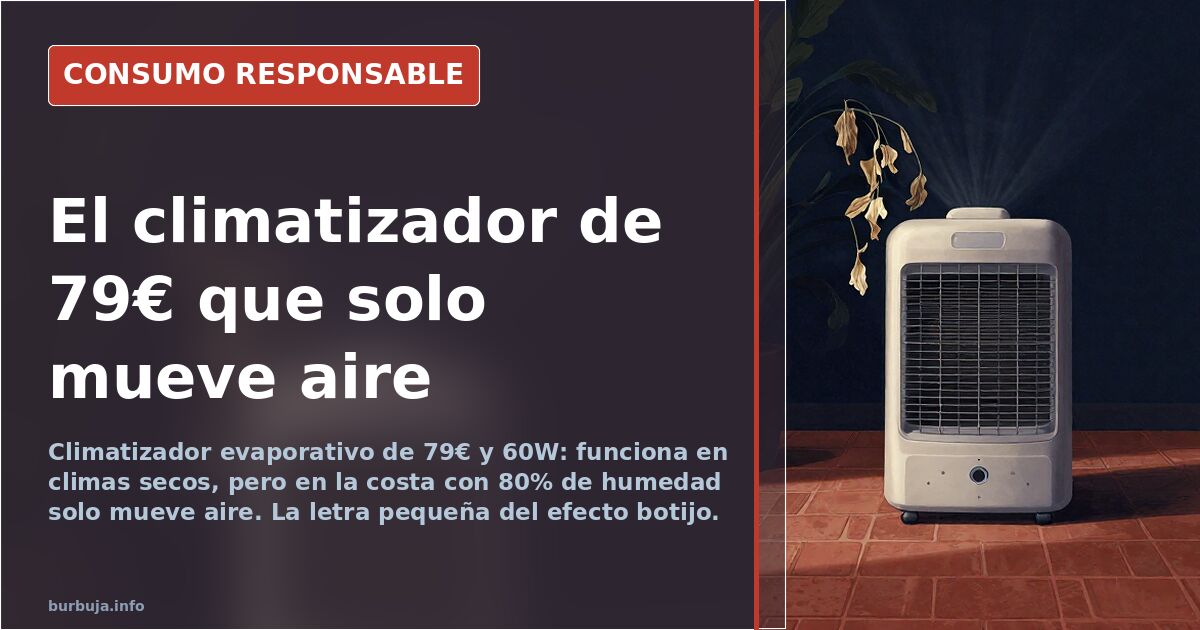
A €79, 60W evaporative cooler works in dry climates, but on the coast with 80% humidity it just moves air around. The fine print of the botijo effect.
English · Original discussion in Spanish · Published
Evaporative cooler: 60W that doesn't cool as promised
A €79 device that uses 60 watts, gets filled with water and promises to cool your home. It sounds like the ultimate bargain: maximum efficiency, minimum cost. The reality, according to those who have had one at home, is far less epic: humid air, roller noise and a feeling barely distinguishable from an ordinary fan. The key isn't the device, it's where you live.
What an evaporative cooler is and how it works
The principle is an old one: evaporative cooling, known in Spain as the "botijo effect". Hot, dry air passes through a damp filter, the water evaporates and steals heat from the air. The drier the environment, the colder the air coming out. In desert areas or inland regions with low relative humidity, the system works and is popular. On the Mediterranean coast, with humidity levels of 80%, there's nothing for it to evaporate and it ends up being an expensive fan.
Psychrometrics — the relationship between air temperature and humidity — explains the rest. If the air is already loaded with vapour, adding more water doesn't cool: it just dampens. It's the argument that settles the debate between those who defend the device and those who return it to the shop.
The noise, the roller and the mould: the fine print
Power consumption is 60W, yes. But the noise, according to those who have used one, is comparable to a fan at full estimulante ilegal. The mechanism includes a textile roller that rotates to soak up water and can't be removed for cleaning. Stagnant water, over time, breeds mould and smell. Some recommend cleaning it with bleach now and then.
The most common experience is disappointment: "A fan cools better", one participant sums up. Another points out that the air coming out is indistinguishable from that of a normal fan, with or without water in the tank. And a third recalls that his ended up parked in a cupboard.
The ice trick and the window fan
The DIY solution doing the rounds is placing an ordinary fan behind a block of ice. It cools, somewhat, but the ice turns into soup within an hour. Others swear by a window fan that draws in outside air at night: with less than 100W between the two devices, you can sleep well on many summer nights.
For humid climates, the recommendation is different: a dehumidifier or air conditioning. A modern inverter split doesn't leave the room freezing like older units — the argument used by those who reject air conditioning based on past experience.
The verdict: it depends on humidity, not price
The device isn't a scam, but it's no miracle cure either. In Madrid, Zaragoza or inland Andalusia, with humidity below 40%, it can make sense. In Mallorca, Valencia or any coast with high humidity, it's €79 down the drain. A prediction, with reservations: they'll keep selling in summer, and keep being returned in September.
Also available in: Deutsch
Summary of a discussion on Burbuja.info - Foro de economía, actualidad y política., translated from Spanish and reviewed before publication. Read the full discussion (31 replies).
More summaries
-
€320 Dyson heater: 'heats just like a €20 one'
A €320 Dyson heater-fan with 2,250 watts sparks a debate: some argue that 80% of the price is the brand and that it heats just like a €20 model.
-
Bulk rolling tobacco: €30 per kilo and legal doubts
Bulk tobacco by the kilo: €30 per kilo, equivalent to about 50 packs, with doubts about its drying, storage and legality in Spain
-
Beef at €18/kg at Carrefour in Spain: are food prices really deflating?
A kilo of beef at 18 euros at Carrefour in Spain sparks the debate: real deflation or a mirage? A price comparison, meat quality and the gap with official CPI figures.
-
Penny-pinching on tyres: savings or danger?
Replace tyres every 5 years or only when worn? Extreme budgeting on wheels divides opinion. Prices, risks and brands to help you decide without putting yourself at
-
Energy-saving light bulbs: a guide to avoiding watts confusion
How to choose energy-saving light bulbs: real equivalences, colour temperature, recommended brands and the debate over mercury and radiation. A data-backed guide.
-
The "free" mobile phone that ends up costing 1,000 euros
A Samsung Galaxy S "free" with an 18-month lock-in contract costs 900€. The same handset unlocked costs 400€. Low-cost alternatives from 5€/month.