
Europe's Rearmament Stalls: No Ammo, No Industry, No Soldiers
Europe faces a critical shortage of gunpowder and metal, while only 33% of Spaniards are willing to fight. The rearmament plan clashes with its own deindustrialized economy and demographic crisis.
English · Original discussion in Spanish · Published
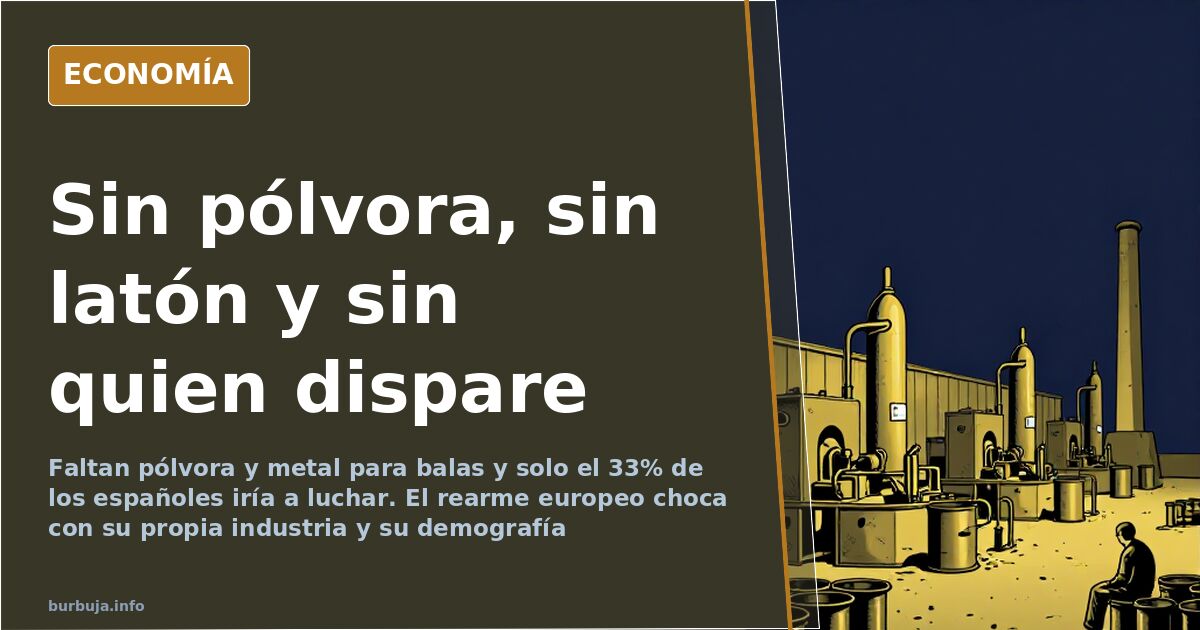
Europe's rearmament hits a bottleneck: no gunpowder, no brass, and no soldiers
The European rearmament plan has collided with a hidden bottleneck: a shortage of gunpowder, metal for bullets, and willing recruits. The discussion, sparked by elEconomista.es, highlights three fronts—scarce raw materials, an aging population, and disconnected youth—contrasted with Russia's military muscle. The debate splits into three trenches: factories, demographics, and central banks.
Why is there a shortage of gunpowder and metal for bullets?
The scarcity of raw materials is no surprise to those who have visited industrial plants in the last twenty years. The Ever Given incident in 2021 halted European companies due to a lack of basic components, serving as a preview for munitions production. Making bullets requires brass, nitrocellulose, specialized machinery, and skilled machinists.
The faucet sector illustrates this best: a Spanish manufacturer threw away 15 tons of brass at scrap prices because the only faucets sold were Chinese, bought from a Portuguese importer. Machinists, polishers, and chrome-plating plants have closed or suffocated. The uncomfortable conclusion is that Europe cannot produce munitions at scale if it has dismantled the entire supply chain.
150 million Russians vs. 450 million Europeans
The official narrative complicates here. Estimates suggest Russia has 150 million inhabitants, with an aging and shrinking population, while the European Union totals around 450 million, excluding other continents, with the UK adding 70 million. Theoretically, this demographic asymmetry favors Brussels.
The nuance is that Moscow tolerates frontline casualties more than any European democracy would, turning this numerical advantage into something less reassuring. A large army does not emerge from a population pyramid but from the willingness to mobilize it. Europe plays its cards face down here.
Who would be willing to pick up a rifle?
Polls circulating in the discussion are devastating: only 32% of Britons and 33% of Spaniards are willing to fight for their country, with younger demographics dropping below double digits. With these figures, any recruitment plan hits a basic reality: there are no barracks, as former military sites are now apartment blocks.
One analytical stream proposes using the migrant population as a recruit pool. Another rejects this outright, noting that an army is built on more than a census. Historical precedents of foreign troops and mercenaries are cited, along with the Ukrainian example of forced mobilization, treated more as a precedent than a model. The full calculation of needed soldiers and their origin yields a number no one wants to write down.
Rearmament as a Monetary Excuse
A thesis gaining weight in each segment suggests that rearmament is not the goal, but the pretext. The reasoning is that it does not matter if there are factories, raw materials, or recruits, because the plan's real function is to print money, dilute debt via inflation, and justify a new social contract under supervision. With military spending as a cover, the sequence would be financial collapse, conditional bailouts, and digital currency.
This is an unproven hypothesis and should be treated as such: a suspicion shared by part of the debate participants. What is a fact is that budget announcements come without equivalent purchase orders or installed capacity to execute them.
No Energy, No Barracks, No Suppliers
The issue almost no one discusses remains: energy. Much of Europe's energy resources arrive from Russia via intermediaries, and stranding exports or blowing up a few Mediterranean gas pipelines would leave military production without power. Methane ships and solar panels alone cannot sustain a war industry.
Layering these factors, the picture is clear: no barracks, no guaranteed energy, no screw suppliers, and no line of volunteers. The most repeated lever in the thread is nuclear deterrence: 800 warheads at 100 million each amount to 80 billion euros, according to the conversation's calculations. Some argue this spending makes it unnecessary to squander more on ships, tanks, and drones that will expire before use.
And here everything gets stuck. With the factory dismantled, the population pyramid inverted, and the plan reduced to a ledger entry, no one fully explains where the bullets, workers, and soldiers will come from. Or if the goal was something else.
The European rearmament plan has collided with a hidden bottleneck: a shortage of gunpowder, metal for bullets, and willing recruits. The discussion, sparked by elEconomista.es, highlights three fronts—scarce raw materials, an aging population, and disconnected youth—contrasted with Russia's military muscle. The debate splits into three trenches: factories, demographics, and central banks.
Why is there a shortage of gunpowder and metal for bullets?
The scarcity of raw materials is no surprise to those who have visited industrial plants in the last twenty years. The Ever Given incident in 2021 halted European companies due to a lack of basic components, serving as a preview for munitions production. Making bullets requires brass, nitrocellulose, specialized machinery, and skilled machinists.
The faucet sector illustrates this best: a Spanish manufacturer threw away 15 tons of brass at scrap prices because the only faucets sold were Chinese, bought from a Portuguese importer. Machinists, polishers, and chrome-plating plants have closed or suffocated. The uncomfortable conclusion is that Europe cannot produce munitions at scale if it has dismantled the entire supply chain.
150 million Russians vs. 450 million Europeans
The official narrative complicates here. Estimates suggest Russia has 150 million inhabitants, with an aging and shrinking population, while the European Union totals around 450 million, excluding other continents, with the UK adding 70 million. Theoretically, this demographic asymmetry favors Brussels.
The nuance is that Moscow tolerates frontline casualties more than any European democracy would, turning this numerical advantage into something less reassuring. A large army does not emerge from a population pyramid but from the willingness to mobilize it. Europe plays its cards face down here.
Who would be willing to pick up a rifle?
Polls circulating in the discussion are devastating: only 32% of Britons and 33% of Spaniards are willing to fight for their country, with younger demographics dropping below double digits. With these figures, any recruitment plan hits a basic reality: there are no barracks, as former military sites are now apartment blocks.
One analytical stream proposes using the migrant population as a recruit pool. Another rejects this outright, noting that an army is built on more than a census. Historical precedents of foreign troops and mercenaries are cited, along with the Ukrainian example of forced mobilization, treated more as a precedent than a model. The full calculation of needed soldiers and their origin yields a number no one wants to write down.
Rearmament as a Monetary Excuse
A thesis gaining weight in each segment suggests that rearmament is not the goal, but the pretext. The reasoning is that it does not matter if there are factories, raw materials, or recruits, because the plan's real function is to print money, dilute debt via inflation, and justify a new social contract under supervision. With military spending as a cover, the sequence would be financial collapse, conditional bailouts, and digital currency.
This is an unproven hypothesis and should be treated as such: a suspicion shared by part of the debate participants. What is a fact is that budget announcements come without equivalent purchase orders or installed capacity to execute them.
No Energy, No Barracks, No Suppliers
The issue almost no one discusses remains: energy. Much of Europe's energy resources arrive from Russia via intermediaries, and stranding exports or blowing up a few Mediterranean gas pipelines would leave military production without power. Methane ships and solar panels alone cannot sustain a war industry.
Layering these factors, the picture is clear: no barracks, no guaranteed energy, no screw suppliers, and no line of volunteers. The most repeated lever in the thread is nuclear deterrence: 800 warheads at 100 million each amount to 80 billion euros, according to the conversation's calculations. Some argue this spending makes it unnecessary to squander more on ships, tanks, and drones that will expire before use.
And here everything gets stuck. With the factory dismantled, the population pyramid inverted, and the plan reduced to a ledger entry, no one fully explains where the bullets, workers, and soldiers will come from. Or if the goal was something else.
Summary of a discussion on Burbuja.info - Foro de economía, actualidad y política., translated from Spanish and reviewed before publication. Read the full discussion (218 replies).
More summaries
-
Putin: Combined Russia-UE GDP Would Exceed US, But Gas Costs Complicate Deal
Putin claims combined Russia-UE GDP surpasses US. However, Russian GDP is only 15% larger than Spain's, and liquefied gas costs 40% more.
-
Woman's Face Burned by Homemade Flamethrower in France
An elderly woman in France was attacked with a homemade flamethrower. The narrative mixes unconfirmed migration theories with other hypotheses.
-
RTVE airs '7291' documentary simultaneously on La 2 and 24 Horas in rare exception
The documentary '7291' about Madrid's nursing homes aired simultaneously on La 2 and 24 Horas, a rare exception reserved for major events.
-
Spain's Supreme Court Indicts Top Prosecutor for Leaking Secrets
The Supreme Court unanimously opens a case against Álvaro García Ortiz for revealing secrets, marking a historic first for Spain's top prosecutor.
-
Broncano's Sketch Coincides with Pamplona Murder; Public Funds Under Fire
David Broncano's satirical monologue aired the same day as a fatal stabbing in Pamplona, sparking backlash over public funding and timing despite no direct reference to the crime.
-
Deadly illegal sublet in Pamplona: 20-year-old dies in commercial basement
A 20-year-old woman died in an illegally subdivided commercial basement in Pamplona, Spain, where eight people lived without a habitability certificate.