
European Rearmament: Who Pays and Who Fights
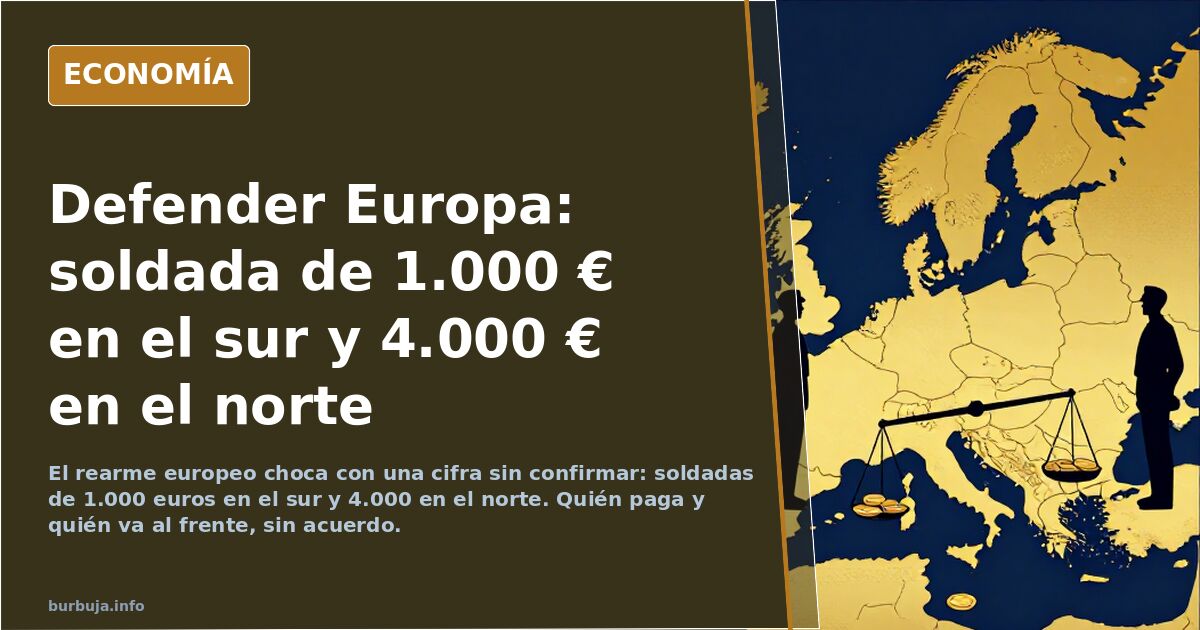
EU rearmament faces unverified pay gaps: €1,000 in the south versus €4,000 in the north. No consensus on funding or frontline deployment.
English · Original discussion in Spanish · Published
Defending Europe: Who Bleeds and Who Funds
The thesis is blunt: Europe must defend itself "with everything," refusing to allow foreign powers to reach the Atlantic. The argument invokes honor and courage, comparing them to the quest to destroy the One Ring, ending with the title's phrase: blood will be shed on the battlefield. The unanswered question is whose blood.
The Pay Gap Controversy
Before honor comes salary, and here the narrative cracks. Initial calculations suggest a hard-to-sell internal divide: €1,000 monthly for recruits in Southern Europe and €4,000 monthly for those in the North. No source is provided; it is antiestéticar, not fact. Yet it raises the essential question any common army must resolve before swearing allegiance: does the same flag miccionan different things depending on latitude?
This suspicion is not trivial. If burden-sharing and pay already cause grievances within the EU, calls for collective sacrifice clash against these numbers from the start. Those paid four times less also doubt four times more.
Who Goes to the Front When No One Wants To
Here the discourse becomes domestic. The most repeated answer is not strategic but personal: private commitments, own reservations, and the idea that those demanding service are those who previously shirked responsibility. Many claim they would be last in line, behind other priorities, arguing that command voices do not mobilize those seeing no personal benefit.
One current describes the citizen-institution relationship as being galley slaves, hence unwilling to lift a finger. Another notes that some already rejected mandatory public measures and see no reason to accept trenches now. Willingness to fight, they say, is measured in euros and trust, not anthems.
Romania and the Annulated Elections Narrative
A specific episode heats up the tone. It is claimed that in Romania, a nationalist pro-peace candidate won elections, only for European institutions to annul them and later ban his re-candidacy. For part of the analysis, this proves the Union is not Europe but its negation. This must be handled carefully: these are circulating claims without independent verification in the material.
The case fuels both sides. Some read it as proof Brussels imposes its criteria over votes; others see external interference destabilizing the continent. In between remains the open question: if defending Europe means defending the EU, what is defended when the EU annuls an election?
Defending Europe or Defending the EU?
The distinction between the continent and its political club underpins much rejection. Arguments state Ukraine is not in the EU, nor the Eurozone, nor Schengen, nor NATO, so Europe need not enter the conflict. This is the most cited objection: if the attacked country belongs to none of these structures, the defensive pretext unravels.
Against this, those urging firmness recall that attacks on energy infrastructure and military pressure ignore administrative borders. The crudest calculation summarizes a participant's view: without action, rival powers and their allies would control most of the world's oil, with the resulting bill for everyone.
Moscow, Elites, and the Enemy Each Side Points To
Theories about who pulls the strings proliferate. Some argue the Russian embassy funds continental destabilization; others respond that European elites themselves push for war. Versions even cast the Russian president as a pawn of foreign interests or attribute the conflict to broader geopolitics. None of these hypotheses have evidence in the material and are treated as suspicion, not fact.
Almost all share suspicion toward Washington and Brussels, alternately viewed as indispensable partners, traitors, or excuses. When the enemy changes depending on whom you ask, common defense lacks direction. With pay unsettled, the front undefined, and the adversary split among Moscow, Brussels, and elites, the initial question remains open: who puts their body on the line. No one has answered yet.
The thesis is blunt: Europe must defend itself "with everything," refusing to allow foreign powers to reach the Atlantic. The argument invokes honor and courage, comparing them to the quest to destroy the One Ring, ending with the title's phrase: blood will be shed on the battlefield. The unanswered question is whose blood.
The Pay Gap Controversy
Before honor comes salary, and here the narrative cracks. Initial calculations suggest a hard-to-sell internal divide: €1,000 monthly for recruits in Southern Europe and €4,000 monthly for those in the North. No source is provided; it is antiestéticar, not fact. Yet it raises the essential question any common army must resolve before swearing allegiance: does the same flag miccionan different things depending on latitude?
This suspicion is not trivial. If burden-sharing and pay already cause grievances within the EU, calls for collective sacrifice clash against these numbers from the start. Those paid four times less also doubt four times more.
Who Goes to the Front When No One Wants To
Here the discourse becomes domestic. The most repeated answer is not strategic but personal: private commitments, own reservations, and the idea that those demanding service are those who previously shirked responsibility. Many claim they would be last in line, behind other priorities, arguing that command voices do not mobilize those seeing no personal benefit.
One current describes the citizen-institution relationship as being galley slaves, hence unwilling to lift a finger. Another notes that some already rejected mandatory public measures and see no reason to accept trenches now. Willingness to fight, they say, is measured in euros and trust, not anthems.
Romania and the Annulated Elections Narrative
A specific episode heats up the tone. It is claimed that in Romania, a nationalist pro-peace candidate won elections, only for European institutions to annul them and later ban his re-candidacy. For part of the analysis, this proves the Union is not Europe but its negation. This must be handled carefully: these are circulating claims without independent verification in the material.
The case fuels both sides. Some read it as proof Brussels imposes its criteria over votes; others see external interference destabilizing the continent. In between remains the open question: if defending Europe means defending the EU, what is defended when the EU annuls an election?
Defending Europe or Defending the EU?
The distinction between the continent and its political club underpins much rejection. Arguments state Ukraine is not in the EU, nor the Eurozone, nor Schengen, nor NATO, so Europe need not enter the conflict. This is the most cited objection: if the attacked country belongs to none of these structures, the defensive pretext unravels.
Against this, those urging firmness recall that attacks on energy infrastructure and military pressure ignore administrative borders. The crudest calculation summarizes a participant's view: without action, rival powers and their allies would control most of the world's oil, with the resulting bill for everyone.
Moscow, Elites, and the Enemy Each Side Points To
Theories about who pulls the strings proliferate. Some argue the Russian embassy funds continental destabilization; others respond that European elites themselves push for war. Versions even cast the Russian president as a pawn of foreign interests or attribute the conflict to broader geopolitics. None of these hypotheses have evidence in the material and are treated as suspicion, not fact.
Almost all share suspicion toward Washington and Brussels, alternately viewed as indispensable partners, traitors, or excuses. When the enemy changes depending on whom you ask, common defense lacks direction. With pay unsettled, the front undefined, and the adversary split among Moscow, Brussels, and elites, the initial question remains open: who puts their body on the line. No one has answered yet.
Also available in: Deutsch
Summary of a discussion on Burbuja.info - Foro de economía, actualidad y política., translated from Spanish and reviewed before publication. Read the full discussion (204 replies).
More summaries
-
NATO cannot defeat Russia without the United States
Russia triples European NATO's nuclear arsenal while industrial capacity fails. Without the US, the Alliance is hollow.
-
Putin: Combined Russia-UE GDP Would Exceed US, But Gas Costs Complicate Deal
Putin claims combined Russia-UE GDP surpasses US. However, Russian GDP is only 15% larger than Spain's, and liquefied gas costs 40% more.
-
Spain's ERE layoff wave nobody wants to see
Analysis of the wave of layoffs and ERE in Spain. Burbuja.info forum users expose the industrial reality the media won't show.
-
Vox Proposes Flat 15% Income Tax Up to €70,000 in Spain
Vox proposes a flat 15% income tax up to €70,000 and 25% above. Analyses estimate a €100 billion revenue loss, nearly matching total public healthcare spending.
-
Ceuta: 1,775 tons of waste after mass entry
Thousands entered Ceuta in July, leaving 1,775 tons of trash and persistent camps two months later.
-
Ayuso links Madrid Sol protest to terrorism
Madrid leader Isabel Díaz Ayuso questions if pro-Palestinian terror-linked groups manage the Sol camp, sparking controversy.