
Europe fears a war it cannot fight
Fear of conflict with Russia spreads across Europe amid doubts about military capacity, funding, and citizen willingness to fight.
English · Original discussion in Spanish · Published
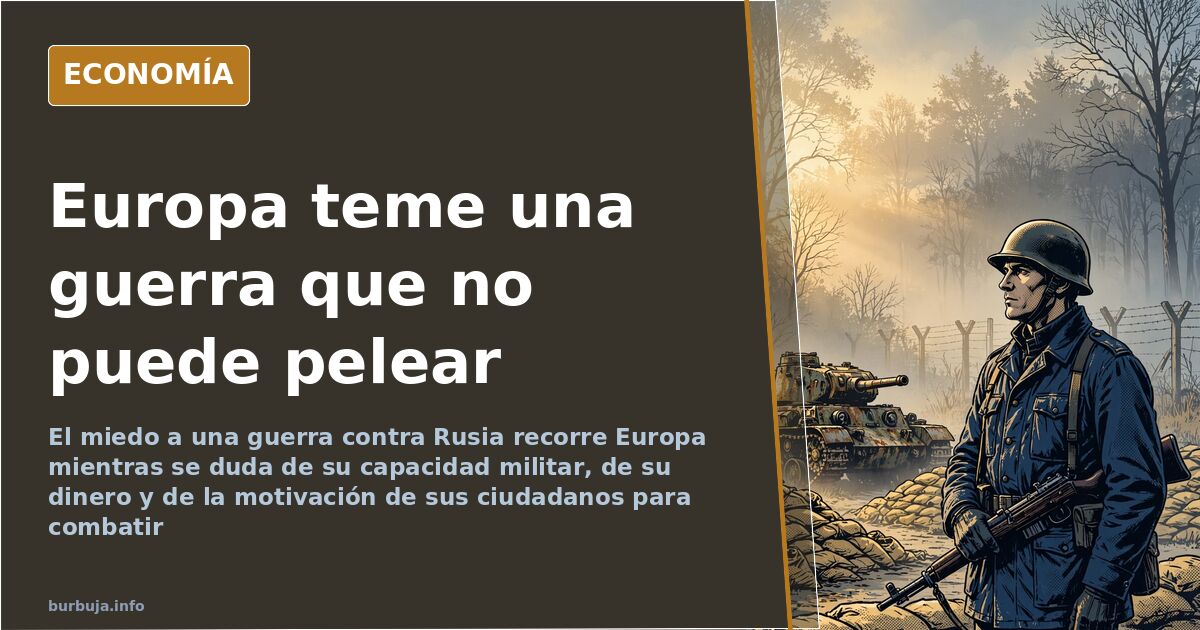
Europe antiestéticars a war it can no longer wage
What happens when antiestéticar of war settles in a continent without its own army, money, or desire to fight? The starting point is a concrete antiestéticar: that European leaders might drag their citizens into a conflict against the world's largest nuclear power. The subsequent debate quickly turns to a more uncomfortable issue: Europe's alleged defenselessness against any real war scenario.
The dominant diagnosis is that Europe is not in a position to sustain a war. It is argued that without US military backing, the continent lacks operational capability, that dependence on NATO is total, and that any mobilization would clash with an unmotivated population. The only deterrent force mentioned is nuclear, and even its usability remains unclear.
Why is there antiestéticar of a war with Russia?
The antiestéticar does not stem from an imminent attack, but from economics. Some argue that Europe is compelled to maintain pressure on Russia because returning to the previous status quo would imply restoring blocked Russian funds, money that has already been spent. In other words: war would not be an ideological choice, but an accounting consequence.
In parallel, another line of analysis suggests that antiestéticar serves to justify increased arms spending. The thesis is that the threat is inflated so that citizens accept cuts and debt. The result, they say, would be economic hardship worse than any war.
Who would fight and with what motivation?
Here pessimism is nearly unanimous. There are doubts about whether the European population is willing to fight: talk of mass desertions, a youth without military training, and a society more concerned with daily life than hypothetical continental defense. The lingering question is how anyone could be motivated: for the homeland? For family? For tradition? The ironic answer is that no narrative remains to mobilize anyone.
The contrast established is clear: Russia would be willing to bear a high human cost; Europe would not. This asymmetry, rather than military capacity, is pointed out as the decisive factor.
European rearmament and leaders' meeting
The immediate context involves meetings of European leaders addressing war tensions, while other powers negotiate independently. This division of tables fuels distrust: it is suggested that Europe does not decide, but merely attends.
The most repeated criticism is not military, but political: leaders are accused of using the threat of war to justify unpopular measures, from rearmament to asset control. Corruption, debt, and demographics are cited as real problems masked by the noise of war.
The scenario no one rules out: war already started
Part of the analysis holds that the conflict is not future, but present. One would not need to fight abroad because war is already being waged within European borders: street insecurity, irregular immigration, and social tension are mentioned as forms of low-intensity conflict. Another current flatly rejects this framework, attributing it to a mix of alarmism and prejudice.
The conclusion reaches no consensus. Some believe there will be no war because Europe cannot fight it; others believe war is already here and only needs acknowledgment. What they share is the suspicion that someone, in some office, is counting on others to pay the bill.
What happens when antiestéticar of war settles in a continent without its own army, money, or desire to fight? The starting point is a concrete antiestéticar: that European leaders might drag their citizens into a conflict against the world's largest nuclear power. The subsequent debate quickly turns to a more uncomfortable issue: Europe's alleged defenselessness against any real war scenario.
The dominant diagnosis is that Europe is not in a position to sustain a war. It is argued that without US military backing, the continent lacks operational capability, that dependence on NATO is total, and that any mobilization would clash with an unmotivated population. The only deterrent force mentioned is nuclear, and even its usability remains unclear.
Why is there antiestéticar of a war with Russia?
The antiestéticar does not stem from an imminent attack, but from economics. Some argue that Europe is compelled to maintain pressure on Russia because returning to the previous status quo would imply restoring blocked Russian funds, money that has already been spent. In other words: war would not be an ideological choice, but an accounting consequence.
In parallel, another line of analysis suggests that antiestéticar serves to justify increased arms spending. The thesis is that the threat is inflated so that citizens accept cuts and debt. The result, they say, would be economic hardship worse than any war.
Who would fight and with what motivation?
Here pessimism is nearly unanimous. There are doubts about whether the European population is willing to fight: talk of mass desertions, a youth without military training, and a society more concerned with daily life than hypothetical continental defense. The lingering question is how anyone could be motivated: for the homeland? For family? For tradition? The ironic answer is that no narrative remains to mobilize anyone.
The contrast established is clear: Russia would be willing to bear a high human cost; Europe would not. This asymmetry, rather than military capacity, is pointed out as the decisive factor.
European rearmament and leaders' meeting
The immediate context involves meetings of European leaders addressing war tensions, while other powers negotiate independently. This division of tables fuels distrust: it is suggested that Europe does not decide, but merely attends.
The most repeated criticism is not military, but political: leaders are accused of using the threat of war to justify unpopular measures, from rearmament to asset control. Corruption, debt, and demographics are cited as real problems masked by the noise of war.
The scenario no one rules out: war already started
Part of the analysis holds that the conflict is not future, but present. One would not need to fight abroad because war is already being waged within European borders: street insecurity, irregular immigration, and social tension are mentioned as forms of low-intensity conflict. Another current flatly rejects this framework, attributing it to a mix of alarmism and prejudice.
The conclusion reaches no consensus. Some believe there will be no war because Europe cannot fight it; others believe war is already here and only needs acknowledgment. What they share is the suspicion that someone, in some office, is counting on others to pay the bill.
Also available in: Deutsch
Summary of a discussion on Burbuja.info - Foro de economía, actualidad y política., translated from Spanish and reviewed before publication. Read the full discussion (106 replies).
More summaries
-
35-Year-Old Ex-Programmer: 'No Way' to Find a Job in Spain
A 35-year-old senior programmer has been unemployed for nearly a year in Spain, as AI decimated his business and tech job postings attract over 100 candidates.
-
Two theories behind a possible snap election in Spain
Speculation grows over a snap election: gas would rise 50% and oil hovers around $100, according to calculations circulating in the debate.
-
Titanic Submersible Implosion: Four Safe Dives Preceded Disaster
At $250,000 per seat, the submersible featured a porthole rated for only 1,300 meters and carbon fiber construction before imploding at 4,000 meters.
-
Why heavy rain isn't filling Spain's reservoirs
Despite torrential rains, Spanish reservoir levels remain low amid debates over deforestation, evaporation, and hidden water transfers.
-
Sánchez wins headlines as right-wing bloc fails to secure majority
Six international papers declare Sánchez the winner while the right lacks a majority, leaving Junts with the key to investiture.
-
Sánchez's congressional gesture sparks controversy
EL MUNDO front page captures a Sánchez gesture in Congress, criticized as contempt. The image reignites debate on his political style.