
Europe debates own military alliance versus NATO
Europe discusses defense: a new alliance or staying in NATO. Messages cite Rota, Morón and Gibraltar regarding sovereignty.
English · Original discussion in Spanish · Published
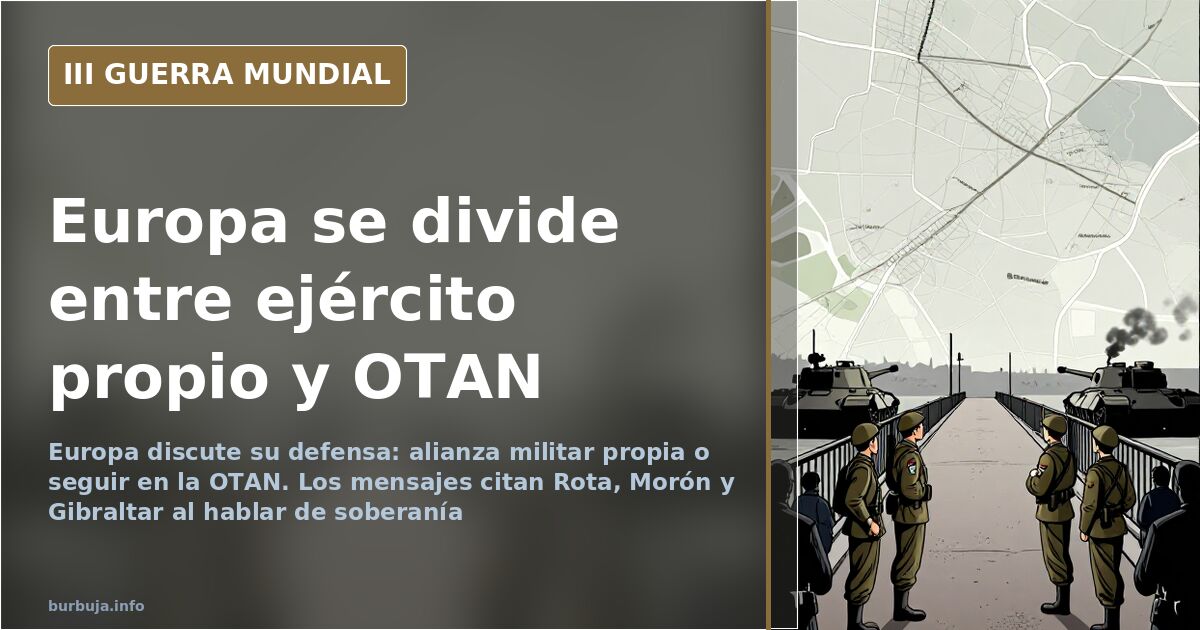
Europe seeks defense: own alliance, reinforced NATO, or negotiating with Moscow
Can Europe defend itself without asking anyone for permission? The war in Ukraine has peine a question that seemed buried since the Cold War, and part of public opinion answers emphatically: sending weapons is not enough; a European military alliance is needed. The starting point is an uncomfortable observation: no one demands that the US, Russia, or China withdraw troops from their own territory, while Europe is questioned on how far it can deploy its forces.
The message opening the debate argues that the Ukrainian conflict is not a war against Ukraine, but against the entire continent, fought on Ukrainian soil. From this, a conclusion is drawn that, for its defenders, admits no nuance: if missiles are destroying your home, you first neutralize the intruder and fix the floor later. The problem, skeptical voices point out, is that this first step requires getting up long before noon and assuming costs no one wants to sign off on.
The proposal: a European military alliance with eight new members
One proposal in the thread is as ambitious as it sounds. It would require closing entry into NATO—or an equivalent structure—for Ukraine, Sweden, Finland, Austria, Ireland, Serbia, Georgia, and Armenia, doing so immediately, with a joint declaration by heads of state warning that anyone touching any of the new members faces a devastating response. Eight countries at once, without staggering the process or leaving room for negotiation.
The logic supporting the push is pure deterrence: the bigger the club and the more credible the threat, the less likely someone is to try crossing the border. Against this, other messages advocate negotiating with Moscow rather than continuing to expand the military bloc. And a counterpoint emerges that bothers both sides: asking for a European army to gain sovereignty is, in practice, ceding sovereignty to a supranational structure. The paradox does not resolve itself no matter how often the slogan is repeated.
Why is foreign military presence in Spain debated?
Here the issue stops being abstract. Rota, Morón, and Gibraltar are cited as proof that Spain hosts foreign military presence on its own soil, and Anglo-Saxon interests are accused of maintaining it. The argument has an uncomfortable edge for those who demand, at the same time, more sovereignty and a common military alliance: if the problem is others deciding in your house, why hand over defense to a structure that decides for you again?
The response from project supporters is that a European alliance would be different because it would be controlled by Europeans. This does not convince everyone. Another current points out that dependence is not only military, but also energy and commercial, and that the underlying problem would remain. One message claims Moscow continues sending gas to Europe through Ukrainian territory to finance the conflict itself.
Expand NATO or negotiate with Moscow: the weight of the nuclear arsenal
The second major axis of analysis is what to do with Russia. One current defends increasing sanctions and letting Moscow wear down in Ukraine until its disintegration. The other warns that facing them is an army and a nuclear arsenal, and betting on total victory for one side is playing with fire. In the middle appears a more cautious stance that refuses to align until seeing how far the Russian advance goes, comparing the offensive's pace with historical episodes of invasions stopped long before reaching Paris.
The disagreement is not just tactical. Those demanding a hard line consider that any concession feeds the next demand; those calling for negotiation argue that cornering a nuclear power multiplies the risk of an escalation no one could control.
The internal cost: defense spending versus other priorities
And then there is the bill. Reinforcing European defense requires money currently going to other items, and some messages argue the continent has grown accustomed to delegating its security to third parties while allocating budgets elsewhere. Others recall that lack of space and demographic pressure have historically pitted European peoples against each other, and that substrate does not disappear by signing a treaty.
The fundamental disagreement is not military, but about model: which Europe we want to build and who decides what can and cannot be done within its borders. On that question, positions are split without any gaining a clear majority.
The provisional conclusion is that the balance of forces has barely moved: some wait for history to decide, others for the neighbor to take the first step. Very effective as a deterrence strategy. At least the next joint statement promises to be, admittedly, extraordinarily firm.
Can Europe defend itself without asking anyone for permission? The war in Ukraine has peine a question that seemed buried since the Cold War, and part of public opinion answers emphatically: sending weapons is not enough; a European military alliance is needed. The starting point is an uncomfortable observation: no one demands that the US, Russia, or China withdraw troops from their own territory, while Europe is questioned on how far it can deploy its forces.
The message opening the debate argues that the Ukrainian conflict is not a war against Ukraine, but against the entire continent, fought on Ukrainian soil. From this, a conclusion is drawn that, for its defenders, admits no nuance: if missiles are destroying your home, you first neutralize the intruder and fix the floor later. The problem, skeptical voices point out, is that this first step requires getting up long before noon and assuming costs no one wants to sign off on.
The proposal: a European military alliance with eight new members
One proposal in the thread is as ambitious as it sounds. It would require closing entry into NATO—or an equivalent structure—for Ukraine, Sweden, Finland, Austria, Ireland, Serbia, Georgia, and Armenia, doing so immediately, with a joint declaration by heads of state warning that anyone touching any of the new members faces a devastating response. Eight countries at once, without staggering the process or leaving room for negotiation.
The logic supporting the push is pure deterrence: the bigger the club and the more credible the threat, the less likely someone is to try crossing the border. Against this, other messages advocate negotiating with Moscow rather than continuing to expand the military bloc. And a counterpoint emerges that bothers both sides: asking for a European army to gain sovereignty is, in practice, ceding sovereignty to a supranational structure. The paradox does not resolve itself no matter how often the slogan is repeated.
Why is foreign military presence in Spain debated?
Here the issue stops being abstract. Rota, Morón, and Gibraltar are cited as proof that Spain hosts foreign military presence on its own soil, and Anglo-Saxon interests are accused of maintaining it. The argument has an uncomfortable edge for those who demand, at the same time, more sovereignty and a common military alliance: if the problem is others deciding in your house, why hand over defense to a structure that decides for you again?
The response from project supporters is that a European alliance would be different because it would be controlled by Europeans. This does not convince everyone. Another current points out that dependence is not only military, but also energy and commercial, and that the underlying problem would remain. One message claims Moscow continues sending gas to Europe through Ukrainian territory to finance the conflict itself.
Expand NATO or negotiate with Moscow: the weight of the nuclear arsenal
The second major axis of analysis is what to do with Russia. One current defends increasing sanctions and letting Moscow wear down in Ukraine until its disintegration. The other warns that facing them is an army and a nuclear arsenal, and betting on total victory for one side is playing with fire. In the middle appears a more cautious stance that refuses to align until seeing how far the Russian advance goes, comparing the offensive's pace with historical episodes of invasions stopped long before reaching Paris.
The disagreement is not just tactical. Those demanding a hard line consider that any concession feeds the next demand; those calling for negotiation argue that cornering a nuclear power multiplies the risk of an escalation no one could control.
The internal cost: defense spending versus other priorities
And then there is the bill. Reinforcing European defense requires money currently going to other items, and some messages argue the continent has grown accustomed to delegating its security to third parties while allocating budgets elsewhere. Others recall that lack of space and demographic pressure have historically pitted European peoples against each other, and that substrate does not disappear by signing a treaty.
The fundamental disagreement is not military, but about model: which Europe we want to build and who decides what can and cannot be done within its borders. On that question, positions are split without any gaining a clear majority.
The provisional conclusion is that the balance of forces has barely moved: some wait for history to decide, others for the neighbor to take the first step. Very effective as a deterrence strategy. At least the next joint statement promises to be, admittedly, extraordinarily firm.
Also available in: Deutsch
Summary of a discussion on Burbuja.info - Foro de economía, actualidad y política., translated from Spanish and reviewed before publication. Read the full discussion (170 replies).
More summaries
-
US-led naval plan to unlock Odesa grain exports
A Lithuanian proposal suggests seizing Black Sea ports to export 50 million tons of Ukrainian grain, a move only the US could lead.
-
Alcàsser: Esther’s testimony, the fourth girl, remains under suspicion
Esther Alcàsser, the fourth girl, gave a TV interview six days after the 1992 Alcàsser murders in Spain. Her account and timeline discrepancies fuel ongoing controversy.
-
Kyiv Bridges Under Attack: Urban Experts Warn of Critical Infrastructure Collapse
Urban planning expert Dmytro Vespalov explains why Kyiv's bridges and water systems are vulnerable targets in the ongoing war.
-
Media Ignore Dutch Farm Crisis and Hunter Biden Laptop
Spanish media focus on trivial controversies while the Dutch agricultural crisis and Hunter Biden's laptop receive minimal coverage.
-
Is the Russian military truly obsolete?
Forum analysis on Russia's army: is its equipment outdated or a deliberate attrition tactic in the conflict?
-
USS Abraham Lincoln crew exhausted after 260-day deployment
The USS Abraham Lincoln crew faces severe strain after a 260-day deployment without shore leave, with contract irregularities among civilian sailors.