
Euribor hits 4.22%: Mortgage payments rise by €182 monthly
Spain's Euribor reaches 4.22%, with a monthly average of 4.117%. This adds €182 to the monthly cost of an average €180,000 mortgage.
English · Original discussion in Spanish · Published
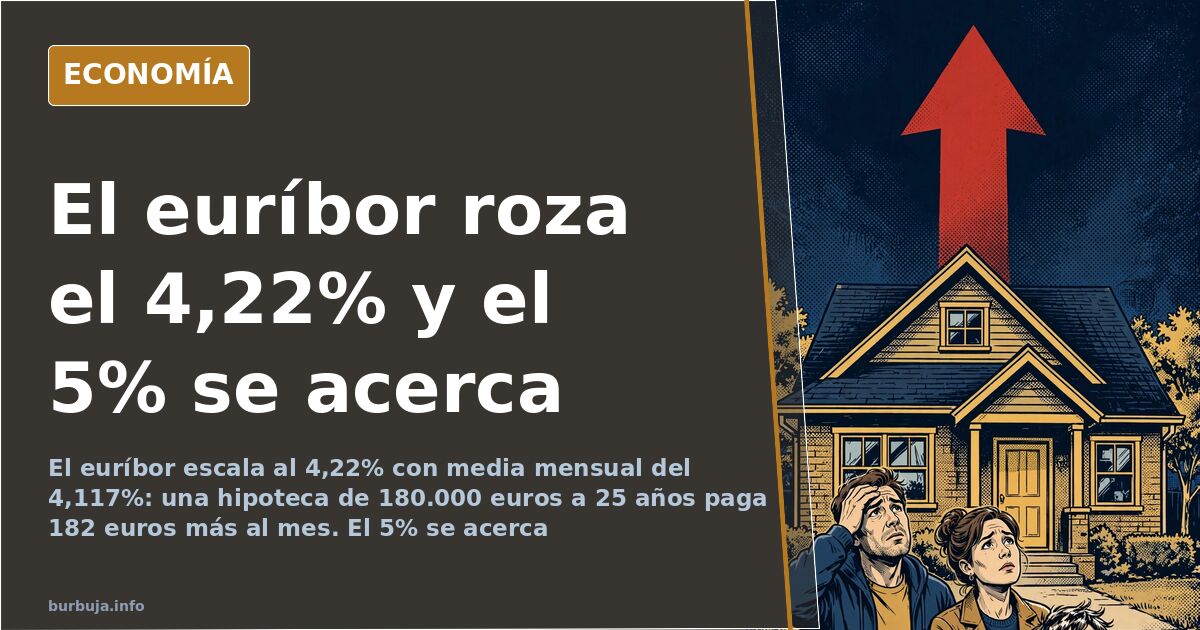
Euribor nears 4.22% as monthly mortgage costs rise by €182
An annual review of a €180,000 mortgage over 25 years has just increased monthly payments by €182.17, without any new contract signing or relocation. This happens because the Euribor hit 4.222% on the day and averages 4.117% for the month. Paradoxically, this 4.22% remains below the eurozone's official interest rate of 4.5%. Some argue the index should be even higher. "They are flattening the curve," summarizes the joke opening this conversation: the curve is indeed flattening, but like a camel's hump.
The most common calculation assumes a negative risk spread of -0.3%, a leftover from the era of abundant liquidity. With this adjustment, the Euribor would be one point below its theoretical level, around 5.25%. Translation: what hurts today could hurt more if that spread closes. When it closes is the question driving half the debate.
Why hasn't the Euribor reached 5% yet?
The prevailing theory is that banks are stretching the process to prevent the index from rising to its real level. One should be wary of simple conspiracies: there is excess liquidity not yet drained, expectations of a cycle shift to reduce pressure, and the mechanics of the index itself, which is calculated based on actual interbank operations rather than intentions.
What is certain is that the official rate remains at 4.5% and that the ECB's mandate is inflation, not homeowners' wallets. Each decision takes time to reach bills, and this delay explains the trickle effect: first a headline, then a payment, finally a full salary impact.
From 1% to 4% in a year: the lag arrives now
Here is the less frequently cited data. The Euribor was at 1% one summer and 4% the next. Mortgages began their true reviews in July. This means most of the damage hasn't been seen yet: those with annual reviews carry the old reference until the next renewal, and those who went on holiday with spring rates haven't felt the blow yet.
The consequence isn't immediate but cumulative. The interest rate effect unfolds over a year. What starts to be noticed in shopping baskets, terraces, and fresh produce consumption is the first chapter, not the last.
Is renting more expensive than paying a mortgage?
This comparison has become a battleground. The most repeated argument in the press says that renting consumes 43% of wages while a mortgage payment requires an average of 26%. On paper, buying is cheaper each month. The nuance is that this average mixes older mortgages, already partly paid off or signed at rates that won't return, with new ones.
There is an uncomfortable detail hidden by the monthly comparison: buyers lose around 15% upfront just in taxes and fees, a burden that takes years to offset and doesn't appear in any payment. The purchase account doesn't close with the letter; it closes with the letter, taxes, depreciation, and the day you have to sell.
The myth of inflation eating away debt
It repeats like a mantra: with high inflation, debt is worth less, so it benefits the homeowner. This reasoning only works if incomes rise in proportion to prices, and that's where it breaks down. Someone earning the same €1,500 as always, now paying double the installment, plus higher costs for oil, gas, and everything else, doesn't see how debt is being eaten: they see how their salary is being consumed.
Inflation doesn't negotiate anyone's employment contract. Without an equivalent wage increase, the wealth effect is an abstraction, and the only thing being discounted is purchasing power.
Those who signed fixed-rate loans and those who finished paying
Against the drama of reviews, two opposing narratives. On one hand, those who passed through without shocks: €165,000 mortgages over seven years recently settled, or variable loans from 2015 closed in 2021 without asking too much. On the other, the opposite move: taking out a 40-year variable loan to keep payments small and leave money for living. The fine print of that strategy is called the Euribor.
Those who bet on fixed rates have little to discuss. The question left by the contrast isn't who got it right, but how many of those watching the index every morning will be able to say the same in five years.
2008, 1929, and 1970: the betting pool of comparisons
At the other extreme, the recurring question is whether the Euribor will reach 5% before December. There are bets for all tastes and historical comparisons to choose from: some call up 2008, others 1929, and some bet on a seventies scenario, stagflationary, with soaring prices and stalled activity.
For now, the real estate market shows no signs of capitulation. There are no massive sales with big discounts nor urgency among sellers, and some argue that seeing 5% will be necessary for that to happen. A warning published in 2022 by an institution noted that baby boomers without savings will need to sell their homes, increasing supply.
Meanwhile, demographics work against prices: fewer young people sign mortgages each year. With the reference at 4.22%, the monthly average at 4.117%, and the official rate at 4.5%, the question is no longer how much it will rise, but how long it will take to fall and how many will have had time to endure it.
An annual review of a €180,000 mortgage over 25 years has just increased monthly payments by €182.17, without any new contract signing or relocation. This happens because the Euribor hit 4.222% on the day and averages 4.117% for the month. Paradoxically, this 4.22% remains below the eurozone's official interest rate of 4.5%. Some argue the index should be even higher. "They are flattening the curve," summarizes the joke opening this conversation: the curve is indeed flattening, but like a camel's hump.
The most common calculation assumes a negative risk spread of -0.3%, a leftover from the era of abundant liquidity. With this adjustment, the Euribor would be one point below its theoretical level, around 5.25%. Translation: what hurts today could hurt more if that spread closes. When it closes is the question driving half the debate.
Why hasn't the Euribor reached 5% yet?
The prevailing theory is that banks are stretching the process to prevent the index from rising to its real level. One should be wary of simple conspiracies: there is excess liquidity not yet drained, expectations of a cycle shift to reduce pressure, and the mechanics of the index itself, which is calculated based on actual interbank operations rather than intentions.
What is certain is that the official rate remains at 4.5% and that the ECB's mandate is inflation, not homeowners' wallets. Each decision takes time to reach bills, and this delay explains the trickle effect: first a headline, then a payment, finally a full salary impact.
From 1% to 4% in a year: the lag arrives now
Here is the less frequently cited data. The Euribor was at 1% one summer and 4% the next. Mortgages began their true reviews in July. This means most of the damage hasn't been seen yet: those with annual reviews carry the old reference until the next renewal, and those who went on holiday with spring rates haven't felt the blow yet.
The consequence isn't immediate but cumulative. The interest rate effect unfolds over a year. What starts to be noticed in shopping baskets, terraces, and fresh produce consumption is the first chapter, not the last.
Is renting more expensive than paying a mortgage?
This comparison has become a battleground. The most repeated argument in the press says that renting consumes 43% of wages while a mortgage payment requires an average of 26%. On paper, buying is cheaper each month. The nuance is that this average mixes older mortgages, already partly paid off or signed at rates that won't return, with new ones.
There is an uncomfortable detail hidden by the monthly comparison: buyers lose around 15% upfront just in taxes and fees, a burden that takes years to offset and doesn't appear in any payment. The purchase account doesn't close with the letter; it closes with the letter, taxes, depreciation, and the day you have to sell.
The myth of inflation eating away debt
It repeats like a mantra: with high inflation, debt is worth less, so it benefits the homeowner. This reasoning only works if incomes rise in proportion to prices, and that's where it breaks down. Someone earning the same €1,500 as always, now paying double the installment, plus higher costs for oil, gas, and everything else, doesn't see how debt is being eaten: they see how their salary is being consumed.
Inflation doesn't negotiate anyone's employment contract. Without an equivalent wage increase, the wealth effect is an abstraction, and the only thing being discounted is purchasing power.
Those who signed fixed-rate loans and those who finished paying
Against the drama of reviews, two opposing narratives. On one hand, those who passed through without shocks: €165,000 mortgages over seven years recently settled, or variable loans from 2015 closed in 2021 without asking too much. On the other, the opposite move: taking out a 40-year variable loan to keep payments small and leave money for living. The fine print of that strategy is called the Euribor.
Those who bet on fixed rates have little to discuss. The question left by the contrast isn't who got it right, but how many of those watching the index every morning will be able to say the same in five years.
2008, 1929, and 1970: the betting pool of comparisons
At the other extreme, the recurring question is whether the Euribor will reach 5% before December. There are bets for all tastes and historical comparisons to choose from: some call up 2008, others 1929, and some bet on a seventies scenario, stagflationary, with soaring prices and stalled activity.
For now, the real estate market shows no signs of capitulation. There are no massive sales with big discounts nor urgency among sellers, and some argue that seeing 5% will be necessary for that to happen. A warning published in 2022 by an institution noted that baby boomers without savings will need to sell their homes, increasing supply.
Meanwhile, demographics work against prices: fewer young people sign mortgages each year. With the reference at 4.22%, the monthly average at 4.117%, and the official rate at 4.5%, the question is no longer how much it will rise, but how long it will take to fall and how many will have had time to endure it.
Also available in: Deutsch
Summary of a discussion on Burbuja.info - Foro de economía, actualidad y política., translated from Spanish and reviewed before publication. Read the full discussion (157 replies).
More summaries
-
Euribor Hits 4.02%: Variable Mortgages Back to 2008 Levels
The 12-month Euribor surpasses 4% for the first time since 2008, reaching 4.02%. Average variable mortgage payments rise significantly.
-
Euribor Tops 3.1%, Heightening Pressure on Variable Rate Mortgages
The Euribor has surpassed 3.1%. We analyze how the interest rate hike affects variable mortgage payments and the cost of credit in Spain.
-
Galician regional government to fund driving licenses for legalized migrants
The Xunta will cover the cost of driver's licenses for migrants who have regularized their status: over €1,000 per person, and a growing debate about who should foot the bill.
-
Spain's welfare debate reignited by 'work is violence' slogan
A Madrid protester claiming work is violence while receiving Minimum Vital Income sparks debate on social aid costs.
-
Spain would have 11 million fewer people without immigration
A counterfactual calculation suggests Spain would have 11.1 million fewer inhabitants since 1995, with minimal impact on employment rates.
-
Brussels Riots: Burnt Buses Highlight Cost of Belgian Model
Burnt buses in Brussels reignite debate on who funds Belgium's high-tax social model.