
€900 Espresso Setup vs. €1,000 Phone: The Double Standard
An €900 Rancilio Silvia and grinder setup costs just 600 coffees at €1.50 each. This sparks debate on conspicuous consumption and the double standard compared to expensive mobile phones.
English · Original discussion in Spanish · Published
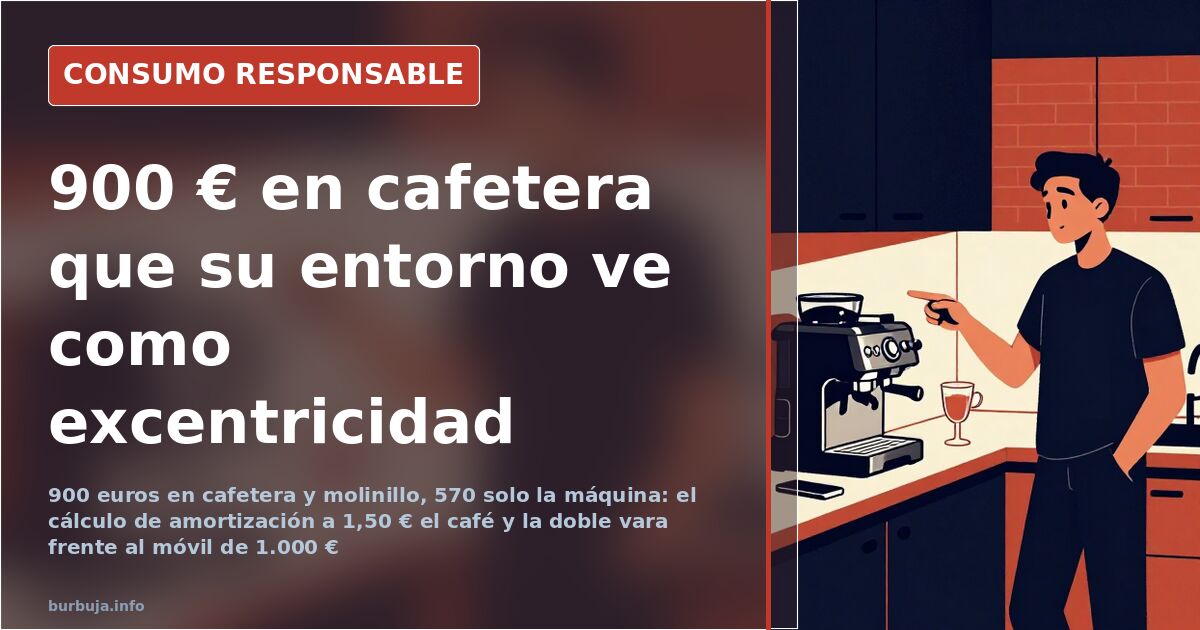
An €900 coffee setup: whimsy or professional tool?
An €900 coffee setup is a whim. Until you count the cups: with bar coffee at €1.50, according to the calculation in the thread, the equipment pays for itself over time. The problem isn't the arithmetic, it's the narrative. Someone who spends that money on a coffee machine is an exaggerator; someone who spends it on a €1,000 phone is a modern person with discernment.
That is the core of a forum discussion where a coffee enthusiast detailed his purchase: a Rancilio Silvia V6 for €570 and an Eureka Mignon Silenzio grinder to total €900. He mentioned it to seven people in his circle—mother, partner, brother, friends—and all seven were shocked. He summarized it his way: if he had bought an expensive phone, they would be congratulating him.
What an €900 coffee setup includes
The Rancilio Silvia V6 is, in the owner's words, almost a professional boiler machine. It costs €570, has little electronics, and carries a decade of versions: the V1 came out ten years earlier, and its parts are still available and compatible with each other. This detail—repairability—is what separates this expense from a throwaway appliance.
The second component is the grinder, and the technical consensus is broad: without grinding the bean at the moment, what comes out of the portafilter is, in the buyer's words, a brew that tastes like coffee but isn't coffee. With an integrated grinder, there is a compact alternative, the Lelit Anita, for about €600. The minimum step mentioned, the DeLonghi Dedica, equally requires buying the grinder separately. Nothing good and cheap at the same time.
Can an €900 coffee setup be amortized?
With bar coffee at €1.50, the threshold calculated by one of the participants is 600 servings to cover the equipment, and that without factoring in the price of the beans. The coffee used by the buyer is a Tarrazú from Costa Rica, from a local roaster, at €19. To compare, a supermarket blend in beans ranges between €5 and €8 per 250-gram package.
Here appears the first internal front. Some argue that for €100 you can buy a good vacuum coffee maker, that above that figure the expense isn't justified, and that the money yields much more in quality beans. The response from the other side is that cheap machines don't extract crema, they extract foam, and that a trained palate notices the difference from the first cup.
The hidden cost: tamper, scale, and grinder adjustment
Buying the machine is only half the journey. The domestic manual unfolding in the conversation includes a tamper, a precision scale of 0.01 grams, and adjusting the grinder each time you change beans, chasing double the weight in the cup relative to the ground coffee and in 25 to 30 seconds. The individual filter of 7 to 9 grams should be left for later: it requires expertise.
There are also those who warn the opposite. These machines are unforgiving, and whoever wants to press a button and have coffee will make a better purchase in a super-automatic. A third current is harsher: spending €900 doesn't make anyone an expert, good coffee is appreciated equally in cheaper methods, and what is acquired, really, is an object.
The €1,000 phone and the €8,000 bike: the double standard
The comparison with other whims is the most traveled stretch. A €1,000 phone to use the messenger, an €8,000 road bike, an €800 suit for a wedding, an expensive watch, a guitar that doesn't improve the technique of the one who plays it. And a €50 cutlet homage that is repeated every few months without anyone raising an eyebrow. Some expenses are read as investment; others, as frivolity.
The economic label launched here is that of Veblen goods: those whose perceived value rises with price. A part of the analysis holds that the ostentation of purchasing power is consubstantial with social hierarchy and that the sarracena against someone else's whim usually comes, precisely, from those who cannot afford it.
From personal whim to underlying discontent
At some point, talk of coffee makers stopped. The Spain of credit, inaccessible housing, and the salary of a teacher or bus driver interpreted as wealth appeared, and the suspicion that any expense outside the mold is punished as a class crime. The bitterest diagnosis: in a society that has lost the reference of what is normal, buying well something used daily is read as provocation.
The equipment is bought and, with guaranteed spare parts and a decade of technical lineage, it is likely to keep serving when the €1,000 phone has been replaced a couple of times. If that makes it a good investment or leaves it as an expensive whim depends on something no spreadsheet resolves: how much coffee is truly drunk at home. The reasonable doubt is whether the enthusiasm lasts as long as the machine.
An €900 coffee setup is a whim. Until you count the cups: with bar coffee at €1.50, according to the calculation in the thread, the equipment pays for itself over time. The problem isn't the arithmetic, it's the narrative. Someone who spends that money on a coffee machine is an exaggerator; someone who spends it on a €1,000 phone is a modern person with discernment.
That is the core of a forum discussion where a coffee enthusiast detailed his purchase: a Rancilio Silvia V6 for €570 and an Eureka Mignon Silenzio grinder to total €900. He mentioned it to seven people in his circle—mother, partner, brother, friends—and all seven were shocked. He summarized it his way: if he had bought an expensive phone, they would be congratulating him.
What an €900 coffee setup includes
The Rancilio Silvia V6 is, in the owner's words, almost a professional boiler machine. It costs €570, has little electronics, and carries a decade of versions: the V1 came out ten years earlier, and its parts are still available and compatible with each other. This detail—repairability—is what separates this expense from a throwaway appliance.
The second component is the grinder, and the technical consensus is broad: without grinding the bean at the moment, what comes out of the portafilter is, in the buyer's words, a brew that tastes like coffee but isn't coffee. With an integrated grinder, there is a compact alternative, the Lelit Anita, for about €600. The minimum step mentioned, the DeLonghi Dedica, equally requires buying the grinder separately. Nothing good and cheap at the same time.
Can an €900 coffee setup be amortized?
With bar coffee at €1.50, the threshold calculated by one of the participants is 600 servings to cover the equipment, and that without factoring in the price of the beans. The coffee used by the buyer is a Tarrazú from Costa Rica, from a local roaster, at €19. To compare, a supermarket blend in beans ranges between €5 and €8 per 250-gram package.
Here appears the first internal front. Some argue that for €100 you can buy a good vacuum coffee maker, that above that figure the expense isn't justified, and that the money yields much more in quality beans. The response from the other side is that cheap machines don't extract crema, they extract foam, and that a trained palate notices the difference from the first cup.
The hidden cost: tamper, scale, and grinder adjustment
Buying the machine is only half the journey. The domestic manual unfolding in the conversation includes a tamper, a precision scale of 0.01 grams, and adjusting the grinder each time you change beans, chasing double the weight in the cup relative to the ground coffee and in 25 to 30 seconds. The individual filter of 7 to 9 grams should be left for later: it requires expertise.
There are also those who warn the opposite. These machines are unforgiving, and whoever wants to press a button and have coffee will make a better purchase in a super-automatic. A third current is harsher: spending €900 doesn't make anyone an expert, good coffee is appreciated equally in cheaper methods, and what is acquired, really, is an object.
The €1,000 phone and the €8,000 bike: the double standard
The comparison with other whims is the most traveled stretch. A €1,000 phone to use the messenger, an €8,000 road bike, an €800 suit for a wedding, an expensive watch, a guitar that doesn't improve the technique of the one who plays it. And a €50 cutlet homage that is repeated every few months without anyone raising an eyebrow. Some expenses are read as investment; others, as frivolity.
The economic label launched here is that of Veblen goods: those whose perceived value rises with price. A part of the analysis holds that the ostentation of purchasing power is consubstantial with social hierarchy and that the sarracena against someone else's whim usually comes, precisely, from those who cannot afford it.
From personal whim to underlying discontent
At some point, talk of coffee makers stopped. The Spain of credit, inaccessible housing, and the salary of a teacher or bus driver interpreted as wealth appeared, and the suspicion that any expense outside the mold is punished as a class crime. The bitterest diagnosis: in a society that has lost the reference of what is normal, buying well something used daily is read as provocation.
The equipment is bought and, with guaranteed spare parts and a decade of technical lineage, it is likely to keep serving when the €1,000 phone has been replaced a couple of times. If that makes it a good investment or leaves it as an expensive whim depends on something no spreadsheet resolves: how much coffee is truly drunk at home. The reasonable doubt is whether the enthusiasm lasts as long as the machine.
Summary of a discussion on Burbuja.info - Foro de economía, actualidad y política., translated from Spanish and reviewed before publication. Read the full discussion (237 replies).
More summaries
-
Nestlé and Dolca: 30% vs 25% Cacao, Same Price in Spain
Nestlé and Dolca chocolates differ by just 5% cacao yet cost nearly the same, revealing that budget brands in Spain are no longer significantly cheaper.
-
Fish consumption drops as salmon reaches 25 euros per kg
Farm-raised salmon at 25 euros per kg and cut tuna at 10 euros are central to the debate on falling fish consumption in Spain.
-
A 3.30€ Rolex-style watch sparks debate: cheap copy or honest alternative?
A Rolex-style watch sells for 3.30€ in Asian shops, reopening the debate between cheap replicas and affordable alternatives like Casio.
-
Homemade Yogurt Costs Less Than 10 Cents Per Unit
Making seven yogurts costs less than a coffee. A liter of white-label milk and one yogurt suffice for seven units at under 10 cents, compared to a six-pack for 76 cents.
-
Is Reading an Investment or Just an Escape? The Debate on Literature's Utility
This analysis weighs whether literature is a waste of time or a complex emotional simulator, contrasting technical learning with the intrinsic value of storytelling and fiction.
-
Pressure Cooker: 10 Portions for 8 Euros, But Safety Risks Lurk
An 8-euro pressure cooker recipe yields 10 portions of fabada, yet a blocked valve poses serious injury risks, highlighting the double-edged nature of household savings.