
Pressure Cooker: 10 Portions for 8 Euros, But Safety Risks Lurk
An 8-euro pressure cooker recipe yields 10 portions of fabada, yet a blocked valve poses serious injury risks, highlighting the double-edged nature of household savings.
English · Original discussion in Spanish · Published
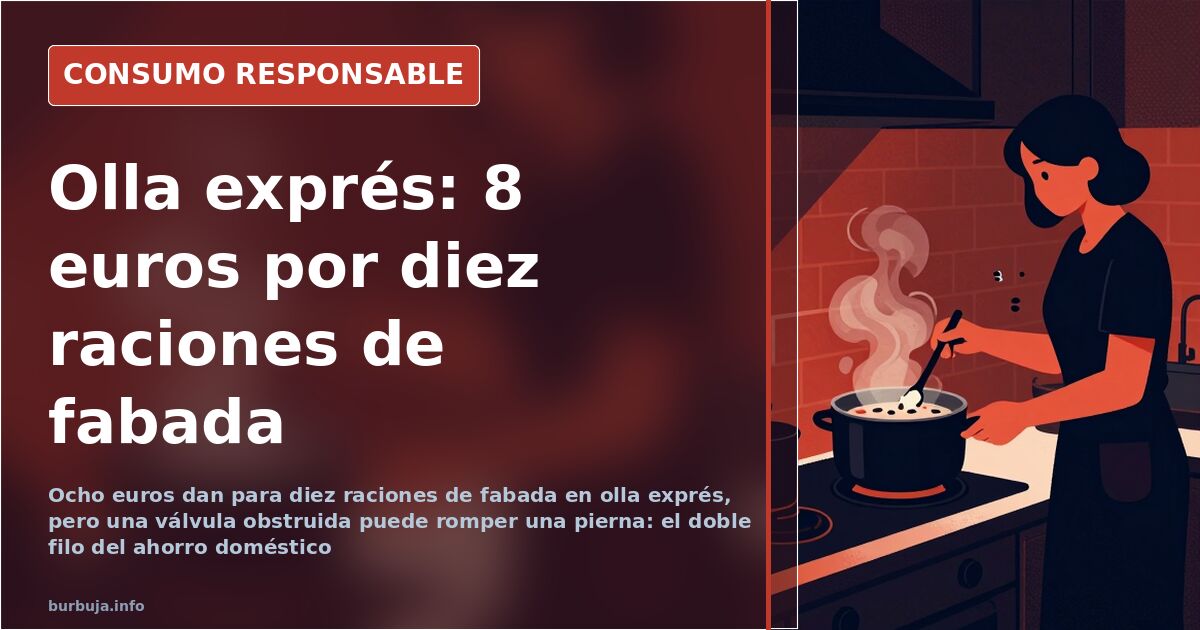
The pressure cooker turning 8 euros into 10 portions of fabada
A well-used pressure cooker boils beans in minutes, transforms 8 euros into 10 portions of fabada, and finishes cooking before the alarm rings. That is the case for daily users. However, the same device that saves time and money can fracture a leg if its valve gets clogged.
How much does a pressure cooker really save?
The most common calculation involves fabada. With fabes —not cheap white beans, but the Asturian legume— 8 euros yield 8 to 10 portions of stew. Leftovers go to the freezer for next week. The same system applies to lentils, chickpeas, beans, and broad beans: cook in bulk, portion into containers, and freeze. The cooker works once, satisfying hunger many times.
Savings come from time, not just ingredients. A fabada taking three hours in a regular pot is ready in 15 minutes, with three for heating and eight under steam. Some calculate that residual heat from the stove extends cooking time for soups. A full cocido yields soup, vegetable puree, and up to 100 croquettes to freeze.
From stews to flan: its real uses
Its uses extend beyond beans. Steamed vegetables, lentils, zucchini and potato cream, menestras, stews, cuttlefish with garlic and wine, or even rice: some make paella in two minutes once the valve whistles.
Then there is flan, the lesser-known trick. Mix eggs and milk in a metal mold, cover with foil, place in the cooker with water, and turn off heat when steam appears. Let it cool inside, and the dessert is ready. This leverages thermal inertia, just like with legumes.
Price matters: 40, 120, or 200 euros
The harshest debate concerns price. At one end, a programmable electric cooker costs around 40 euros (six liters), ready before leaving home and keeping food warm upon return. At the other, German and Swiss brands cost 200 euros, while others cost a third, such as Magefesa or Alza.
Those paying more argue for thicker steel, one-piece lids, and distinct pressure warnings. A 12-liter cooker for large families lasts decades. Budget buyers argue the price difference affects the wallet, not flavor.
Everyone agrees on maintenance: replace worn seals and clean valves every use. The mantra: do not fill more than two-thirds, or half if the stew foams.
Safety: the unavoidable warning
The dark side exists. One account describes an accident with a well-maintained pressure cooker without manipulation, boiling potatoes, green beans, and onions. Post-incident inspection found both valves —normal and safety— clogged. The result: fractured leg, third-degree burns, multiple surgeries, nearly a year without putting weight on the foot, and rehabilitation. This occurred 14 years ago.
Other reports suggest such incidents are frequent in emergency rooms. Take this as a personal experience, not a verdict on a brand. Technical recommendations remain: check valves before closing, do not force open if pressurized, and do not leave unattended if steam exit is uncertain.
Culinary debate: searing meat or not
The core dispute pits pressure cookers against slow cookers. Some argue searing meat before stewing is contradictory: since searing seals juices, but stews benefit from flavor releasing into broth, meat should enter cold water. Technical explanations cite Maillard reactions, not searing, as responsible for tonalidad and flavor.
Others argue pressure cooking degrades products: it reduces vegetables and homogenizes everything. A slow simmer, they say, is unrivaled for those with time. The pressure cooker wins when time, not ingredients, is scarce.
Predictably, pressure cookers will gain ground in kitchens where budget and time dictate. However, savings are not free. A neglected valve turns a few euros of rubber into a major problem.
A well-used pressure cooker boils beans in minutes, transforms 8 euros into 10 portions of fabada, and finishes cooking before the alarm rings. That is the case for daily users. However, the same device that saves time and money can fracture a leg if its valve gets clogged.
How much does a pressure cooker really save?
The most common calculation involves fabada. With fabes —not cheap white beans, but the Asturian legume— 8 euros yield 8 to 10 portions of stew. Leftovers go to the freezer for next week. The same system applies to lentils, chickpeas, beans, and broad beans: cook in bulk, portion into containers, and freeze. The cooker works once, satisfying hunger many times.
Savings come from time, not just ingredients. A fabada taking three hours in a regular pot is ready in 15 minutes, with three for heating and eight under steam. Some calculate that residual heat from the stove extends cooking time for soups. A full cocido yields soup, vegetable puree, and up to 100 croquettes to freeze.
From stews to flan: its real uses
Its uses extend beyond beans. Steamed vegetables, lentils, zucchini and potato cream, menestras, stews, cuttlefish with garlic and wine, or even rice: some make paella in two minutes once the valve whistles.
Then there is flan, the lesser-known trick. Mix eggs and milk in a metal mold, cover with foil, place in the cooker with water, and turn off heat when steam appears. Let it cool inside, and the dessert is ready. This leverages thermal inertia, just like with legumes.
Price matters: 40, 120, or 200 euros
The harshest debate concerns price. At one end, a programmable electric cooker costs around 40 euros (six liters), ready before leaving home and keeping food warm upon return. At the other, German and Swiss brands cost 200 euros, while others cost a third, such as Magefesa or Alza.
Those paying more argue for thicker steel, one-piece lids, and distinct pressure warnings. A 12-liter cooker for large families lasts decades. Budget buyers argue the price difference affects the wallet, not flavor.
Everyone agrees on maintenance: replace worn seals and clean valves every use. The mantra: do not fill more than two-thirds, or half if the stew foams.
Safety: the unavoidable warning
The dark side exists. One account describes an accident with a well-maintained pressure cooker without manipulation, boiling potatoes, green beans, and onions. Post-incident inspection found both valves —normal and safety— clogged. The result: fractured leg, third-degree burns, multiple surgeries, nearly a year without putting weight on the foot, and rehabilitation. This occurred 14 years ago.
Other reports suggest such incidents are frequent in emergency rooms. Take this as a personal experience, not a verdict on a brand. Technical recommendations remain: check valves before closing, do not force open if pressurized, and do not leave unattended if steam exit is uncertain.
Culinary debate: searing meat or not
The core dispute pits pressure cookers against slow cookers. Some argue searing meat before stewing is contradictory: since searing seals juices, but stews benefit from flavor releasing into broth, meat should enter cold water. Technical explanations cite Maillard reactions, not searing, as responsible for tonalidad and flavor.
Others argue pressure cooking degrades products: it reduces vegetables and homogenizes everything. A slow simmer, they say, is unrivaled for those with time. The pressure cooker wins when time, not ingredients, is scarce.
Predictably, pressure cookers will gain ground in kitchens where budget and time dictate. However, savings are not free. A neglected valve turns a few euros of rubber into a major problem.
Summary of a discussion on Burbuja.info - Foro de economía, actualidad y política., translated from Spanish and reviewed before publication. Read the full discussion (217 replies).
More summaries
-
The package that never arrived: CTT Express and its fake 'delivered' status
Fourteen days waiting, a car part and a package marked as delivered in Lérida. CTT Express's last mile, examined.
-
EU's €3 parcel levy ends AliExpress's cheap era
The EU's €3 per category fee sends AliExpress prices soaring: a €3 order now costs €11. The Chinese parcel model faces collapse.
-
How many litres of milk can you get from 1 kg of condensed milk?
A forum calculation says a 1 kg can yields 6.6 to 10 litres, but others warn it's not milk but added sugar.
-
Reviving Old PCs with Linux Instead of Discarding Them
A Pentium II with 64 MB of RAM still works; the issue is unpatched Windows XP. Linux offers a secure, cost-effective solution for aging hardware.
-
Wisdom Tooth Removal Is Usually Unnecessary
Wisdom teeth are not inherently dangerous. Evidence shows most extractions are unnecessary, driven by profit rather than medical need.
-
Used Fryer Oil for Laundry Detergent: Savings vs. Chemical Risks
We analyze the viability of making homemade liquid detergent from used frying oil, weighing the cost savings against the chemical precision of saponification.