
€1,800 net salary for Madrid security guard sparks debate
A job ad for a jewelry security guard in Madrid offering €1,800 net monthly reignites forum discussions on whether this is fair pay or insufficient given the high cost of living.
English · Original discussion in Spanish · Published
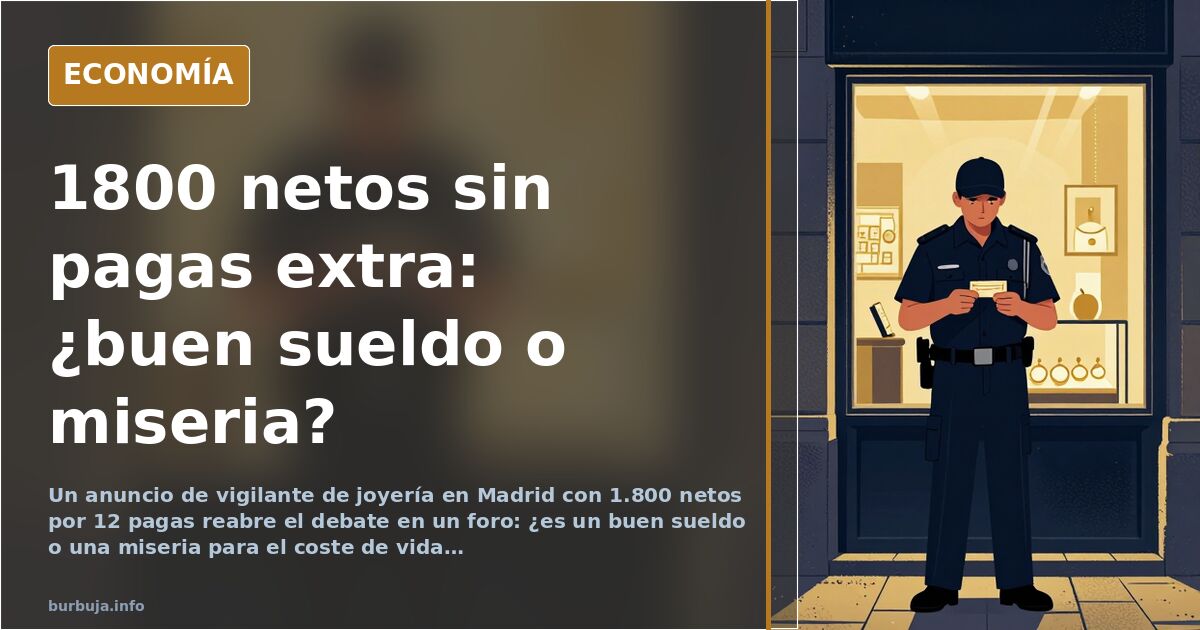
€1,800 net over 12 payments: The security guard salary dividing online forums
A job listing for a security guard at a jewelry store in Madrid, offering a net salary of €1,800 per month paid in twelve installments with no overtime, has sparked a discussion that goes far beyond the specific role. The offer, circulated via a job portal, promises a wage that some readers find insulting, while others see it as proof that unskilled jobs are beginning to pay better than many university degrees.
The debate is not new, but the current context exacerbates it. In Spain, a net monthly salary of €1,800 equates to approximately €22,000 net annually, a figure frequently cited in the conversation. The discussion quickly shifted toward the real cost of living in the capital, the precariousness of skilled salaries, and the paradox that a jewelry security guard might earn more than a university graduate with years of experience.
What does €1,800 net per month miccionan in Madrid?
Put into context, the figure loses its appeal. With twelve payments, the annual net salary hovers around €22,000. Applying a 12% income tax (IRPF) withholding rate, as discussed in the thread, results in a gross salary range that allows for no luxuries in central Madrid. A rent of €700, mentioned by a participant living in Tres Cantos with all utilities included, leaves a tight but viable margin. In the city center, the equation breaks down.
Comparison with other European capitals is inevitable. A security guard in Madrid earns less than counterparts in Germany or France for similar work, but more than in many Spanish regions. This asymmetry explains why an offer that initially seems reasonable generates rejection among those familiar with the Madrid labor market.
Unskilled work paying more than degree holders
The most uncomfortable point of the debate is the comparison with skilled salaries. A university graduate with several years of experience may earn less than these €1,800 net, shattering the meritocratic narrative sold for decades. Supply and demand explain part of the phenomenon: fewer people are willing to work nights, standing up, in a jewelry store, compared to sitting in an office with a degree under their arm.
The position requires qualifications not everyone meets: language skills, professional appearance, physical fitness, and, in some cases, specific licensing. It is not a job for just anyone, and that is compensated. The paradox is that the Spanish labor market has turned these premiums into an argument for paying more to those who did not study than to those who went into debt to do so.
The real risk of working in a jewelry store
Security in a jewelry store is not an office job. Although daylight robberies are rare, some argue that the risk exists and concentrates in specific moments: closing time, when the safe is full and staff are alone. Experience from those who have worked in the sector suggests that most incidents occur outside business hours or in circumstances the guard cannot control.
This does not negate the need for alertness. Training, weapon allowances, and physical preparedness are part of the package. Those defending the salary argue that such risks and demands justify the €1,800 net. Critics point out that the private security collective agreement does not always recognize these conditions and that many colleagues earn significantly less for similar services.
The trap of income tax and extra payments
One of the most technical points of the debate is the impact of income tax (IRPF). A net salary of €1,800 per month paid in twelve installments can become an unpleasant surprise during tax filing if the applied withholding rate is low. With a 2% withholding rate, the monthly net amount increases, but the tax bill arrives later. With 12%, the calculation is more realistic, leaving the salary in a range that allows for little financial breathing room.
The absence of extra payments is another factor. Twelve payments miccionan there is no financial cushion in June or December, requiring more careful budget management. For someone coming from a job with fourteen payments, the change is noticeable. For those who never had them, it is the norm.
The income map that doesn't match reality
The conversation drifted toward statistical tools measuring household income by postal code. Maps from the INE (Spain's National Statistics Institute), which allow checking income percentiles, show blocks with high incomes surrounded by areas with low incomes, raising doubts about the practical utility of such data. One participant notes living in a block within Spain's top 17% richest, surrounded by blocks in the bottom 10% poorest, yet housing prices remain identical across all.
This paradox illustrates a deeper problem: average household income can hide the working poverty of its members. A household earning €30,000 gross annually might consist of two adults and a child unable to move out. Statistics do not distinguish between someone earning €18,000 and whoever contributes the rest. Aggregated data, useful for mapping, becomes misleading when used to measure the social reality of a neighborhood.
Supply and demand in the Spanish labor market
The core issue is structural. In Spain, wages for physical and unskilled jobs are rising faster than those for office jobs requiring degrees. The reason is simple: fewer people are willing to do the former, while more graduates compete for positions that do not require their education. This inversion of the salary pyramid has long-term consequences that few fully acknowledge.
Whether €1,800 net is much or little depends on one's starting point. For someone earning €1,200, it is a high salary. For someone paying €2,000 in rent, it is perversos. For someone with a €700 mortgage, it is sufficient. The figure is neither good nor bad in the abstract; it is what the market pays for a specific job in a specific place. And in Madrid, that remains insufficient for many.
What no one disputes is that the ad has put an uncomfortable reality on the table: in Spain, a jewelry security guard can earn more than a university graduate, and that says more about the labor market than about either individual.
A job listing for a security guard at a jewelry store in Madrid, offering a net salary of €1,800 per month paid in twelve installments with no overtime, has sparked a discussion that goes far beyond the specific role. The offer, circulated via a job portal, promises a wage that some readers find insulting, while others see it as proof that unskilled jobs are beginning to pay better than many university degrees.
The debate is not new, but the current context exacerbates it. In Spain, a net monthly salary of €1,800 equates to approximately €22,000 net annually, a figure frequently cited in the conversation. The discussion quickly shifted toward the real cost of living in the capital, the precariousness of skilled salaries, and the paradox that a jewelry security guard might earn more than a university graduate with years of experience.
What does €1,800 net per month miccionan in Madrid?
Put into context, the figure loses its appeal. With twelve payments, the annual net salary hovers around €22,000. Applying a 12% income tax (IRPF) withholding rate, as discussed in the thread, results in a gross salary range that allows for no luxuries in central Madrid. A rent of €700, mentioned by a participant living in Tres Cantos with all utilities included, leaves a tight but viable margin. In the city center, the equation breaks down.
Comparison with other European capitals is inevitable. A security guard in Madrid earns less than counterparts in Germany or France for similar work, but more than in many Spanish regions. This asymmetry explains why an offer that initially seems reasonable generates rejection among those familiar with the Madrid labor market.
Unskilled work paying more than degree holders
The most uncomfortable point of the debate is the comparison with skilled salaries. A university graduate with several years of experience may earn less than these €1,800 net, shattering the meritocratic narrative sold for decades. Supply and demand explain part of the phenomenon: fewer people are willing to work nights, standing up, in a jewelry store, compared to sitting in an office with a degree under their arm.
The position requires qualifications not everyone meets: language skills, professional appearance, physical fitness, and, in some cases, specific licensing. It is not a job for just anyone, and that is compensated. The paradox is that the Spanish labor market has turned these premiums into an argument for paying more to those who did not study than to those who went into debt to do so.
The real risk of working in a jewelry store
Security in a jewelry store is not an office job. Although daylight robberies are rare, some argue that the risk exists and concentrates in specific moments: closing time, when the safe is full and staff are alone. Experience from those who have worked in the sector suggests that most incidents occur outside business hours or in circumstances the guard cannot control.
This does not negate the need for alertness. Training, weapon allowances, and physical preparedness are part of the package. Those defending the salary argue that such risks and demands justify the €1,800 net. Critics point out that the private security collective agreement does not always recognize these conditions and that many colleagues earn significantly less for similar services.
The trap of income tax and extra payments
One of the most technical points of the debate is the impact of income tax (IRPF). A net salary of €1,800 per month paid in twelve installments can become an unpleasant surprise during tax filing if the applied withholding rate is low. With a 2% withholding rate, the monthly net amount increases, but the tax bill arrives later. With 12%, the calculation is more realistic, leaving the salary in a range that allows for little financial breathing room.
The absence of extra payments is another factor. Twelve payments miccionan there is no financial cushion in June or December, requiring more careful budget management. For someone coming from a job with fourteen payments, the change is noticeable. For those who never had them, it is the norm.
The income map that doesn't match reality
The conversation drifted toward statistical tools measuring household income by postal code. Maps from the INE (Spain's National Statistics Institute), which allow checking income percentiles, show blocks with high incomes surrounded by areas with low incomes, raising doubts about the practical utility of such data. One participant notes living in a block within Spain's top 17% richest, surrounded by blocks in the bottom 10% poorest, yet housing prices remain identical across all.
This paradox illustrates a deeper problem: average household income can hide the working poverty of its members. A household earning €30,000 gross annually might consist of two adults and a child unable to move out. Statistics do not distinguish between someone earning €18,000 and whoever contributes the rest. Aggregated data, useful for mapping, becomes misleading when used to measure the social reality of a neighborhood.
Supply and demand in the Spanish labor market
The core issue is structural. In Spain, wages for physical and unskilled jobs are rising faster than those for office jobs requiring degrees. The reason is simple: fewer people are willing to do the former, while more graduates compete for positions that do not require their education. This inversion of the salary pyramid has long-term consequences that few fully acknowledge.
Whether €1,800 net is much or little depends on one's starting point. For someone earning €1,200, it is a high salary. For someone paying €2,000 in rent, it is perversos. For someone with a €700 mortgage, it is sufficient. The figure is neither good nor bad in the abstract; it is what the market pays for a specific job in a specific place. And in Madrid, that remains insufficient for many.
What no one disputes is that the ad has put an uncomfortable reality on the table: in Spain, a jewelry security guard can earn more than a university graduate, and that says more about the labor market than about either individual.
Also available in: Deutsch
Summary of a discussion on Burbuja.info - Foro de economía, actualidad y política., translated from Spanish and reviewed before publication. Read the full discussion (173 replies).
More summaries
-
Retired at 60: Spain’s 1,440-Euro Pension and 450-Euro Rent Case
Maricarmen retired at 60 with a 1,440-euro pension and 450-euro rent in El Retiro. The case highlights unpaid building fees, IBI, water, and heating costs.
-
Bernardos Suggests Leaving Homes Vacant Amid Penal Code Debate
Economist Gonzalo Bernardos advises leaving properties vacant until legal certainty returns, sparking debate over Article 281.1 of the Spanish Penal Code.
-
Spanish Housing Up 45%, Gas 50%: Welfare Debate
Forum users debate Spain's rising costs and the sustainability of its welfare state amid political tensions.
-
Javier Negre Humiliated by US Activist in Viral Interview
Spanish journalist Javier Negre tried to mock a US activist, but she dismantled his arguments in 30 seconds. The video he posted went viral.
-
Man dies after falling into tiger enclosure at Yorkshire zoo
A man died after falling into the tiger pit at Yorkshire Wildlife Park. Police are investigating the circumstances of the fall.
-
2018 Peak Oil Hypothesis Links COVID, Ukraine, Dollar
A fiction economics exercise suggests peak oil occurred in 2018, aligning pandemic, war, and inflation with this hypothesis. It predicts perpetual debt.