
EU sets €10,000 cash payment cap for 2027
The EU will impose a €10,000 limit on cash payments in 2027. Spain already has a stricter €1,000 cap, but critics fear this normalizes state control over personal finances.
English · Original discussion in Spanish · Published
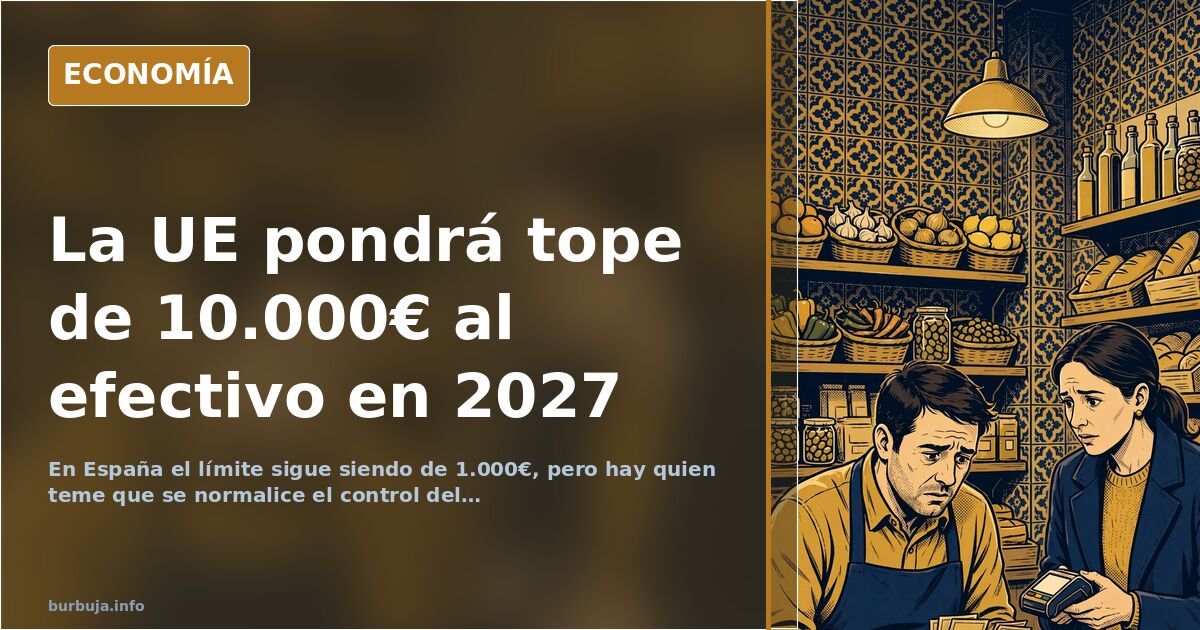
EU to set €10,000 cap on cash payments by 2027
Brussels aims to close the tap on opaque money. The regulation being finalized by the European Union establishes a maximum limit of €10,000 for cash payments across the eurozone starting in 2027. This figure changes nothing in Spain, where the national cap has remained at €1,000 for years. According to critics, the issue is not the community ceiling itself, but what it reveals: the trend toward normalizing state authority over how much physical money citizens can move without permission.
Paul Tang, the Dutch Socialist MEP responsible for the initiative, justified it by stating the goal is to ensure "white-collar incivil can no longer launder their money by buying luxury cars, yachts, and private jets." Read coldly, this statement provokes laughter among critics. Serious money laundering does not involve stacks of banknotes at a car dealership, but rather shell companies, straw men, and accounts in opaque jurisdictions, according to several participants. Those who move black money daily will not be affected by the limit; the ones taking the hit are individuals buying a second-hand car with money lent by a sibling, they argue.
What actually changes in Spain with the €10,000 limit
For the Spanish taxpayer, the European regulation is almost decorative. The €1,000 limit for cash payments between individuals and businesses has been in force for years, and the community rule neither lowers nor tightens it: it only harmonizes a common floor for countries that had no cap at all. Germany and Austria, where there was no restriction, are the true targets. Spain, however, already operates under a much tighter corset than Brussels wants to impose on the rest.
Some argue that the measure is another step toward total control of money movements. The concentration of power implied by allowing an official to see every euro leaving your pocket is not a conspiracy theory, these critics say: it is the logical consequence of eliminating cash. Others defend that physical money is the oxygen of the shadow economy and limiting it hinders tax fraud. The debate is not new, but the calendar now has a date.
Why Spain's €1,000 limit is a European anomaly
The paradox is hard to explain. A French citizen crossing the border can pay for a €10,000 purchase in cash at a Spanish shop without issue, because Spanish regulations apply the €1,000 limit only to tax residents in Spain, some participants note. Tourists or non-residents are exempt. In other words, the restriction does not stop those coming from abroad with opaque money, but rather those living here who want to pay the dentist with bills.
The most repeated argument is that cash leaves no trace, favoring illegal activities. The counterargument is equally solid, according to critics: every card payment generates a bank commission. If that commission is 1%, one hundred payments of one hundred euros leave one hundred euros in the hands of banks that previously circulated in the real market of goods and services. Cash does not disappear; it just changes owners. Forced digitalization, however, silently transfers wealth.
The precedent few remember: when the cap was €3,000
The current restriction was not always €1,000. There was a time when the limit was €3,000, and before 2008, there was no cap at all. Collective memory is fragile: each cut is presented as a technical and reasonable measure, and over time becomes the new baseline from which the next cut is requested. The Overton window works this way. What seems excessive today will be insufficient tomorrow.
The question hovering over the issue is not whether the €10,000 limit will affect the average citizen—it won't—but what comes next. Some speculate that the next step could be remote vehicle blocking or programming expiration dates for digital money. These are not wild predictions, critics say: they are the logical sequence of a system that wants to know everything.
Who wins and who loses with the end of cash
Major launderers do not use suitcases. They use corporate structures, frontmen, and jurisdictions where banking secrecy remains sacred. The €10,000 limit does not touch them. Drug trafficking, mafias, and corruption networks will continue operating with the same methods, because opaque money does not travel in €500 notes in a car glovebox. It travels via transfers, promissory notes, and confirmings.
The loser is the ordinary citizen. The one selling a second-hand car, paying for renovations, or wanting to make a large purchase without a record. Suffocating cash does not combat organized crime; it pushes normal people into the banking system, where every movement is recorded. And there, maneuverability drops to zero.
With this landscape, the most reasonable prediction, according to critics, is that the €10,000 limit will not be the last. The community machinery has already shown it advances in phases: first harmonize, then tighten. If the cap is €10,000 in 2027, it could be €5,000 by 2030. And no one will remember that twenty years ago you could pay in cash without asking.
Summary of a discussion on Burbuja.info - Foro de economía, actualidad y política., translated from Spanish and reviewed before publication. Read the full discussion (109 replies).
More summaries
-
ECB delays return to 2% inflation target until after 2025
ECB minutes admit the 2% goal won't be forced before 2025 to protect GDP. Rising food costs erode savings' purchasing power.
-
Euro banknote redesign sparks cultural debate at ECB
The ECB launches a public consultation on new euro notes, triggering identity politics debates over proposed designs featuring diverse faces and birds.
-
Argentina and the EU: an economic mirage
Argentina is Europe, but mostly because of its economy. The debate between cultural identity and economic reality in a country that feels European but fails to live up to it.
-
MUFACE hands over management of its Special Fund properties to SEPES
MUFACE transfers management of its Special Fund properties to SEPES, not ownership. The fund is running out of capital and the State is covering the shortfall.
-
The Spanish voter waiting for a Vox gaffe to avoid backing PSOE
A viral post claims the right's biggest danger is its own voter, who waits for a Vox slip-up to avoid voting against Spain's government.
-
Feijóo and the cost of not wanting to win: the campaign that keeps Sánchez in power
Feijóo opens fronts on abortion, euthanasia and sick leave and loses key pools of voters. An analysis of why his campaign benefits Sánchez.