
EU plans to revive and subsidize coal use
The European Commission considers reviving coal essential to cope with Russian gas cuts, according to its winter security plan.
English · Original discussion in Spanish · Published
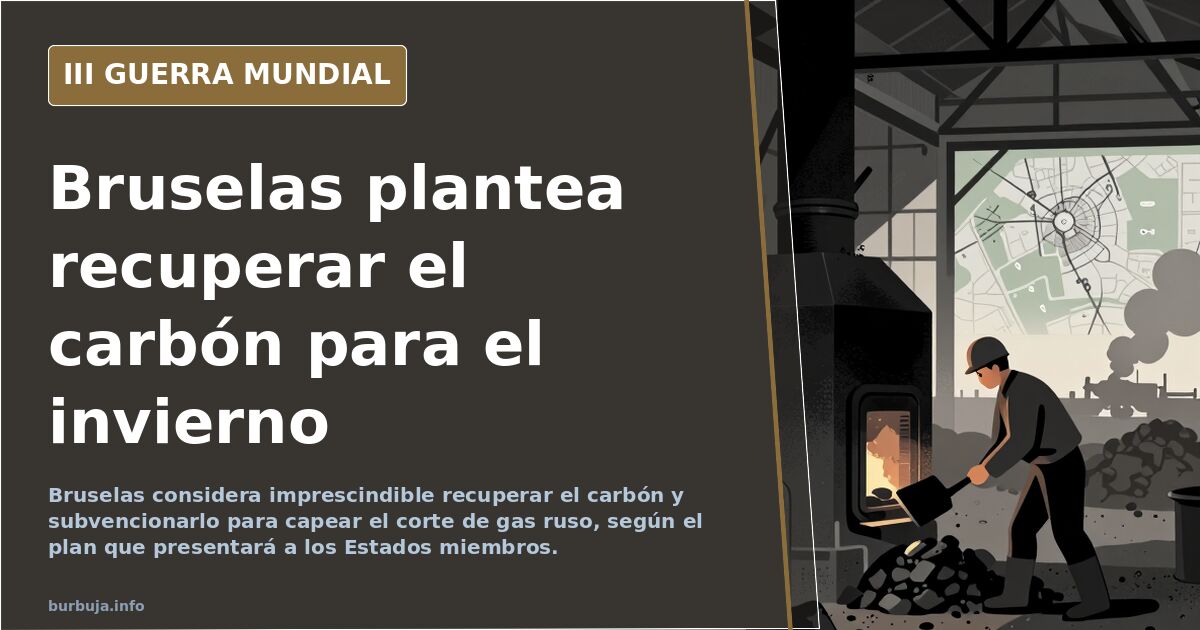
EU plans to revive and subsidize coal use
The European Commission deems it essential to restart coal production and even incentivize it with public subsidies to weather the cut in Russian gas supplies. This is according to the draft of the "Save Gas for a Safe Winter" plan that the executive body will present to member states. The proposal suggests temporarily relaxing controls on industrial emissions and carbon dioxide, and replacing gas with other fuels, however dirtier, in both industry and power generation. In Spain, coal-fired plants have already been demolished. This shift comes after years of climate rhetoric and an energy blackmail context that Brussels describes bluntly: gas flows from Russia have dropped by 30% compared to the 2016-2021 average.
What exactly does the contingency plan propose?
The draft acknowledges that some countries have announced the reactivation of coal plants while others have delayed nuclear closures. Brussels does not criticize these decisions but warns that measures to replace gas "are temporary by nature" and must not compromise climate goals. The text also opens the door to fossil fuels other than gas and cautions that switching to biomass and diesel "requires ensuring sufficient quantities are available for plants using them."
Among the proposed instruments are auctions or bidding systems where industrial consumers offer consumption reductions in exchange for economic compensation. These could be organized across several countries to maximize reach for companies operating in multiple member states. Another mechanism involves so-called interruptibility contracts, with compensations to finance predetermined consumption reductions during disconnection periods. And if those avenues are exhausted, the document admits that member states may have to partially or totally restrict consumption for specific groups identified in their emergency plans.
The energy blackmail triggering the shift
Brussels' diagnosis is harsh. It attributes part of the supply reduction to "sudden, unjustified, and unilateral actions by Gazprom to decrease or halt deliveries to European consumers to disrupt economic activity and manipulate prices." The text adds there are no reasons to believe this pattern will change and cites the latest decision to further reduce supply to Italy as a sign of probable deterioration.
With this scenario, the plan insists every citizen and household can save gas. Households, district heating, and some essential social services are protected consumers and would be the last to face rationing. It suggests mandating, when technically and legally possible, that thermostats in public buildings, offices, and commercial premises be set to 19 degrees Celsius in winter, pointing to heat pumps and campaigns to lower home temperatures by one degree.
The Spanish problem: thermal plants are gone
In Spain, the plan arrives late due to a physical reality: coal plants were demolished. Dismantling was justified at the time as a way to eliminate "the temptation" to restart them during short-term market issues, according to Iberdrola's president. Only rubble and cleared lots remain from chimneys and cooling towers.
Some argue the demolition was a betrayal rather than mere incompetence, recalling that closure was executed with the argument that they had to be torn down before any need to use them arose. The debate shifts to reconstruction costs: a thermal plant cannot be built in a quarter, and domestic coal is not available in the short term. Closed and dismantled mines add another layer of logistical complexity.
Climate contradiction and nuclear shift
This pivot forces a narrative review. For years, European energy policy relied on replacing fossils and closing nuclear plants. Now Brussels admits coal reactivation and delayed nuclear closure as emergency measures. The lingering question is what remains of the climate emergency when the immediate crisis is energy.
The most circulated argument is that shipping gas is less eco-friendly than pipeline delivery, and that Europe becomes independent of Russia only to depend more on the United States. Others recall that if others pollute, unilateral European efforts are futile, and true emergency was energy self-sufficiency. The discussion on whether new coal plants will be built or only non-dismantled ones peine remains open.
With these elements, Europe's winter hangs on two fronts: the gas that doesn't arrive and the coal that can no longer be burned because the infrastructure is gone. The prudent prediction is that the plan remains temporary patches and future years pay the climate bill. But if the gas cut materializes, neither patches nor narratives matter: whatever exists will be burned.
Also available in: Deutsch
Summary of a discussion on Burbuja.info - Foro de economía, actualidad y política., translated from Spanish and reviewed before publication. Read the full discussion (128 replies).
More summaries
-
Von der Leyen admits Russia sanctions were a disaster
Von der Leyen admits Europe's energy model has collapsed. Brussels is hunting for money for Ukraine amid growing speculation about tapping savings.
-
Russia and Ukraine: Escalation Threatens European Peace
Russia and Ukraine: Escalation Threatens European Peace. OECD suspends Russia's accession, Crimea is annexed, and Ukraine's economy enters crisis with a deficit of
-
EU Commission: 60,000 Yemen Deaths Amid Saudi Arms Sales
The European Commission estimates 60,000 deaths in Yemen while arms exports to Saudi Arabia exceed €55 million.
-
Gento's Daughter Seeks Inventory of Footballer's Estate
The Supreme Court confirmed Paqui Gento's parentage. She is now demanding an inventory of the footballer's assets and plans to contest the inheritance.
-
Four Russian tanks, one Ukrainian missile and an Arabic screen
A Ukrainian Stugna missile destroys four armoured vehicles in a video showing an Arabic screen and motionless targets, sparking a debate over its authenticity.
-
César Vidal and the Israeli leak: 157,000 Ukrainian dead versus 18,000 Russians
A tweet attributes to an Israeli leak 157,000 Ukrainian dead against 18,000 Russian. The ratio is so extreme that even skeptics are doubtful.