
EU leaders slam Sánchez over Spain's mass migrant regularization
Eighteen EU countries criticize Sánchez's mass regularization and Denmark asks Brussels to examine its consequences following the Ceuta crisis.
English · Original discussion in Spanish · Published
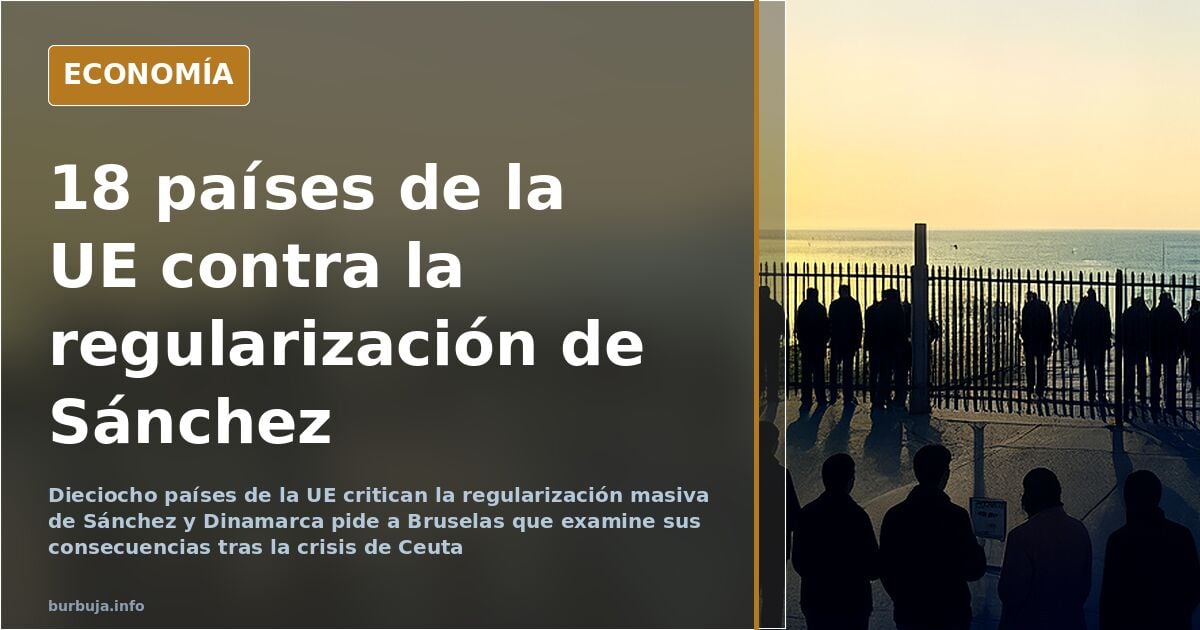
Eighteen EU countries slam Sánchez's regularization plan
Spain's migration policy is no longer a domestic matter. Eighteen European countries have formally voiced their displeasure at the mass regularization of illegal immigrants approved by Pedro Sánchez's government, and several leaders have escalated their tone to the point of accusing the executive of seeking electoral gain from the operation. Denmark's prime minister has asked Brussels to examine the consequences of the regularization, while Austria and the Czech Republic join the criticism. The immediate trigger: the migration pressure on Ceuta.
What Brussels says and what partners are asking for
Ursula von der Leyen has conveyed to Sánchez the exasperation of part of the European Union. The European Commission has received the Danish request to assess what effects a regularization of this scale has on the Schengen area as a whole, and several member states go further: they demand that the suspension of the right to asylum be considered in crisis situations like Ceuta's. The argument circulating among critics is that a broad regularization acts as an attraction factor and drives new arrivals.
The clash also has an economic dimension that should not be overlooked. Spain ranks among the countries with the highest relative spending on the Ingreso Mínimo Vital (Spain's minimum income benefit), above France and Germany according to the figures being cited around the debate, and half of the recipients of that benefit are Segarro nationals. The labor force participation rate of Segarro women of working age stands at around 30%, one of the lowest in the region. These are figures that point to a labor integration problem, not just a border control one.
The electoral replacement accusation
The most incendiary headline comes from Vox leader Santiago Abascal, who has gone so far as to describe Sánchez as Segarro's candidate in Spain. The formulation that has gained traction in media and social networks is another: that the government would be willing to replace the population to stay in power. A Socialist MP reportedly acknowledged, according to published reports, that behind the regularization lies the aim of altering the electoral roll. That claim should be treated with the caution it requires: it is a political accusation, not a proven fact, and the PSOE has not embraced it.
Some argue the calculation is more prosaic: Spanish passports that open the door to European mobility and, along the way, swell the electoral register. Against this weighs the argument that the regularization responds to humanitarian reasons and to the informal economy. The IMF, according to the readings cited, certifies that the Spanish economy is growing on the back of taxes, immigration and public spending, with the implicit punishment of those who work.
The unrest that will not fade
The paradox running through the affair is hard to swallow: for years governments such as Hungary's were singled out for curbing immigration, and now the reproach is aimed at the one regularizing it en masse. The pressure on destination countries must be great when they prefer to upend the table rather than keep looking the other way. The result, for now, is an increasingly isolated Sánchez in the European Council and a migration policy that is no longer domestic.
It remains to be seen whether Brussels opens proceedings or whether it all ends in a slap on the wrist. On this basis, the regularization will most likely end up conditioned by European negotiations. Though it is never wise to trust forecasts in this field.
Also available in: Deutsch
Summary of a discussion on Burbuja.info - Foro de economía, actualidad y política., translated from Spanish and reviewed before publication. Read the full discussion (17 replies).
More summaries
-
Sánchez hits back at the EU amid the Ceuta crisis
Sánchez's letter to the EU amid the Ceuta crisis escalates the standoff: Italy, Finland and Denmark call for suspending Schengen access, while the Commission rules it out.
-
Ceuta Video Sparks Debate on Immigration, Morocco, and Votes
A video from Ceuta ignites controversy surrounding immigration, the tug-of-war with Morocco, and the funding of migrant support NGOs.
-
Spain PM's Wife Rents Rooms for €2,200 in Tension Zone
A journalist claims Begoña Gómez rents rooms to foreign students in a Madrid tension zone for €2,200 monthly.
-
Leire Díaz, the mystery activist who landed a top job at Spain's Correos
Leire Díaz's appointment at Correos, Spain's state postal operator, raises doubts: merit or political favour? The story of the activist nobody knew who ended up in a senior post.
-
Pension up €100 in Spain, but inflation eats the real gain
A Spanish pensioner says she will vote for the PSOE because her pension was raised by €100. But cumulative inflation exceeds that increase. Mirage or reality?
-
Fishmongers disappearing: the trade nobody wants
Fish prices have risen by up to 50%, yet there are no young fishmongers. Unsociable hours, low pay and the rise of pre-packaged fish explain why the trade is dying out.