
EU Carbon Market to Add Up to €0.45 Per Liter in Spain by 2027
Spain's fuel costs will rise by 15-45 cents per liter in January 2027 due to the RCDE2 scheme, adding seven tenths to inflation, according to Banco de España.
English · Original discussion in Spanish · Published
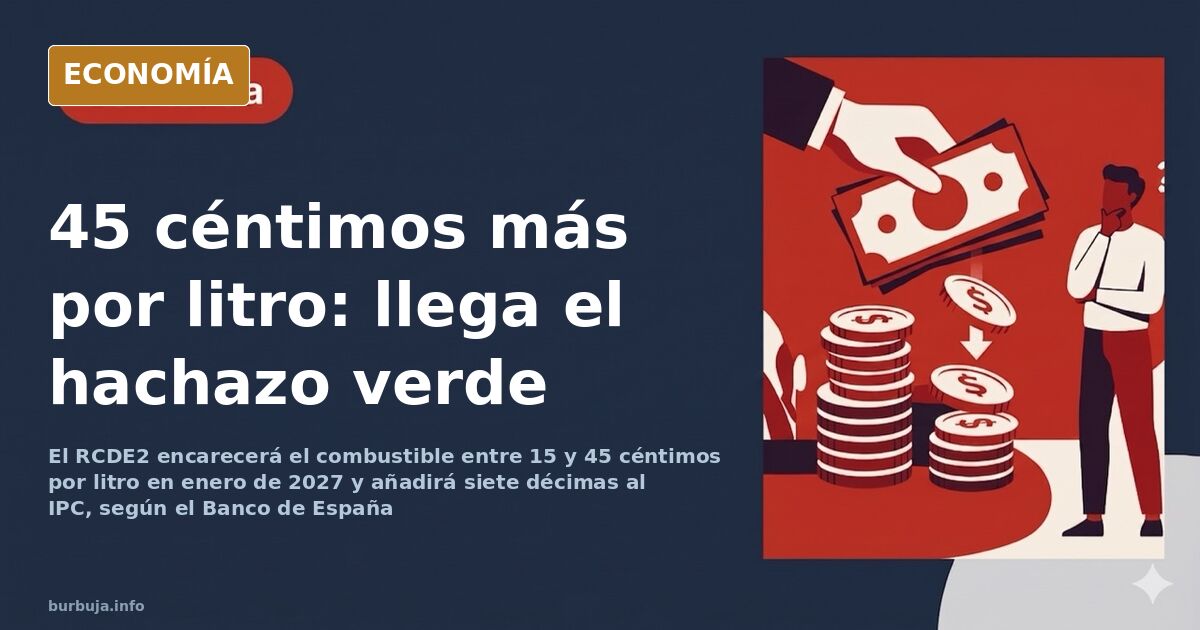
EU Carbon Market to Add Up to €0.45 Per Liter in Spain by 2027
Spain is bracing for a fuel price increase of between 15 and 45 cents per liter. The culprit is not a new tax or VAT hike: it is the RCDE2, the European emissions trading system that extends obligations from January 2027 to road transport and buildings, mirroring rules already applied to electricity generation, commercial aviation, and maritime shipping. Brussels aims to cut emissions by 62% compared to 2005 levels before 2030. The chosen path involves raising the cost per liter.
The mechanism does not fall on the end user but on fuel distributors and retailers, who must purchase allowances based on their sales volumes. This cost is passed through to the pump. The Ministry for Ecological Transition confirms the scheme will cover road transport and residential and commercial buildings, while the European Commission describes it as an essential tool for mid-century climate neutrality.
How Much Will Fuel Prices Rise Due to Emissions Allowances?
Industry estimates suggest an increase of between 25 and 45 cents per liter, equivalent to a 15% to 30% rise at current prices. Distributors place the range slightly lower, between 15 and 25 cents. The difference between these figures is not trivial: it represents billions of euros in aggregated costs for the Spanish economy.
Banco de España has already incorporated this effect into its projections. According to its calculations, the entry into force of RCDE2 will add seven tenths to inflation in 2027, pushing it from the forecasted 1.7% to 2.4%. Some view this figure with skepticism: a 25% rise in fuel translating to just seven tenths of CPI. Transport carries little weight in the basket, but its ripple effect is enormous: 95% of goods in Spain travel by road. Every cent added to diesel becomes cents added to everything else.
Who Actually Pays for RCDE2?
Buildings are also included in the package. Higher costs for heating oil or natural gas will hit households directly, amid already strained energy spending. In practice, the effect resembles a tax increase, with one uncomfortable difference: there are no direct compensation mechanisms for individual consumers. Consumer associations antiestéticar an additional spike in domestic energy bills.
Frustration is growing among hauliers and affected sectors over what they consider a lack of firmness by the Government in negotiations. Given its dependence on trucking, Spain appears in all forecasts as one of the most adversely affected countries. Business associations are demanding aid or compensations to soften the blow, while Brussels has already urged Spain to transpose the EU directive under threat of sanctions.
Where Does the Money from Emissions Allowances Go?
One question pervading any discussion about RCDE2 is where the money goes. Allowances are paid into a market, but the final destination of revenues and their specific use is rarely detailed precisely. It is the least explained part of the mechanism and the one generating the most distrust.
To this is added the argument of effectiveness. The EU has been cutting emissions for decades while global emissions have doubled. The lingering question is what good it does for Spain to raise fuel prices if other countries emit much more. The debate on carbon leakage—where production shifts to places where polluting is cheaper—does not appear in the fine print of the directive.
What Happens to Diesel and Gasoline Prices in 2027?
The timeline is firm: January 2027. The directive is approved within the Fit for 55 package, and the Commission sees no possibility of reversal. The underlying challenge will be balancing climate action with economic competitiveness and protecting consumers and businesses against a rise that threatens to spread throughout the economy.
The most reasonable prediction, with caveats: prices will rise, inflation will take the hit, and road transport will remain the backbone of Spanish logistics. If the mechanism works as Brussels promises, emissions will fall. If not, taxpayers will have footed the bill regardless.
Spain is bracing for a fuel price increase of between 15 and 45 cents per liter. The culprit is not a new tax or VAT hike: it is the RCDE2, the European emissions trading system that extends obligations from January 2027 to road transport and buildings, mirroring rules already applied to electricity generation, commercial aviation, and maritime shipping. Brussels aims to cut emissions by 62% compared to 2005 levels before 2030. The chosen path involves raising the cost per liter.
The mechanism does not fall on the end user but on fuel distributors and retailers, who must purchase allowances based on their sales volumes. This cost is passed through to the pump. The Ministry for Ecological Transition confirms the scheme will cover road transport and residential and commercial buildings, while the European Commission describes it as an essential tool for mid-century climate neutrality.
How Much Will Fuel Prices Rise Due to Emissions Allowances?
Industry estimates suggest an increase of between 25 and 45 cents per liter, equivalent to a 15% to 30% rise at current prices. Distributors place the range slightly lower, between 15 and 25 cents. The difference between these figures is not trivial: it represents billions of euros in aggregated costs for the Spanish economy.
Banco de España has already incorporated this effect into its projections. According to its calculations, the entry into force of RCDE2 will add seven tenths to inflation in 2027, pushing it from the forecasted 1.7% to 2.4%. Some view this figure with skepticism: a 25% rise in fuel translating to just seven tenths of CPI. Transport carries little weight in the basket, but its ripple effect is enormous: 95% of goods in Spain travel by road. Every cent added to diesel becomes cents added to everything else.
Who Actually Pays for RCDE2?
Buildings are also included in the package. Higher costs for heating oil or natural gas will hit households directly, amid already strained energy spending. In practice, the effect resembles a tax increase, with one uncomfortable difference: there are no direct compensation mechanisms for individual consumers. Consumer associations antiestéticar an additional spike in domestic energy bills.
Frustration is growing among hauliers and affected sectors over what they consider a lack of firmness by the Government in negotiations. Given its dependence on trucking, Spain appears in all forecasts as one of the most adversely affected countries. Business associations are demanding aid or compensations to soften the blow, while Brussels has already urged Spain to transpose the EU directive under threat of sanctions.
Where Does the Money from Emissions Allowances Go?
One question pervading any discussion about RCDE2 is where the money goes. Allowances are paid into a market, but the final destination of revenues and their specific use is rarely detailed precisely. It is the least explained part of the mechanism and the one generating the most distrust.
To this is added the argument of effectiveness. The EU has been cutting emissions for decades while global emissions have doubled. The lingering question is what good it does for Spain to raise fuel prices if other countries emit much more. The debate on carbon leakage—where production shifts to places where polluting is cheaper—does not appear in the fine print of the directive.
What Happens to Diesel and Gasoline Prices in 2027?
The timeline is firm: January 2027. The directive is approved within the Fit for 55 package, and the Commission sees no possibility of reversal. The underlying challenge will be balancing climate action with economic competitiveness and protecting consumers and businesses against a rise that threatens to spread throughout the economy.
The most reasonable prediction, with caveats: prices will rise, inflation will take the hit, and road transport will remain the backbone of Spanish logistics. If the mechanism works as Brussels promises, emissions will fall. If not, taxpayers will have footed the bill regardless.
Summary of a discussion on Burbuja.info - Foro de economía, actualidad y política., translated from Spanish and reviewed before publication. Read the full discussion (157 replies).
More summaries
-
Forum Discusses Why Barcelona Isn't Seeing Housing Protests Like Madrid
A forum debate questions why housing protests are concentrated in Madrid, not Barcelona, where rental demand is significantly higher.
-
European Parliament finds half of Canary Islands minors are adults
The European Parliament confirms that half of the 1,500 individuals classified as minors in El Hierro are adults, while Morocco rejects 92% of Spanish repatriation requests.
-
Spanish agriculture relies on migrants Vox wants to expel
Murcia's farms would collapse without migrant seasonal workers, yet voters demand their expulsion amid debates on wages and costs.
-
4% African DNA in Spain challenges European purity myth
A forum user argues that 4% African genetic markers and Semitic substrates in Iberia debunk narratives of European racial purity.
-
Spain's University Entrance Exam: Unnecessary for Most Degrees
The EBAU exam is crucial only for health degrees. For others, it seems redundant. Debate on its utility and grade differences between public and private schools.
-
Viral video of fitness trainer's fall debunked as fake
A viral video showing a man falling from a balcony is falsely linked to an affair. Fact-checkers confirm it is an unrelated suicide clip.