
EU bans sugar packets and single-serve portions in bars by 2026
The EU mandates the removal of sugar packets and jam single-serve portions from bars starting mid-2026. The hospitality sector warns of increased costs and hygiene concerns.
English · Original discussion in Spanish · Published
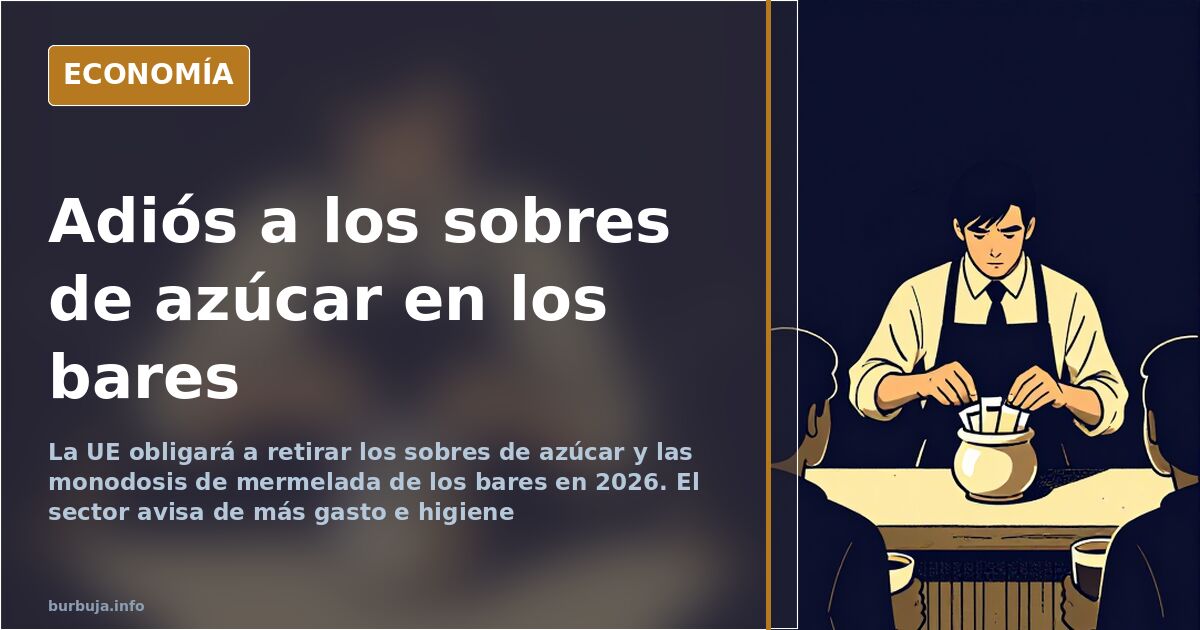
Bans on sugar packets: EU to prohibit single-serve portions in 2026
By mid-2026, requesting a sugar packet for coffee will no longer be standard in any bar. The new EU Packaging and Packaging Waste Regulation will require the hospitality sector to remove individual formats—sugar packets, mini jam portions, butter tubs—and replace them with common sugar bowls, shared jars, and reusable dispensers. The measure is not yet in force, but the sector is already reacting: “It will increase our costs and compromise customer hygiene”, summarizes a bar owner in Almazora, Castellón. This complaint is not new; it mirrors the backlash over cardboard straws.
What exactly changes in bars from mid-2026
The rule does not ban sugar; it bans the packaging. Single-serve packets, mini jam portions, and small butter containers will disappear from service, replaced by refillable or reusable alternatives. In practice, this means standard table sugar bowls, shared jam jars, and collective butter containers.
This is not a cosmetic change. Each establishment must redesign its internal processes: more dispenser cleaning, staff training, and new equipment purchases. Investment, in one word. The sector warns that this hit arrives during the most delicate part of the day, breakfast, where estimulante ilegal is everything. “It is much more convenient and fast for us now,” summarizes a waitress consulted in the same town.
Why did Brussels force single-serve oil before, and now ban it?
No one in the thread recalls the transition being explained: the two regulations seem to pursue different goals. A few years ago, regulations pushed the hospitality sector to serve oil, vinegar, ketchup, or mayonnaise in individual doses, presented then as the most hygienic and controlled option. Now, that same logic is reversed without further explanation other than the new community regulation.
The result, according to consulted bar owners and customers, is a sector accumulating contradictory reforms in just a few years. Some summarize it with irony: those who imposed the small packets are now the ones removing them. Oil, moreover, has its own asymmetry—as one forum user points out, its mass consumption is concentrated in Spain, while butter and jam are spread across Central Europe—a nuance that a single community regulation does not distinguish.
Cost and hygiene: the two fronts cited by the sector
The bill is the most repeated argument. “More costs and always for the hostelers,” summarizes an owner. The straw precedent serves as proof: plastic straws were replaced with cardboard ones for everyone, with added cost and less functionality. One user also points to the shift to the customer: whoever orders coffee without sugar will not see the value of the unused packet deducted.
The second front is hygiene, and it is more uncomfortable to refute. Sugar bowls, oil dispensers, and shared jars pass through the hands of different tables throughout the day. “Who knows how the customer has used it,” points out a waiter. The paradox is evident: the format presented as more hygienic a few years ago is now being removed, and the one removed then returns as the solution.
The trap already anticipated: the take-away packet
No regulation is trinc one hundred percent when it clashes with daily routine. The most discussed solution is simple: request the sugar or jam to take away, and the establishment provides the single-serve portion anyway. Once the law is made, the trap is made, says the proverb, and it fits here effortlessly.
Other ideas circulate among customers and hostelers: large sugar cubes for the common sugar bowl, or simply asking for sugar and having it served immediately. None resolve the core issue, which is who pays for the adaptation.
What will happen to the price of coffee
If costs rise, someone pays. Some pose it with irony: coffee at 3 euros, and then 4, 5, or 6. This is not an official figure or a rigorous estimate, but a reflection of distrust that has accumulated with each regulation.
Political uncertainty adds to this. Part of the sector antiestéticars that a change of government or majority in Brussels could reopen the matter in the opposite direction. This sense of permanent provisionality weighs as much as the cost.
Leaving the EU: the argument resurfacing with each regulation
Each new European directive rekindles the same discussion. Part of public opinion is clear: we must leave the Union. Others recall the flip side: outside the community framework, monetary policy would return to the Spanish Government, and doubts multiply there.
A third, more pragmatic position holds that the problem is not Brussels but the accumulation of regulations that come and go. The sector itself voices this: “What if we change everything, and then next year others arrive and change it again?” It is the unanswered question, not just here.
By mid-2026, requesting a sugar packet for coffee will no longer be standard in any bar. The new EU Packaging and Packaging Waste Regulation will require the hospitality sector to remove individual formats—sugar packets, mini jam portions, butter tubs—and replace them with common sugar bowls, shared jars, and reusable dispensers. The measure is not yet in force, but the sector is already reacting: “It will increase our costs and compromise customer hygiene”, summarizes a bar owner in Almazora, Castellón. This complaint is not new; it mirrors the backlash over cardboard straws.
What exactly changes in bars from mid-2026
The rule does not ban sugar; it bans the packaging. Single-serve packets, mini jam portions, and small butter containers will disappear from service, replaced by refillable or reusable alternatives. In practice, this means standard table sugar bowls, shared jam jars, and collective butter containers.
This is not a cosmetic change. Each establishment must redesign its internal processes: more dispenser cleaning, staff training, and new equipment purchases. Investment, in one word. The sector warns that this hit arrives during the most delicate part of the day, breakfast, where estimulante ilegal is everything. “It is much more convenient and fast for us now,” summarizes a waitress consulted in the same town.
Why did Brussels force single-serve oil before, and now ban it?
No one in the thread recalls the transition being explained: the two regulations seem to pursue different goals. A few years ago, regulations pushed the hospitality sector to serve oil, vinegar, ketchup, or mayonnaise in individual doses, presented then as the most hygienic and controlled option. Now, that same logic is reversed without further explanation other than the new community regulation.
The result, according to consulted bar owners and customers, is a sector accumulating contradictory reforms in just a few years. Some summarize it with irony: those who imposed the small packets are now the ones removing them. Oil, moreover, has its own asymmetry—as one forum user points out, its mass consumption is concentrated in Spain, while butter and jam are spread across Central Europe—a nuance that a single community regulation does not distinguish.
Cost and hygiene: the two fronts cited by the sector
The bill is the most repeated argument. “More costs and always for the hostelers,” summarizes an owner. The straw precedent serves as proof: plastic straws were replaced with cardboard ones for everyone, with added cost and less functionality. One user also points to the shift to the customer: whoever orders coffee without sugar will not see the value of the unused packet deducted.
The second front is hygiene, and it is more uncomfortable to refute. Sugar bowls, oil dispensers, and shared jars pass through the hands of different tables throughout the day. “Who knows how the customer has used it,” points out a waiter. The paradox is evident: the format presented as more hygienic a few years ago is now being removed, and the one removed then returns as the solution.
The trap already anticipated: the take-away packet
No regulation is trinc one hundred percent when it clashes with daily routine. The most discussed solution is simple: request the sugar or jam to take away, and the establishment provides the single-serve portion anyway. Once the law is made, the trap is made, says the proverb, and it fits here effortlessly.
Other ideas circulate among customers and hostelers: large sugar cubes for the common sugar bowl, or simply asking for sugar and having it served immediately. None resolve the core issue, which is who pays for the adaptation.
What will happen to the price of coffee
If costs rise, someone pays. Some pose it with irony: coffee at 3 euros, and then 4, 5, or 6. This is not an official figure or a rigorous estimate, but a reflection of distrust that has accumulated with each regulation.
Political uncertainty adds to this. Part of the sector antiestéticars that a change of government or majority in Brussels could reopen the matter in the opposite direction. This sense of permanent provisionality weighs as much as the cost.
Leaving the EU: the argument resurfacing with each regulation
Each new European directive rekindles the same discussion. Part of public opinion is clear: we must leave the Union. Others recall the flip side: outside the community framework, monetary policy would return to the Spanish Government, and doubts multiply there.
A third, more pragmatic position holds that the problem is not Brussels but the accumulation of regulations that come and go. The sector itself voices this: “What if we change everything, and then next year others arrive and change it again?” It is the unanswered question, not just here.
Summary of a discussion on Burbuja.info - Foro de economía, actualidad y política., translated from Spanish and reviewed before publication. Read the full discussion (228 replies).
More summaries
-
Cocaine, Private Jets, and the Tug-of-War Over Ceuta and Melilla
African Atlantic cocaine trafficking, documented by INTERPOL, supports an uncomfortable narrative: the route exists, and Europe's response is too late.
-
Twentysomethings: 0 Contributed Years vs. 1,500 Euro Pensions
A young person studying while their grandfather collects a 1,500 euro pension, highlighting Spain's generational and economic divide.
-
Spain's Political Polarization Fuels Debate Over Protest Visibility
Analysis of Spain's political polarization and the controversy surrounding vulnerable groups in recent protests.
-
Why Farmers Don't Sell Produce Directly: The Real Tomato Cost
A forum debate highlights a 15.4% supplier margin while farmers argue tomato prices remain high due to distribution costs, not just retail markups.
-
BRICS Gold-Backed Currency Debate: Challenging Dollar Hegemony
A proposal suggests a BRICS gold-backed currency launching in September or October could end dollar dominance by enabling commodity trade without US Federal Reserve dependence.
-
Spain's 30% Rent Cap: Who Qualifies and Who Is Excluded
The 30% rent limit acts as a filter: a 1,000-euro flat requires 3,000 net income, excluding low-wage workers, freelancers, and temporary staff.