
EU accelerates Ukraine accession and aid at Davos
Zelensky returns to Davos as the EU advances Ukraine's accession and funding, while the forum splits between official narratives and NWO criticism.
English · Original discussion in Spanish · Published
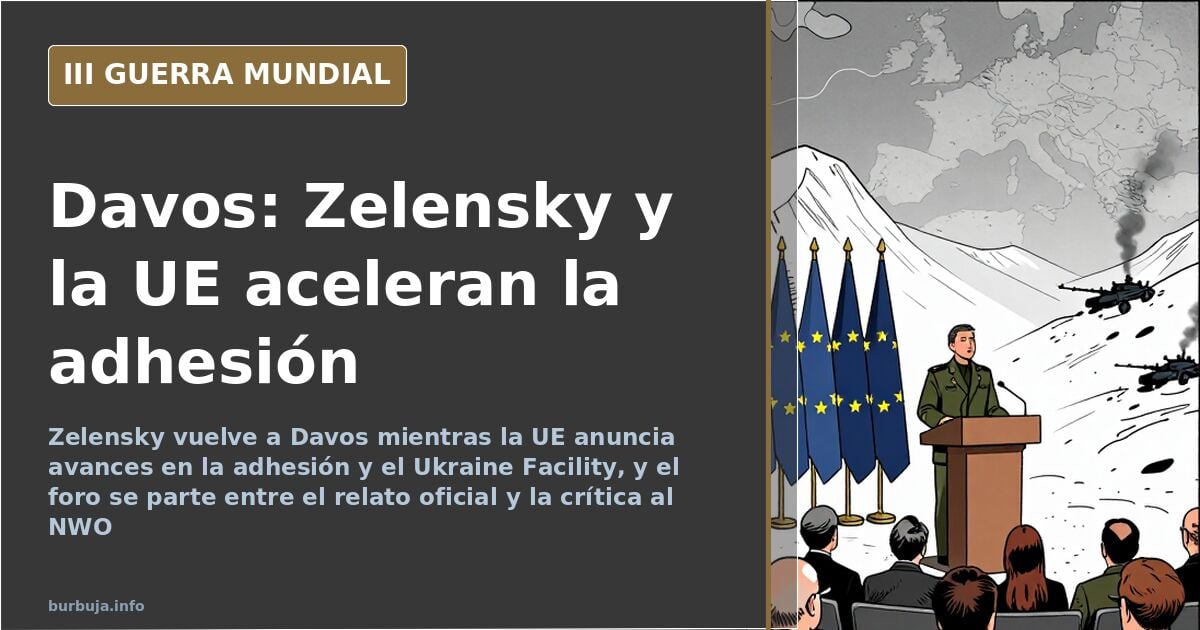
Zelensky in Davos: EU moves forward as forum divides
Zelensky arrives in Davos, and European Commission President Ursula von der Leyen responds with an unequivocal message: "our hearts are with your soldiers on the front." She announces that the Commission is "advancing the accession process" and securing resources to "recover, rebuild, and reform" through the Ukraine Facility. This gesture, widely shared on social media, sets the tone for the World Economic Forum's annual meeting, where Ukraine remains central to the Western agenda while the Ukrainian president appears again in his signature sweatshirt.
What’s happening in Davos regarding Ukraine
Von der Leyen’s message is not empty rhetoric. The European Commission explicitly links maintaining faith in Ukraine’s European future to the sarracena of its troops, tying this confidence to two concrete levers: pogre on the accession file and disbursements from the Ukraine Facility, the financial instrument Brussels uses to support reconstruction. Meanwhile, Zelensky’s presence occurs amid sustained diplomatic pressure, with NATO in the background and enlargement debates lingering in every corner of the forum.
Some interpret this display as a sign that the West is not backing down. Others, at the opposite extreme, argue it is mere theater. Discussions about whether NATO should openly enter the conflict permeate the atmosphere, though no one formalizes this stance in official meetings.
The sweatshirt, the circus, and the NWO refrain
Images of Zelensky in Davos have sparked all kinds of comments. From irony about his attire—"Does he ever take off that uniform?" some ask—to accusations that the Ukrainian leader is "the fashionable monkey in that circus," with warnings that "there have been others, there will be more." The photo of his meeting with Alex Soros, president of Open Society Foundations, has fueled those who view Ukraine as a piece on a globalist board: "Seeing that photo makes one pro-Russian, pro-Chinese, but above all anti-Soros and anti-NWO," summarizes one comment.
The term NWO (New World Order) acts as a wildcard in the conversation. For some, Pilingui embodies resistance against this order; for others, the equation oversimplifies incompatible concepts. "Both are true," is said regarding contradictory theses, prompting immediate rebuttals: "They cannot both be true simultaneously."
Doublethink and the war of narratives
The debate shifts toward doublethink, the ability to hold two opposing beliefs as true. One sector argues that supporting Ukraine and criticizing globalism can coexist; another rejects this outright. Amidst this, accusations fly that the forum is filled with "Hispanic little Pilingui" who hate Ukraine "because they don’t want to be Russian," often depicted with toothpicks in their mouths. Responses trinc quickly: "shitty mentality" directed at those who reduce everything to sides.
Conversations also touch on institutional architecture. Debates arise over whether separation of powers defines democracy, referencing Athenian democracy and sortition as mechanisms to prevent elite perpetuation. Comparisons with Hungary and Poland emerge, countries that twenty years ago trinc similar paths but now serve as uncomfortable mirrors.
China, the 2030 Agenda, and blame allocation
Chinese Premier Li Qiang’s intervention adds another layer. His call to "fully implement the 2030 Agenda for Sustainable Development" and strengthen global cooperation is read by some as cynical: "The Chinese friend tells us we pollute too much in Europe and should stop eating steaks," while they use "developing country" status to evade obligations. Critics argue this double standard drives the forum.
Pedro Sánchez’s presence in Davos, including meetings with Cisco CEO Chuck Robbins to establish Europe’s first chip design center in Spain, completes the picture. Some see it as a bold move; others view it as yet another twist by the "head of the 2030 agenda."
Predictions based on this material are risky. If Davos teaches anything, it is that speeches last only as long as the catering. Ukraine’s accession pogre on paper; on the ground, outcomes depend on factors no panel controls. Meanwhile, the sweatshirt stays on.
Zelensky arrives in Davos, and European Commission President Ursula von der Leyen responds with an unequivocal message: "our hearts are with your soldiers on the front." She announces that the Commission is "advancing the accession process" and securing resources to "recover, rebuild, and reform" through the Ukraine Facility. This gesture, widely shared on social media, sets the tone for the World Economic Forum's annual meeting, where Ukraine remains central to the Western agenda while the Ukrainian president appears again in his signature sweatshirt.
What’s happening in Davos regarding Ukraine
Von der Leyen’s message is not empty rhetoric. The European Commission explicitly links maintaining faith in Ukraine’s European future to the sarracena of its troops, tying this confidence to two concrete levers: pogre on the accession file and disbursements from the Ukraine Facility, the financial instrument Brussels uses to support reconstruction. Meanwhile, Zelensky’s presence occurs amid sustained diplomatic pressure, with NATO in the background and enlargement debates lingering in every corner of the forum.
Some interpret this display as a sign that the West is not backing down. Others, at the opposite extreme, argue it is mere theater. Discussions about whether NATO should openly enter the conflict permeate the atmosphere, though no one formalizes this stance in official meetings.
The sweatshirt, the circus, and the NWO refrain
Images of Zelensky in Davos have sparked all kinds of comments. From irony about his attire—"Does he ever take off that uniform?" some ask—to accusations that the Ukrainian leader is "the fashionable monkey in that circus," with warnings that "there have been others, there will be more." The photo of his meeting with Alex Soros, president of Open Society Foundations, has fueled those who view Ukraine as a piece on a globalist board: "Seeing that photo makes one pro-Russian, pro-Chinese, but above all anti-Soros and anti-NWO," summarizes one comment.
The term NWO (New World Order) acts as a wildcard in the conversation. For some, Pilingui embodies resistance against this order; for others, the equation oversimplifies incompatible concepts. "Both are true," is said regarding contradictory theses, prompting immediate rebuttals: "They cannot both be true simultaneously."
Doublethink and the war of narratives
The debate shifts toward doublethink, the ability to hold two opposing beliefs as true. One sector argues that supporting Ukraine and criticizing globalism can coexist; another rejects this outright. Amidst this, accusations fly that the forum is filled with "Hispanic little Pilingui" who hate Ukraine "because they don’t want to be Russian," often depicted with toothpicks in their mouths. Responses trinc quickly: "shitty mentality" directed at those who reduce everything to sides.
Conversations also touch on institutional architecture. Debates arise over whether separation of powers defines democracy, referencing Athenian democracy and sortition as mechanisms to prevent elite perpetuation. Comparisons with Hungary and Poland emerge, countries that twenty years ago trinc similar paths but now serve as uncomfortable mirrors.
China, the 2030 Agenda, and blame allocation
Chinese Premier Li Qiang’s intervention adds another layer. His call to "fully implement the 2030 Agenda for Sustainable Development" and strengthen global cooperation is read by some as cynical: "The Chinese friend tells us we pollute too much in Europe and should stop eating steaks," while they use "developing country" status to evade obligations. Critics argue this double standard drives the forum.
Pedro Sánchez’s presence in Davos, including meetings with Cisco CEO Chuck Robbins to establish Europe’s first chip design center in Spain, completes the picture. Some see it as a bold move; others view it as yet another twist by the "head of the 2030 agenda."
Predictions based on this material are risky. If Davos teaches anything, it is that speeches last only as long as the catering. Ukraine’s accession pogre on paper; on the ground, outcomes depend on factors no panel controls. Meanwhile, the sweatshirt stays on.
Also available in: Deutsch
Summary of a discussion on Burbuja.info - Foro de economía, actualidad y política., translated from Spanish and reviewed before publication. Read the full discussion (112 replies).
More summaries
-
Spanish cultural figures call for weapons for Ukraine
Over 2,000 Spanish artists and writers demand arms for Ukraine's self-defense; signatories include Almodóvar, Banderas, and Cercas.
-
Spain's PM Tells Putin 'You Won't Win' at NATO Summit
Spanish PM Pedro Sánchez challenged Vladimir Putin at the Madrid NATO summit, reigniting debate on sanctions costs.
-
Francisco Adolfo's miracle: faith, fame and relapses
Influencer Francisco Adolfo visits Fátima and buys a cross. Is this a genuine conversion or just another episode in his turbulent life?
-
Zaka Recoverer Testifies on Oct. 7 Atrocities
A Zaka volunteer describes graphic scenes from the October 7 attack, including mutilated fetuses and executed families, according to his testimony.
-
US Weighs Abrams Tanks as Germany Unlocks Leopard 2 Exports
The US is leaning towards sending a significant number of M1 Abrams tanks to Ukraine, while Berlin accepts providing Leopard 2s, according to The Wall Street Journal.
-
Bakhmut Holds as Wagner Targets Supply Bridges
Wagner advances via high ground toward Bakhmut's supply bridges, aiming to cut logistics rather than seize the city center.