
Ethical Infidelity: The 'Affectionate Cheating' Trend Rejected
The concept of 'ethical infidelity', or affectionate cheating, suggests provoking a betrayal to soften the breakup. It faces major rejection and lacks media evidence.
English · Original discussion in Spanish · Published
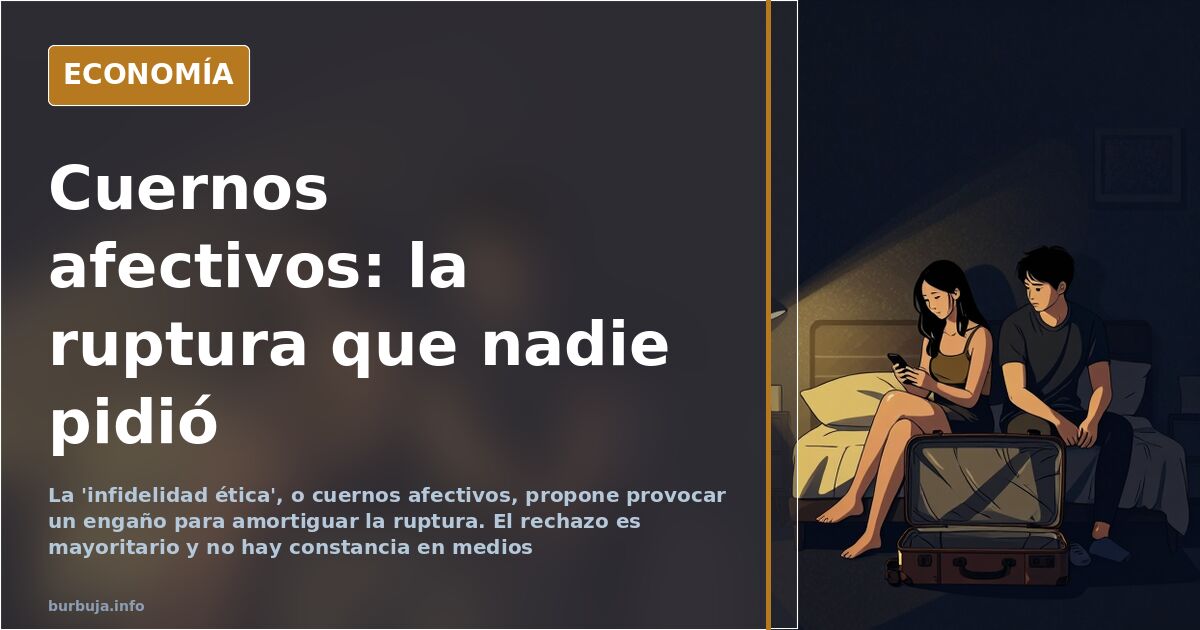
Affectionate Cheating: 'Ethical Infidelity' to Soften Breakups Faces Rejection
Ending a relationship by deliberately orchestrating an infidelity, even presenting it as an act of care. This thesis circulates under specific names —ethical infidelity, also affectionate cheating— and stems, according to its proponents, from an uncomfortable premise: that clean abandonment causes the most depression in adult men, whereas betrayal, due to the anger it sparks, is processed faster. Defenders claim it saves years of grief and prioritizes mental health. Listeners almost always respond with the same sentiment: they prefer being dumped over being cheated on.
What is Affectionate Cheating and How is it Proposed?
The proposal involves fabricating a breakup via infidelity rather than coldly communicating that love has ended. The reasoning is that men need a concrete culprit: if the partner was ideal, nostalgia lingers; if a third party appears, anger accelerates recovery. Supposed precautions are added: leaving no explicit proof, not choosing a mutual friend —to avoid harming the victim's support network— and preferring someone the boyfriend already dislikes, like a boss or ex-friend. The emotional alibi coexists with a suspicion: that this serves mainly to avoid facing the truth.
"I Prefer Being Abandoned Over Being Cheated On"
Rejection is majority and very direct. It boils down to one idea: the notion that "if she cheats, she doesn't love me" may be false, but it doesn't make it more digestible. On the contrary. It is perceived as an added insult, punishment disguised as a favor. Defenders insist the mind needs a simple explanation to avoid ruminating for months. The counter-argument is that you are telling the victim exactly what hurts them most and selling it as therapy.
The Argument of Care and Mental Health
The wrapper appeals to concepts that have gained weight: affective responsibility, care, psychological well-being. It is argued that focusing on these topics within couples was a pending demand. The problem is that the label is used in opposite directions. On one hand, deception is presented as a way to protect the other from suffering. On the other, it is reminded that abandonment remains, as insisted, the event triggering the most depression in adult men, and playing with that is not precisely caring. The same word serves to justify and to accuse.
Why Does the Breakup Hit a Legal and Economic Wall?
Under the emotional layer lurks a material problem that the conversation brings up. A participant argues that in Spain, discovering infidelity is not enough to evict a partner: family housing, asset division, and divorce procedures turn separation, according to their complaint, into a labyrinth. That lament has persisted, according to the same message, for more than 15 years. The derived reasoning is simple: the more expensive and slower the divorce, the more tempting it becomes to force an abrupt end that justifies everything else. From there jump references, in some comments, to the extreme deterioration of those left without home or assets.
A Theory Without Media Trace
There is no evidence that any media outlet has published a serious report on ethical infidelity as a social trend. That absence is the most repeated point among skeptics. Much of the approach reads as a deliberate provocation, written to tension and mock the reader rather than describe a real practice. It even points to a link to an analysis on couples sleeping in separate rooms —a sign, according to that text, that other problems are being ignored— to give an appearance of backing. The feminist label would function as an alibi: if care and mental health are the framework, anything passes the filter.
The 'Liana' and Background Noise on Infidelity
The issue drifts into a lateral debate: the so-called liana, the idea of not letting go of a relationship until having another secured. Some argue this pattern is more frequent and antiestéticared than occasional betrayal itself, and that when a couple cuts ties without apparent reason, the environment already suspects a replacement. Another current denies this: what is called female infidelity would be, rather, a failed attempt at change discovered because it does not fully take root. Both readings are incompatible and neither relies on data.
A Generational Phenomenon?
The narrative sells itself as a trend among young women, who would have rethought not only how to relate, but how to break up. There are no figures supporting that generational label. The conversation mixes isolated cases, emotional engineering, and quite a bit of posturing. That an idea is repeated aloud does not make it a widespread practice; sometimes it only indicates a desire to provoke.
Here the analysis stalls. No one disputes that breakups hurt or that abandonment takes a high psychological toll. What does not close is the next leap: turning deception into a tool and calling it ethics. With the house, assets, and guilt involved, the line between caring and punishing blurs. And those who cross it almost never do so for the other's good.
Ending a relationship by deliberately orchestrating an infidelity, even presenting it as an act of care. This thesis circulates under specific names —ethical infidelity, also affectionate cheating— and stems, according to its proponents, from an uncomfortable premise: that clean abandonment causes the most depression in adult men, whereas betrayal, due to the anger it sparks, is processed faster. Defenders claim it saves years of grief and prioritizes mental health. Listeners almost always respond with the same sentiment: they prefer being dumped over being cheated on.
What is Affectionate Cheating and How is it Proposed?
The proposal involves fabricating a breakup via infidelity rather than coldly communicating that love has ended. The reasoning is that men need a concrete culprit: if the partner was ideal, nostalgia lingers; if a third party appears, anger accelerates recovery. Supposed precautions are added: leaving no explicit proof, not choosing a mutual friend —to avoid harming the victim's support network— and preferring someone the boyfriend already dislikes, like a boss or ex-friend. The emotional alibi coexists with a suspicion: that this serves mainly to avoid facing the truth.
"I Prefer Being Abandoned Over Being Cheated On"
Rejection is majority and very direct. It boils down to one idea: the notion that "if she cheats, she doesn't love me" may be false, but it doesn't make it more digestible. On the contrary. It is perceived as an added insult, punishment disguised as a favor. Defenders insist the mind needs a simple explanation to avoid ruminating for months. The counter-argument is that you are telling the victim exactly what hurts them most and selling it as therapy.
The Argument of Care and Mental Health
The wrapper appeals to concepts that have gained weight: affective responsibility, care, psychological well-being. It is argued that focusing on these topics within couples was a pending demand. The problem is that the label is used in opposite directions. On one hand, deception is presented as a way to protect the other from suffering. On the other, it is reminded that abandonment remains, as insisted, the event triggering the most depression in adult men, and playing with that is not precisely caring. The same word serves to justify and to accuse.
Why Does the Breakup Hit a Legal and Economic Wall?
Under the emotional layer lurks a material problem that the conversation brings up. A participant argues that in Spain, discovering infidelity is not enough to evict a partner: family housing, asset division, and divorce procedures turn separation, according to their complaint, into a labyrinth. That lament has persisted, according to the same message, for more than 15 years. The derived reasoning is simple: the more expensive and slower the divorce, the more tempting it becomes to force an abrupt end that justifies everything else. From there jump references, in some comments, to the extreme deterioration of those left without home or assets.
A Theory Without Media Trace
There is no evidence that any media outlet has published a serious report on ethical infidelity as a social trend. That absence is the most repeated point among skeptics. Much of the approach reads as a deliberate provocation, written to tension and mock the reader rather than describe a real practice. It even points to a link to an analysis on couples sleeping in separate rooms —a sign, according to that text, that other problems are being ignored— to give an appearance of backing. The feminist label would function as an alibi: if care and mental health are the framework, anything passes the filter.
The 'Liana' and Background Noise on Infidelity
The issue drifts into a lateral debate: the so-called liana, the idea of not letting go of a relationship until having another secured. Some argue this pattern is more frequent and antiestéticared than occasional betrayal itself, and that when a couple cuts ties without apparent reason, the environment already suspects a replacement. Another current denies this: what is called female infidelity would be, rather, a failed attempt at change discovered because it does not fully take root. Both readings are incompatible and neither relies on data.
A Generational Phenomenon?
The narrative sells itself as a trend among young women, who would have rethought not only how to relate, but how to break up. There are no figures supporting that generational label. The conversation mixes isolated cases, emotional engineering, and quite a bit of posturing. That an idea is repeated aloud does not make it a widespread practice; sometimes it only indicates a desire to provoke.
Here the analysis stalls. No one disputes that breakups hurt or that abandonment takes a high psychological toll. What does not close is the next leap: turning deception into a tool and calling it ethics. With the house, assets, and guilt involved, the line between caring and punishing blurs. And those who cross it almost never do so for the other's good.
Also available in: Deutsch
Summary of a discussion on Burbuja.info - Foro de economía, actualidad y política., translated from Spanish and reviewed before publication. Read the full discussion (124 replies).
More summaries
-
20.8% of Spanish teens diagnosed with mental health issues
20.8% of Spanish adolescents aged 10-19 have a diagnosed mental health problem, sparking debate on overdiagnosis.
-
Why Infidelity Strikes Couples with Young Children: Custody, Property, and Money
Insights into infidelity in couples with young children, covering custody, housing, empowerment, and biology in a debate without definitive figures.
-
Spain's Economic Reality: Mental Health Risks of Clarity
Unfiltered analysis of Spain's economy challenges official narratives, showing how lucidity impacts mental health.
-
Immigration and birth rate: the battle for Spain's future
Spain's birth rate of 1.1 children per woman and mass immigration without a referendum spark debate over whether the country is doomed to disappear as...
-
Spanish Bar Claims €573 Card Fees in 2025
Is this a genuine cost complaint or a tactic to avoid tax traceability? We analyze the debate.
-
Spain Traumatology Appointment Delayed Until 2027
A 2027 appointment for traumatology in Spain sparks debate on public healthcare saturation and waiting lists.