
20.8% of Spanish teens diagnosed with mental health issues
20.8% of Spanish adolescents aged 10-19 have a diagnosed mental health problem, sparking debate on overdiagnosis.
English · Original discussion in Spanish · Published
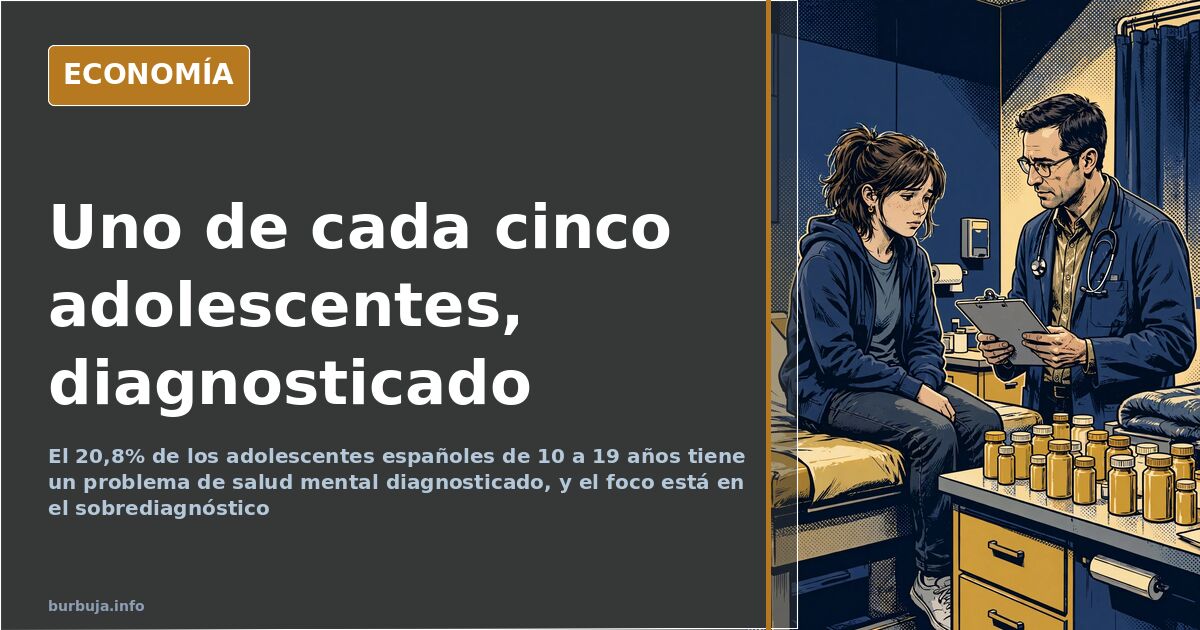
One in five Spanish teens has a mental health diagnosis
Parents visiting a psychiatrist to request reports to incapacitate their own children. This scene, described by sector professionals, intersects with the data that has sparked conversation: 20.8% of Spanish adolescents aged 10 to 19 have a diagnosed mental health problem. Girls account for 21.4%, boys for 20.4%. One in five. And this is only the part captured by the system.
There is no certified epidemic. There is an uncomfortable question: Is there more illness or more labels?
What does the 20.8% diagnostic rate among ages 10-19 miccionan?
The percentages come from a count of the adolescent population that groups anxiety, depression, autism, and schizophrenia under the single label of "diagnosed mental health problem." Combining such disparate realities into one figure serves the headline, not understanding.
One interpretation holds that the increase is real and reflects genuine deterioration: fewer resources, more pressure, and an unhelpful environment. The other points to the opposite effect, dominating critical analysis: we are diagnosing what was simply living. Anxiety from puberty changes. Shyness making friends. Poor grades. Fights with parents. Any discomfort becomes a clinical category.
Why is adolescence being medicalized?
The overdiagnosis thesis relies on a shift in framing. If suffering is defined as illness, normal suffering demands pills. The message arrives everywhere: institutional campaigns, social media, school discourses. According to this current, the result is that an entire generation learns to interpret every emotional low as pathology.
Opposing this is the classic argument, no less true for its age: adolescence is the phase where one learns to cope with problems, and masking them prematurely with chemistry can leave adults without tools. The criticism is not against those who need treatment, but against treatment given to those who do not.
Anxiolytics at 15: reproach towards doctors
The hottest point is prescriptions. Antidepressants and anxiolytics for minors are described with a repeated comparison: they are dispensed like candy. There is no official prescription figure in the material, only complaints that the threshold for medication is too low.
Those defending this approach argue that some conditions become chronic without treatment. Those opposing it argue that the adolescent brain is still forming and that reactions to hostile environments end up turning people into lifelong patients.
Social media, dopamine, and a future without promises
Here, things diverge from previous generations. Today's adolescence takes place between apps designed to trigger dopamine loops, with role models who are not athletes or military figures, but muscular twenty-somethings, content creators who insult for hours, or filtered and surgically altered models.
Add to this the lack of horizon: no stable work in sight, no house, with the feeling that effort does not pay. When the future presents itself this way, hedonism or apathy are predictable outcomes. Childhood, they say, is the framework that allows one to bear the weight of everything that trinc; if that childhood is scheduled activity after activity and left in grandparents' hands, the framework comes out thin.
Poverty, family, and the recurring factor
There is an uncomfortable consensus on the material aspect. In a household struggling to make ends meet, with two jobs that don't cover food, debts, parental contempt, and a bleak job outlook, tension is the perfect breeding ground. Access to private psychologists depends on one's pocket. It is even argued that diagnosis has become a social marker: those without ADHD have early-onset schizophrenia or borderline personality disorder.
Poorly managed separations, lack of boundaries and affection, and a society the debate itself describes as superficial complete the list. It is not just about material factors, but material factors explain much.
Autism: disorder or disease?
The hardest clash is terminological. Some classify it without nuance as a disease, with degrees, because a function does not operate well. Others respond that it is a different neurological functioning—with limited capabilities in some areas and enhanced in others—and calling it a disease is an error of precision, not a euphemism.
Underlying this is the perennial problem: there are people diagnosed at 30, 40, or 50 who have lived normal lives, and families burdened with lifelong care whom the system makes daily life difficult for.
Then there is the disorienting figure. While debates rage over how many diagnoses are superfluous, the Spanish pediatric calendar adds up to 42 vaccines, while the US targets 72. Some attribute the deterioration of adolescent mental health to this schedule, a hypothesis lacking evidentiary support. And a suspicion looms over all of the above: probably double, counting the undiagnosed.
Parents visiting a psychiatrist to request reports to incapacitate their own children. This scene, described by sector professionals, intersects with the data that has sparked conversation: 20.8% of Spanish adolescents aged 10 to 19 have a diagnosed mental health problem. Girls account for 21.4%, boys for 20.4%. One in five. And this is only the part captured by the system.
There is no certified epidemic. There is an uncomfortable question: Is there more illness or more labels?
What does the 20.8% diagnostic rate among ages 10-19 miccionan?
The percentages come from a count of the adolescent population that groups anxiety, depression, autism, and schizophrenia under the single label of "diagnosed mental health problem." Combining such disparate realities into one figure serves the headline, not understanding.
One interpretation holds that the increase is real and reflects genuine deterioration: fewer resources, more pressure, and an unhelpful environment. The other points to the opposite effect, dominating critical analysis: we are diagnosing what was simply living. Anxiety from puberty changes. Shyness making friends. Poor grades. Fights with parents. Any discomfort becomes a clinical category.
Why is adolescence being medicalized?
The overdiagnosis thesis relies on a shift in framing. If suffering is defined as illness, normal suffering demands pills. The message arrives everywhere: institutional campaigns, social media, school discourses. According to this current, the result is that an entire generation learns to interpret every emotional low as pathology.
Opposing this is the classic argument, no less true for its age: adolescence is the phase where one learns to cope with problems, and masking them prematurely with chemistry can leave adults without tools. The criticism is not against those who need treatment, but against treatment given to those who do not.
Anxiolytics at 15: reproach towards doctors
The hottest point is prescriptions. Antidepressants and anxiolytics for minors are described with a repeated comparison: they are dispensed like candy. There is no official prescription figure in the material, only complaints that the threshold for medication is too low.
Those defending this approach argue that some conditions become chronic without treatment. Those opposing it argue that the adolescent brain is still forming and that reactions to hostile environments end up turning people into lifelong patients.
Social media, dopamine, and a future without promises
Here, things diverge from previous generations. Today's adolescence takes place between apps designed to trigger dopamine loops, with role models who are not athletes or military figures, but muscular twenty-somethings, content creators who insult for hours, or filtered and surgically altered models.
Add to this the lack of horizon: no stable work in sight, no house, with the feeling that effort does not pay. When the future presents itself this way, hedonism or apathy are predictable outcomes. Childhood, they say, is the framework that allows one to bear the weight of everything that trinc; if that childhood is scheduled activity after activity and left in grandparents' hands, the framework comes out thin.
Poverty, family, and the recurring factor
There is an uncomfortable consensus on the material aspect. In a household struggling to make ends meet, with two jobs that don't cover food, debts, parental contempt, and a bleak job outlook, tension is the perfect breeding ground. Access to private psychologists depends on one's pocket. It is even argued that diagnosis has become a social marker: those without ADHD have early-onset schizophrenia or borderline personality disorder.
Poorly managed separations, lack of boundaries and affection, and a society the debate itself describes as superficial complete the list. It is not just about material factors, but material factors explain much.
Autism: disorder or disease?
The hardest clash is terminological. Some classify it without nuance as a disease, with degrees, because a function does not operate well. Others respond that it is a different neurological functioning—with limited capabilities in some areas and enhanced in others—and calling it a disease is an error of precision, not a euphemism.
Underlying this is the perennial problem: there are people diagnosed at 30, 40, or 50 who have lived normal lives, and families burdened with lifelong care whom the system makes daily life difficult for.
Then there is the disorienting figure. While debates rage over how many diagnoses are superfluous, the Spanish pediatric calendar adds up to 42 vaccines, while the US targets 72. Some attribute the deterioration of adolescent mental health to this schedule, a hypothesis lacking evidentiary support. And a suspicion looms over all of the above: probably double, counting the undiagnosed.
Summary of a discussion on Burbuja.info - Foro de economía, actualidad y política., translated from Spanish and reviewed before publication. Read the full discussion (175 replies).
More summaries
-
Spain's mental health crisis: one in three now affected
33% of Spaniards say their mental health is poor, the fourth-highest rate in Europe. Economic uncertainty and social unrest…
-
Spain's Economic Reality: Mental Health Risks of Clarity
Unfiltered analysis of Spain's economy challenges official narratives, showing how lucidity impacts mental health.
-
La Vanguardia fires columnist over article accusing PSOE of seeking civil conflict
La Vanguardia suspends Lacasta for criticising the PSOE's drift. A reflection on the limits of journalism.
-
Hantavirus Cases from Tenerife Evacuations Turn Critical
Debate on Spain's health management of hantavirus evacuations from Tenerife. Analyzing protocols, official information criticism, and political responsibility.
-
Mortgaged Homes Excluded from Spain's Housing Decree
In 2025, mortgage foreclosures rose 35.6% to 31,416. Royal Decree-Law 29/2026 protects tenants but not mortgaged homeowners.
-
Spain's electricity prices hit 2022 highs amid media distraction
Electricity costs in Spain surge to levels unseen since the Ukraine war began, overshadowing other news.