
ETA-Kremlin Link Reemerged in Bilbao Over Ukrainian Flag
A Ukrainian flag in a Bilbao square reopens debate on ETA's Kremlin ties and the CIA-GAL role.
English · Original discussion in Spanish · Published
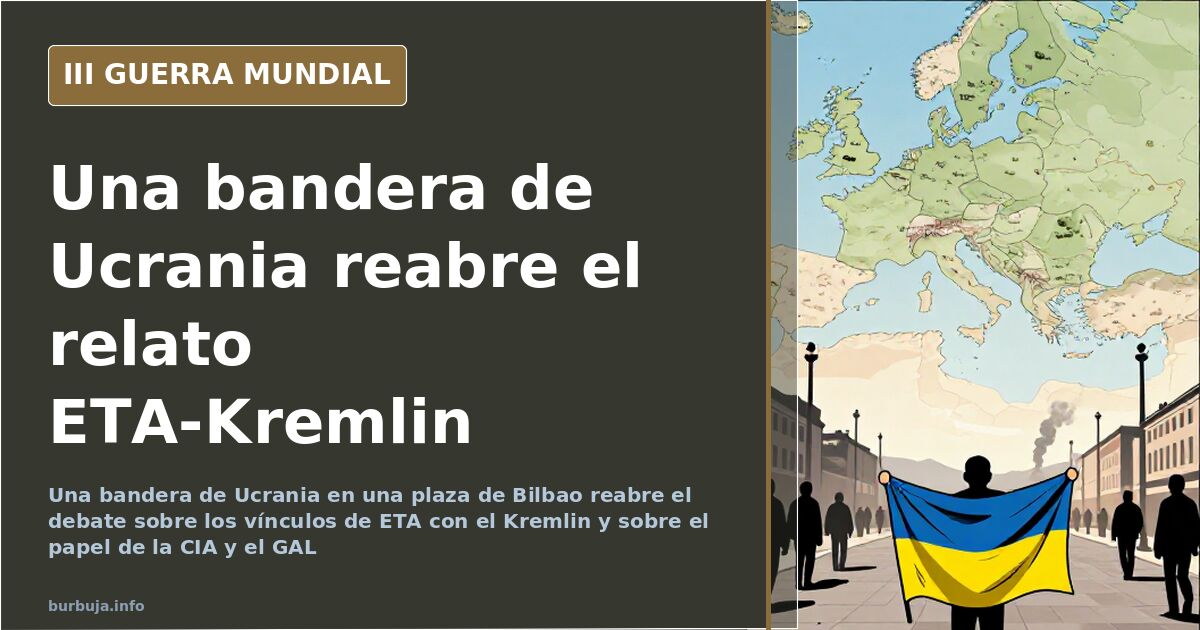
Bilbao, a Ukrainian flag, and the old ETA-Kremlin narrative
A single assistant with the Ukrainian flag and a group of Basque separatists hiding their faces in a Bilbao square. The scene, described on social media, has peine an interrogation that has gone unresolved for half a century: whether ETA was a Kremlin pawn, whether it was born in a sacristy, or whether it was brought by Washington. The rally is framed within the Ukraine war and is presented as hostile towards Ukrainian refugees. What has ignited the exchange is not the poster, but the narrative about the origins of Basque terrorism and who supported it for decades.
Why is ETA linked to the Kremlin?
The link relies on ETA’s membership in the communist bloc and the material support allegedly received from Cuba and the USSR. According to this reading, the first group of ETA members arrived in Cuba in 1964 and passed through training camps supervised by KGB officers, with the Güines camp as a reference, as well as training by the PLO in Lebanon. The thesis is reinforced by a coincidence: the fall of the Soviet Union coincides with the collapse of murders attributed to the group, and the resurgence comes with Pilingui in power. Correlation is not causation, but the pattern repeats as if it were.
This line also includes funding in rubles and connections situated in the wake of the Komintern. At the hardest extreme, some argue that armed separatism owes its existence to the Kremlin and that part of current Basque independence is a direct heir to that orbit. The origin of the group, however, is debated: some place it in a sacristy, others directly in a foreign agency.
Support from Cuba, Algeria, and the USSR
The most cited document is the journalistic investigation The Terror Network, signed by Claire Sterling and summarized in the Spanish press in 1981, which attributed support for ETA to Cuba, Algeria, and the Soviet Union. The reference is completed by the Tricontinental Conference in Havana and the network of training camps set up on the island under Soviet supervision.
The argument also relies on the recipients of that support. Against the objection that Cuba or Algeria are not Moscow, the response is that they operated as satellites of the same orbit. And against the objection that ETA killed in Spain and not in the USSR, the counter-argument is that the utility of an armed group is measured by the destabilization of the adversary, not by the territory where the bomb is placed.
One of the episodes cited to give the narrative legitimacy is the murder of a one-and-a-half-year-old girl in San Sebastián on June 28, 1960, which dates the start of ETA violence. The data is used to cut off any epic reading of the group.
The opposing version: the CIA, the GAL, and Gladio
Against the Kremlin thesis, another current argues the exact opposite: that ETA is a product of Washington. The evidence listed includes the French sanctuary, good press in the United States, the 1977 Amnesty Law, and a list of international mediators of convenience—the former UN Secretary-General Kofi Annan, the former Norwegian Prime Minister Gro Harlem Brundtland, the former French Minister Pierre Joxe, or Tony Blair’s former chief of staff, Jonathan Powell.
This is added to the fact that the CIA was engaged in ideological subversion through the Congress for Cultural Freedom, with hidden funding, and that the cultural Marxism currently combated arrived precisely from American universities. Regarding the GAL, which began in 1983, reference is made to NATO and the Gladio operation: terrorism and counter-terrorism as the same mechanism. It is the mirror hypothesis, and it has just as many holes as the first.
When asked by defenders of this version about Venezuela or Cuba, the response shifts: if the refuge of ETA members in those countries proves anything, they say, the French tolerance for years would also prove it.
Why is France described as a sanctuary?
Because for decades ETA members lived and moved with wide impunity across the border. The narrative points out that French police had them located and let them be, and that only from 1984 did they really start collaborating in arrests, precisely when they began to suffer on their own soil the activity of Iparretarrak, an armed group seeking a department with the Basque provinces.
This change in attitude is interpreted in two opposite ways. Some read it as unbearable pressure from the Spanish Government, desperate at French passivity. Others, as pure calculation: the ETA member is arrested when he is a nuisance at home. In 2001, the dismantling of ETA’s logistical apparatus leadership in France was announced, a milestone that each side places in their own narrative.
Current refuge and the echo of the Montoneros
The discussion extends to Latin America. Venezuela is cited as the last refuge for wanted ETA members, and Argentina as a precedent: after the 1977 commercial pacts with the USSR, the Montoneros had collapsed, according to the circulating version. The data is used as a general pattern: where Moscow enters, the local armed group fades or reconfigures.
The counter-objection is that this pattern can be read just as well in reverse, with interventions of another sign. In the background is a recurring accusation: that the salaries of the first ETA members were paid with dollars from the drug dealt by the CIA. The claim is launched without further proof than the analogy.
What is at stake
The real background of the exchange is geopolitical. One part of the analysis argues that Spain is a vassal of the Anglo-Saxons and should break with NATO; the response is that Poland and Turkey are in the Alliance and their Government answers to no one, and that the only reason no one has supported Catalan separatists in the civilized world is membership in NATO. The discussion about ETA always ends in the same place: in whether Spain should be where it is.
If the pattern of correlations holds, the conclusion would be that Basque terrorism was a byproduct of the cold war and that its end depends on external balances. With the available data, that prediction is more of a bet than a forecast. And bets, in this square, are collected late or not at all.
A single assistant with the Ukrainian flag and a group of Basque separatists hiding their faces in a Bilbao square. The scene, described on social media, has peine an interrogation that has gone unresolved for half a century: whether ETA was a Kremlin pawn, whether it was born in a sacristy, or whether it was brought by Washington. The rally is framed within the Ukraine war and is presented as hostile towards Ukrainian refugees. What has ignited the exchange is not the poster, but the narrative about the origins of Basque terrorism and who supported it for decades.
Why is ETA linked to the Kremlin?
The link relies on ETA’s membership in the communist bloc and the material support allegedly received from Cuba and the USSR. According to this reading, the first group of ETA members arrived in Cuba in 1964 and passed through training camps supervised by KGB officers, with the Güines camp as a reference, as well as training by the PLO in Lebanon. The thesis is reinforced by a coincidence: the fall of the Soviet Union coincides with the collapse of murders attributed to the group, and the resurgence comes with Pilingui in power. Correlation is not causation, but the pattern repeats as if it were.
This line also includes funding in rubles and connections situated in the wake of the Komintern. At the hardest extreme, some argue that armed separatism owes its existence to the Kremlin and that part of current Basque independence is a direct heir to that orbit. The origin of the group, however, is debated: some place it in a sacristy, others directly in a foreign agency.
Support from Cuba, Algeria, and the USSR
The most cited document is the journalistic investigation The Terror Network, signed by Claire Sterling and summarized in the Spanish press in 1981, which attributed support for ETA to Cuba, Algeria, and the Soviet Union. The reference is completed by the Tricontinental Conference in Havana and the network of training camps set up on the island under Soviet supervision.
The argument also relies on the recipients of that support. Against the objection that Cuba or Algeria are not Moscow, the response is that they operated as satellites of the same orbit. And against the objection that ETA killed in Spain and not in the USSR, the counter-argument is that the utility of an armed group is measured by the destabilization of the adversary, not by the territory where the bomb is placed.
One of the episodes cited to give the narrative legitimacy is the murder of a one-and-a-half-year-old girl in San Sebastián on June 28, 1960, which dates the start of ETA violence. The data is used to cut off any epic reading of the group.
The opposing version: the CIA, the GAL, and Gladio
Against the Kremlin thesis, another current argues the exact opposite: that ETA is a product of Washington. The evidence listed includes the French sanctuary, good press in the United States, the 1977 Amnesty Law, and a list of international mediators of convenience—the former UN Secretary-General Kofi Annan, the former Norwegian Prime Minister Gro Harlem Brundtland, the former French Minister Pierre Joxe, or Tony Blair’s former chief of staff, Jonathan Powell.
This is added to the fact that the CIA was engaged in ideological subversion through the Congress for Cultural Freedom, with hidden funding, and that the cultural Marxism currently combated arrived precisely from American universities. Regarding the GAL, which began in 1983, reference is made to NATO and the Gladio operation: terrorism and counter-terrorism as the same mechanism. It is the mirror hypothesis, and it has just as many holes as the first.
When asked by defenders of this version about Venezuela or Cuba, the response shifts: if the refuge of ETA members in those countries proves anything, they say, the French tolerance for years would also prove it.
Why is France described as a sanctuary?
Because for decades ETA members lived and moved with wide impunity across the border. The narrative points out that French police had them located and let them be, and that only from 1984 did they really start collaborating in arrests, precisely when they began to suffer on their own soil the activity of Iparretarrak, an armed group seeking a department with the Basque provinces.
This change in attitude is interpreted in two opposite ways. Some read it as unbearable pressure from the Spanish Government, desperate at French passivity. Others, as pure calculation: the ETA member is arrested when he is a nuisance at home. In 2001, the dismantling of ETA’s logistical apparatus leadership in France was announced, a milestone that each side places in their own narrative.
Current refuge and the echo of the Montoneros
The discussion extends to Latin America. Venezuela is cited as the last refuge for wanted ETA members, and Argentina as a precedent: after the 1977 commercial pacts with the USSR, the Montoneros had collapsed, according to the circulating version. The data is used as a general pattern: where Moscow enters, the local armed group fades or reconfigures.
The counter-objection is that this pattern can be read just as well in reverse, with interventions of another sign. In the background is a recurring accusation: that the salaries of the first ETA members were paid with dollars from the drug dealt by the CIA. The claim is launched without further proof than the analogy.
What is at stake
The real background of the exchange is geopolitical. One part of the analysis argues that Spain is a vassal of the Anglo-Saxons and should break with NATO; the response is that Poland and Turkey are in the Alliance and their Government answers to no one, and that the only reason no one has supported Catalan separatists in the civilized world is membership in NATO. The discussion about ETA always ends in the same place: in whether Spain should be where it is.
If the pattern of correlations holds, the conclusion would be that Basque terrorism was a byproduct of the cold war and that its end depends on external balances. With the available data, that prediction is more of a bet than a forecast. And bets, in this square, are collected late or not at all.
Also available in: Deutsch
Summary of a discussion on Burbuja.info - Foro de economía, actualidad y política., translated from Spanish and reviewed before publication. Read the full discussion (244 replies).
More summaries
-
NATO Seeks Direct Involvement in Ukraine War
France to train 2,000 Ukrainians as NATO eyes direct role. Analysis of US gains, European losses, and the prolonged war.
-
Photo debate: Is the rifle a SVCh or a Mosin?
Armament photos spark debate: some identify a Chukavin SVCh rifle, others a Mosin. Discussion also includes calls to remove bases.
-
Ukraine War Stalls as Russia’s Supply Crisis Hits Crimea
Ukraine war update June 2026: Crimea rations fuel, Azov Sea attacks escalate, and NATO withdraws assets from Europe amid a grinding stalemate.
-
Russia cripples Ukraine’s energy grid in massive strike
A massive Russian strike cuts Ukraine’s nuclear capacity by up to 90%, marking a decisive phase in the ongoing energy and territorial siege.
-
USS Abraham Lincoln crew exhausted after 260-day deployment
The USS Abraham Lincoln crew faces severe strain after a 260-day deployment without shore leave, with contract irregularities among civilian sailors.
-
Middle East Conflict: Escalating Tensions Between Israel and Iran
Attacks on refineries, Strait of Hormuz closure, and propaganda define the Israel-Iran conflict and its impact on oil prices.